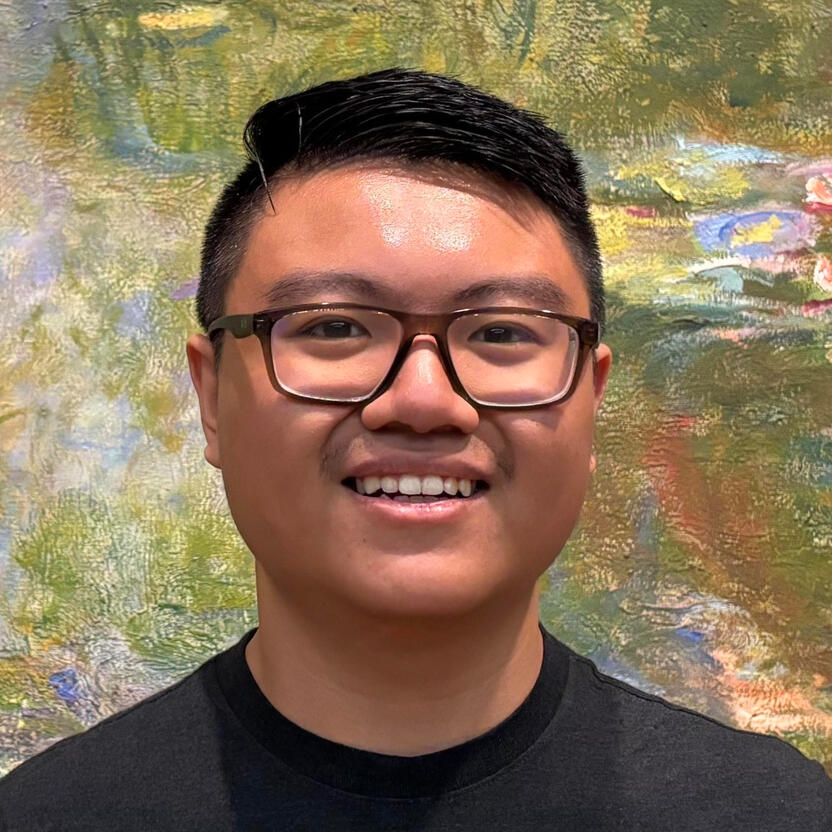
Tintin Nguyen
(Nguyễn Quốc Bảo)
Astronomy Ph.D. Student
Center for Astrophysics | Harvard & Smithsonian
Black Hole Initiative - Harvard University
Event Horizon Telescope Collaboration
About me
Research
outreach
Teaching
Side quests
Research interests
I'm broadly interested in black holes of all sizes and scales over cosmic time, across the electromagnetic and gravitational wave spectra! I'm interested in the interplay between gravity, accretion physics, magnetic fields, and polarization at the intersection of theoretical physics and observational astronomy. Observationally, I'm biased towards mm-VLBI imaging as a member of the Event Horizon Telescope (EHT) collaboration, but I'm also interested in infrared IFU spectroscopy and gravitational wave detections. My black hole interests broadly fall under three umbrellas:
1) Gravity: How do horizon-scale black hole images and gravitational wave events probe strong-field gravity? Could we use these results to constrain deviation from the Kerr metric and General Relativity, as well as testing cosmic censorship? How do we disentangle purely gravitational effects from astrophysical ones (e.g., plasma physics)? How do we robustly measure black hole spin from strongly lensed images (e.g., photon ring)?
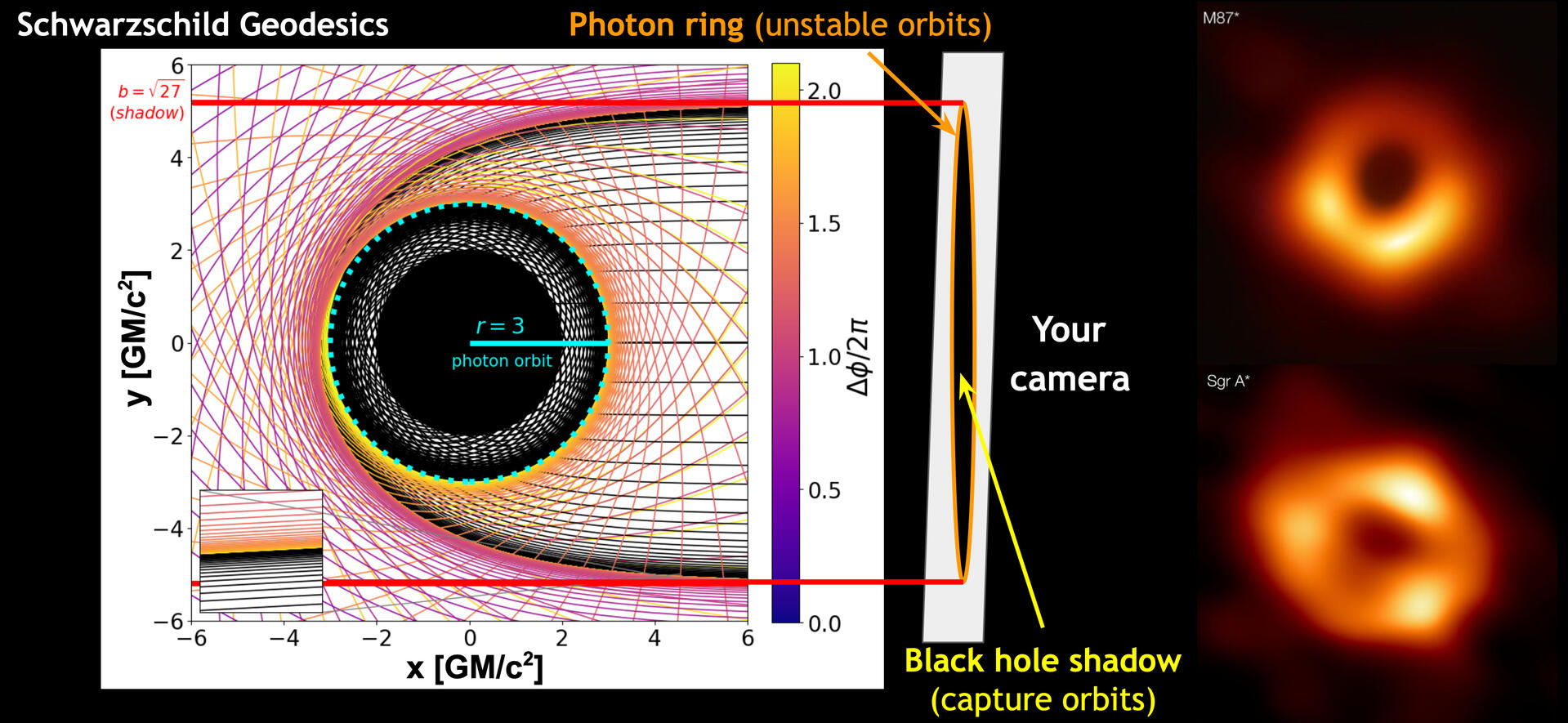
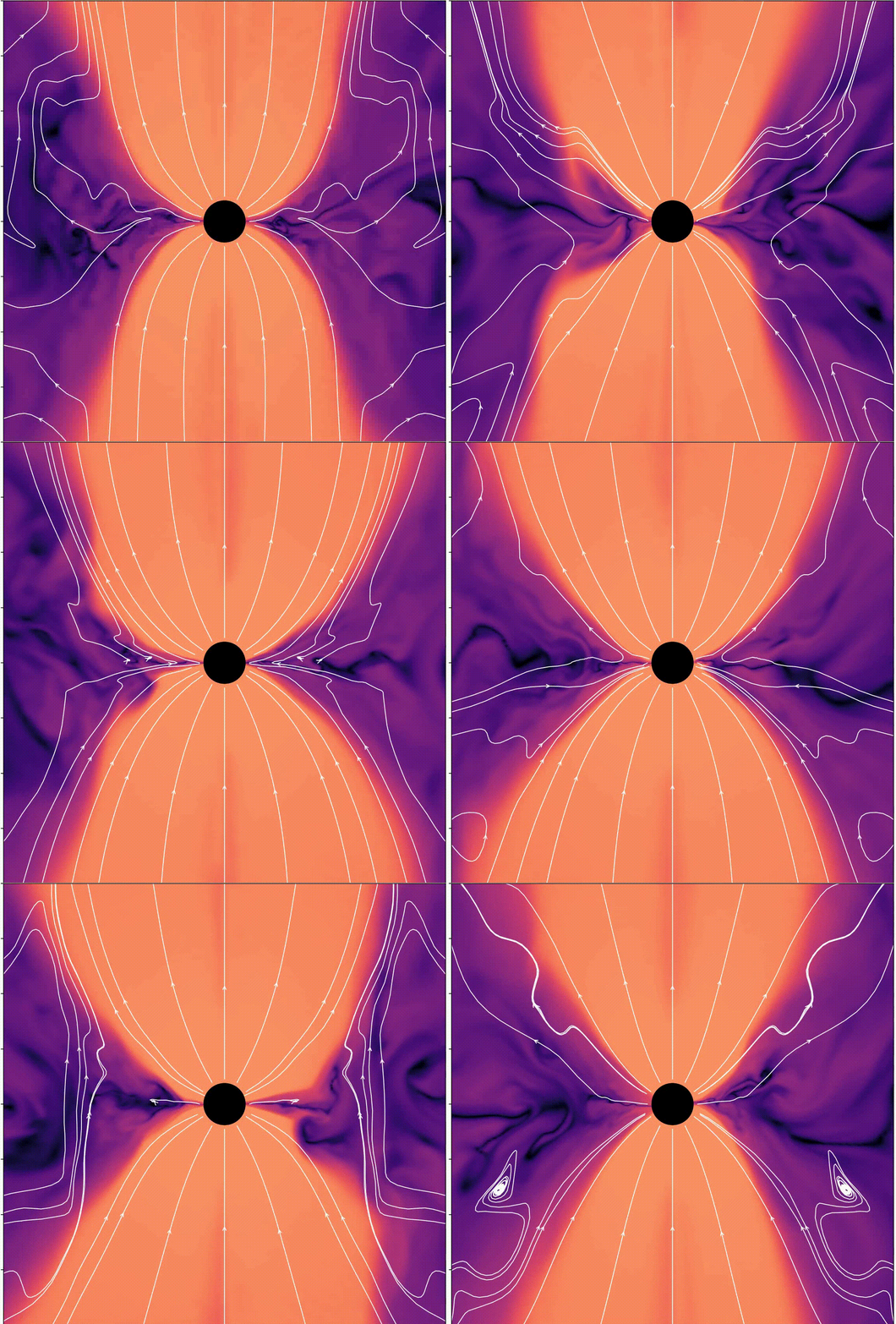
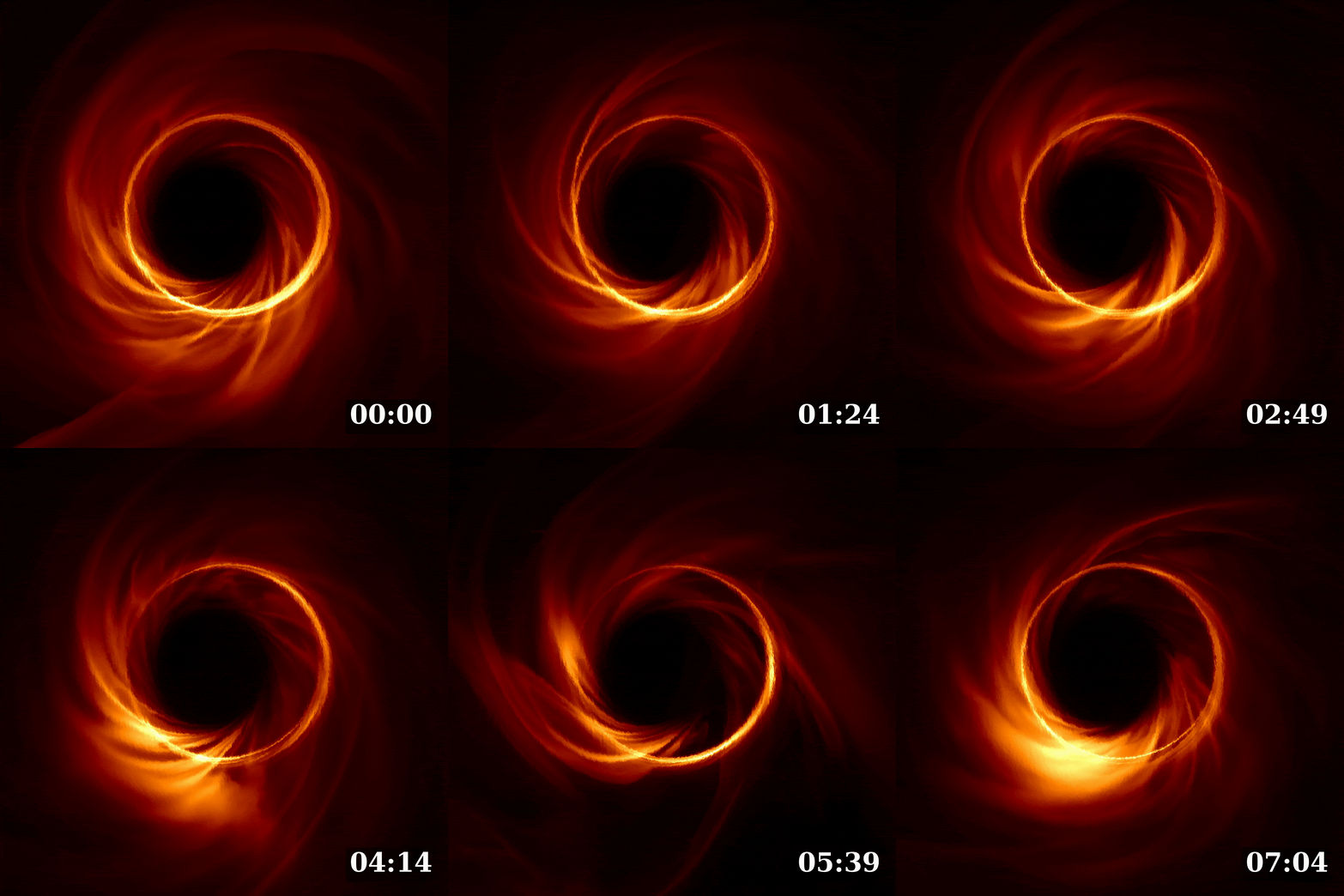
2) Astrophysical Theory: How do black holes accrete materials and launch relativistic jets? How does accretion physics drive observed imaging feature and light curve variability of black holes? How does polarization pattern in black hole images trace near-horizon magnetic fields? How does black hole feedback affect their environments and galaxy evolution? What do mergers reveal about the binary formation and evolution pathways?
3) Demographics: How do supermassive black holes form and grow? What are their mass and spin distributions throughout cosmic time? How do they co-evolve with their host galaxies? How can we detect elusive populations like intermediate-mass black holes, supermassive black hole binaries, and extreme mass ratio inspirals systems? How do observations across the electromagnetic and gravitational wave spectra map out different demographics?
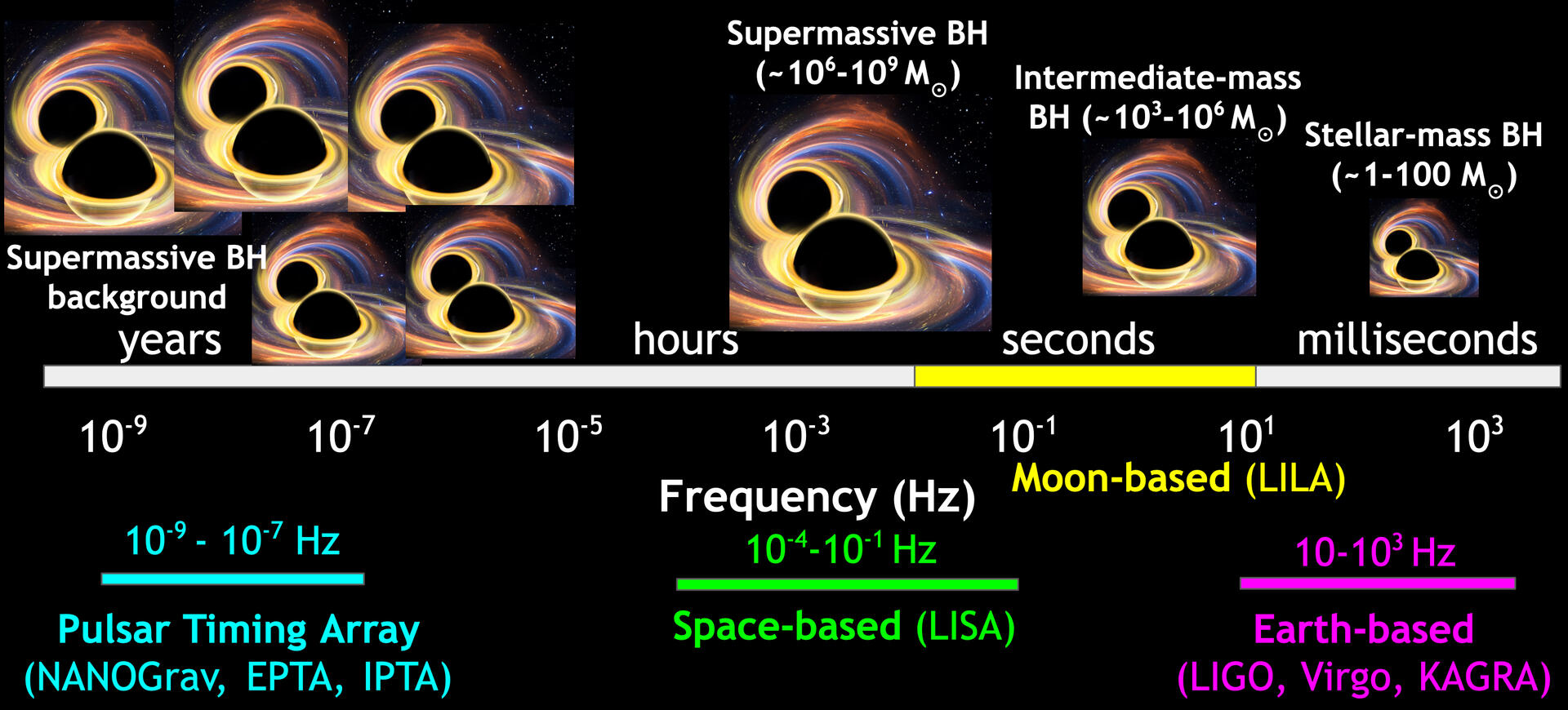
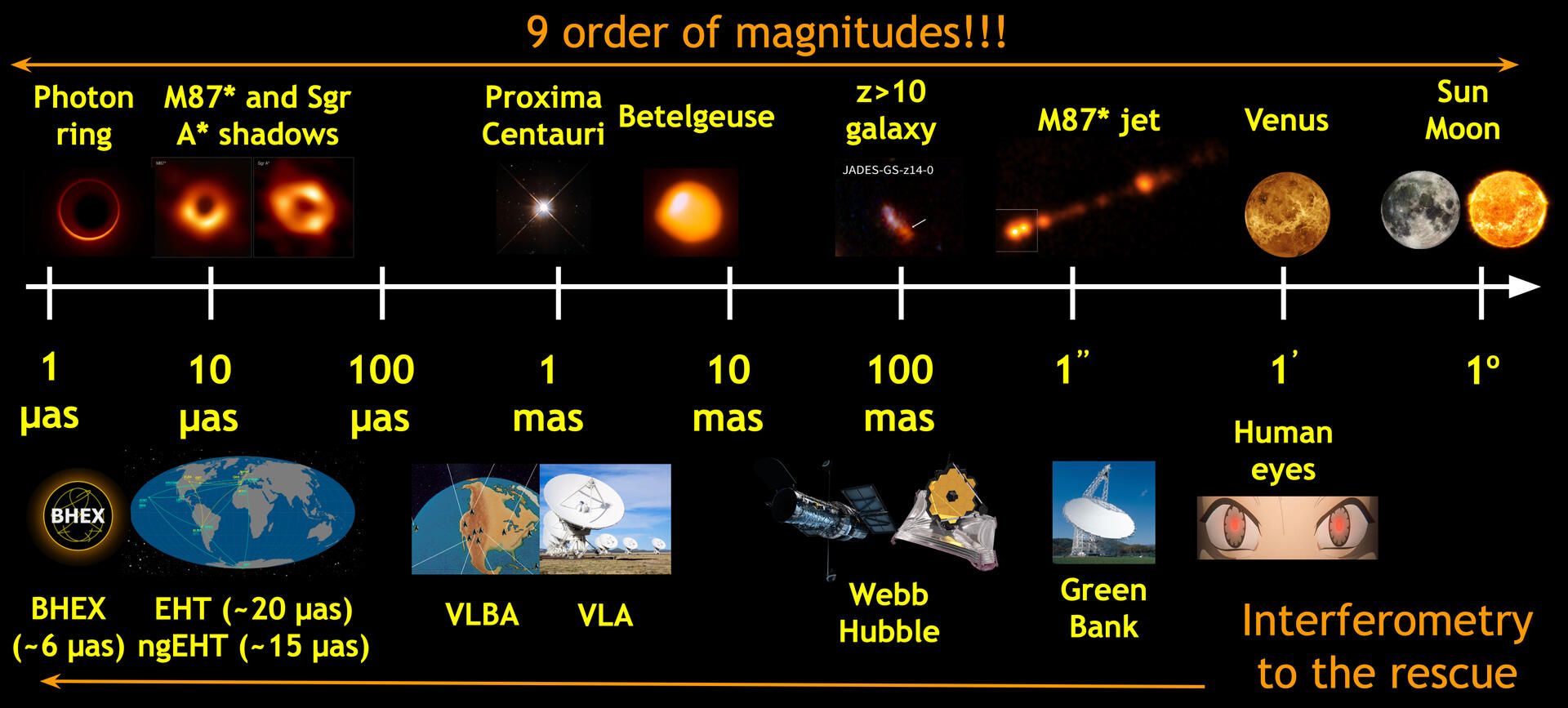
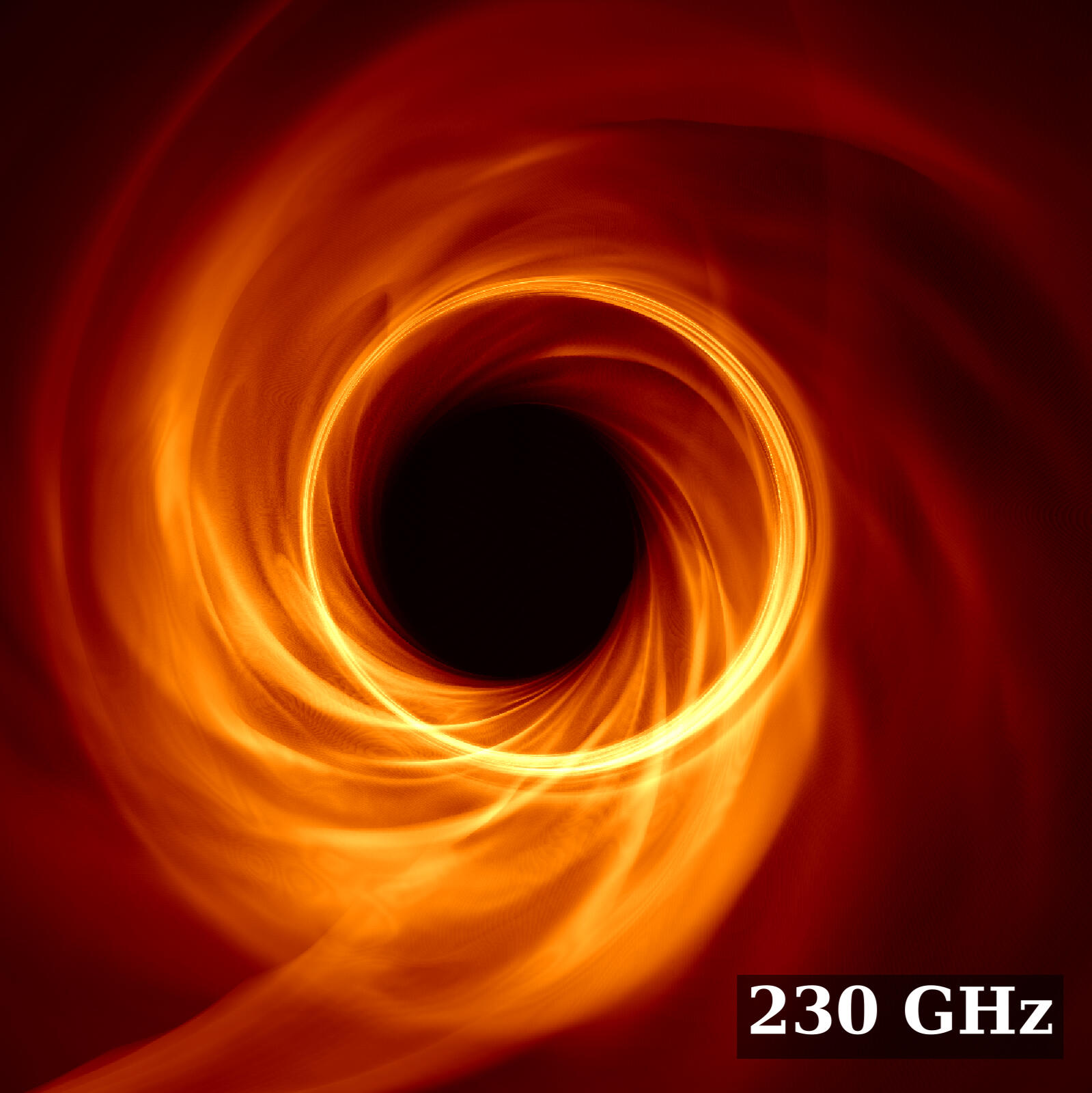
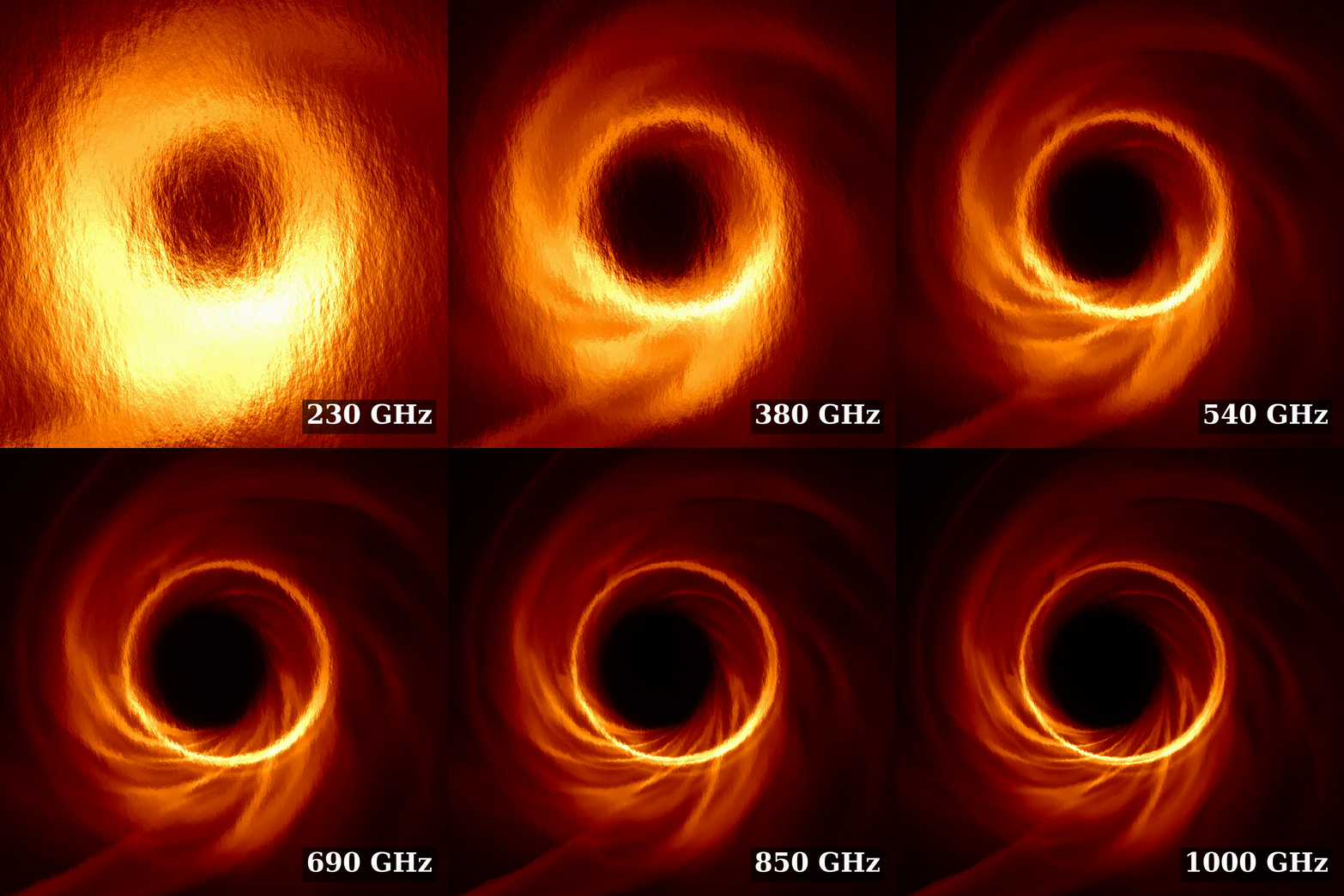
While I'm theoretically inclined, I've found myself to be a question-driven researcher. If I'm interested enough in a question, I'd love to learn any tools at my disposal to take one step towards solving it, whether it's carrying out analytic pen-and-paper calculations, writing a numerical ray-tracing program from scratch, analyzing existing GRMHD simulations, or proposing for observations! An interesting (and unintentional) commonality throughout my research experience so far is space-based instrument: James Webb Space Telescope (JWST), Black Hole Explorer (BHEX), and Laser Interferometer Lunar Antenna (LILA). Recently, I explored a space-VLBI concept that extends to the THz frequency. An interesting science case is the lessened impact of interstellar scattering to Sgr A* image by about 20 times, in comparison to current EHT observations at 230 GHz (see below!).
PublicationsNguyen et al., Black Hole Binary Detection Landscape for the Laser Interferometer Lunar Antenna (LILA): Signal-to-Noise Calculations & Science Cases, submitted to CQG Lunar Gravitational-wave Detector focus issue (2026)Bernshteyn et al. (incl. Nguyen), Polarimetry of Black Hole Spin and Axisymmetric Emission Geometry, ApJ 1010 25 (2026)Suzuki et al. (incl. Nguyen), High-Order Photon Rings around Kerr Naked Singularities, ApJ 1006 202 (2026)Pacucci, Nguyen et al., JWST CEERS & JADES Active Galaxies at z = 4-7 Violate the Local MBH - Mstar Relation at >3σ: Implications for Low-Mass Black Holes and Seeding Models, ApJL 957 L3 (2023)Nguyen et al., Shadow Geometry of Kerr Naked Singularities, ApJ 954 78 (2023)Nguyen, Compatibilism Through the Lenses of Social Science, Moral Philosophy, Theology, and Quantum Physics, Arizona Journal of Interdisciplinary Studies 9, 47-63 (2023)Research NotesHere are a couple research notes that I've written throughout my projects:
A compilation of notable black holes in mass and redshift
Gravitational wave strain evolution of binary systems
Light deflection and weak lensing in spherically symmetric spacetimes
Geodesic equation derivation through the principle of least action
Interferometric response of thin ring(s) and arc(s) [Colab notebook]
Ongoing Projects
Horizon-Scale Black Hole Polarimetry
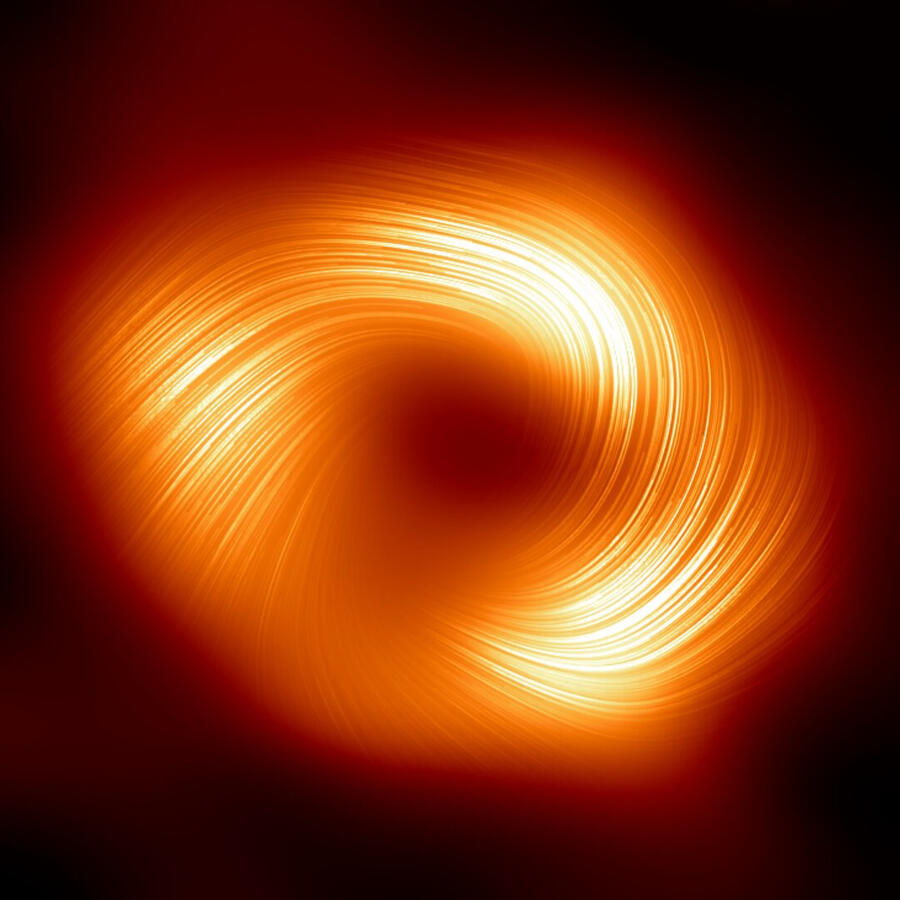
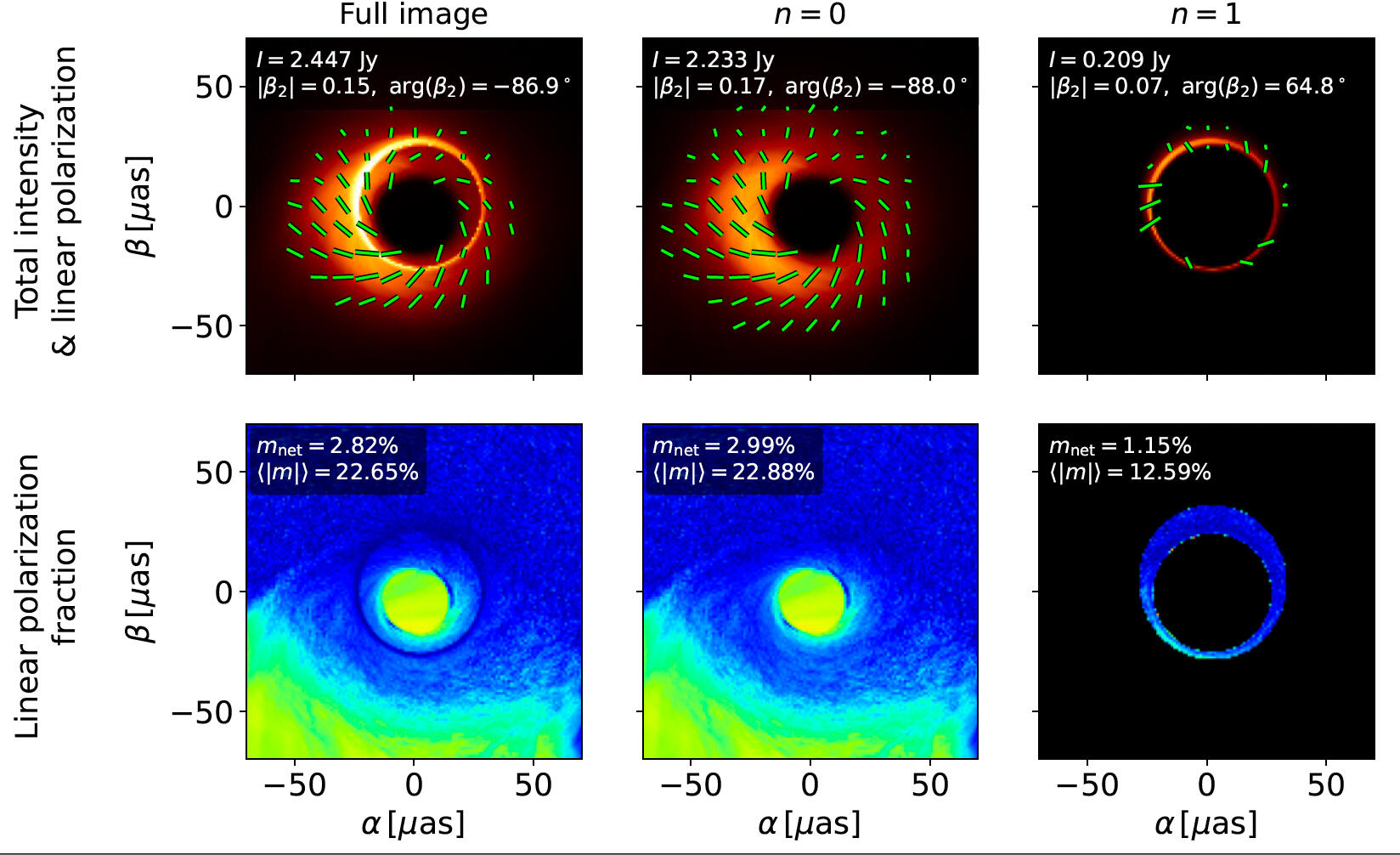
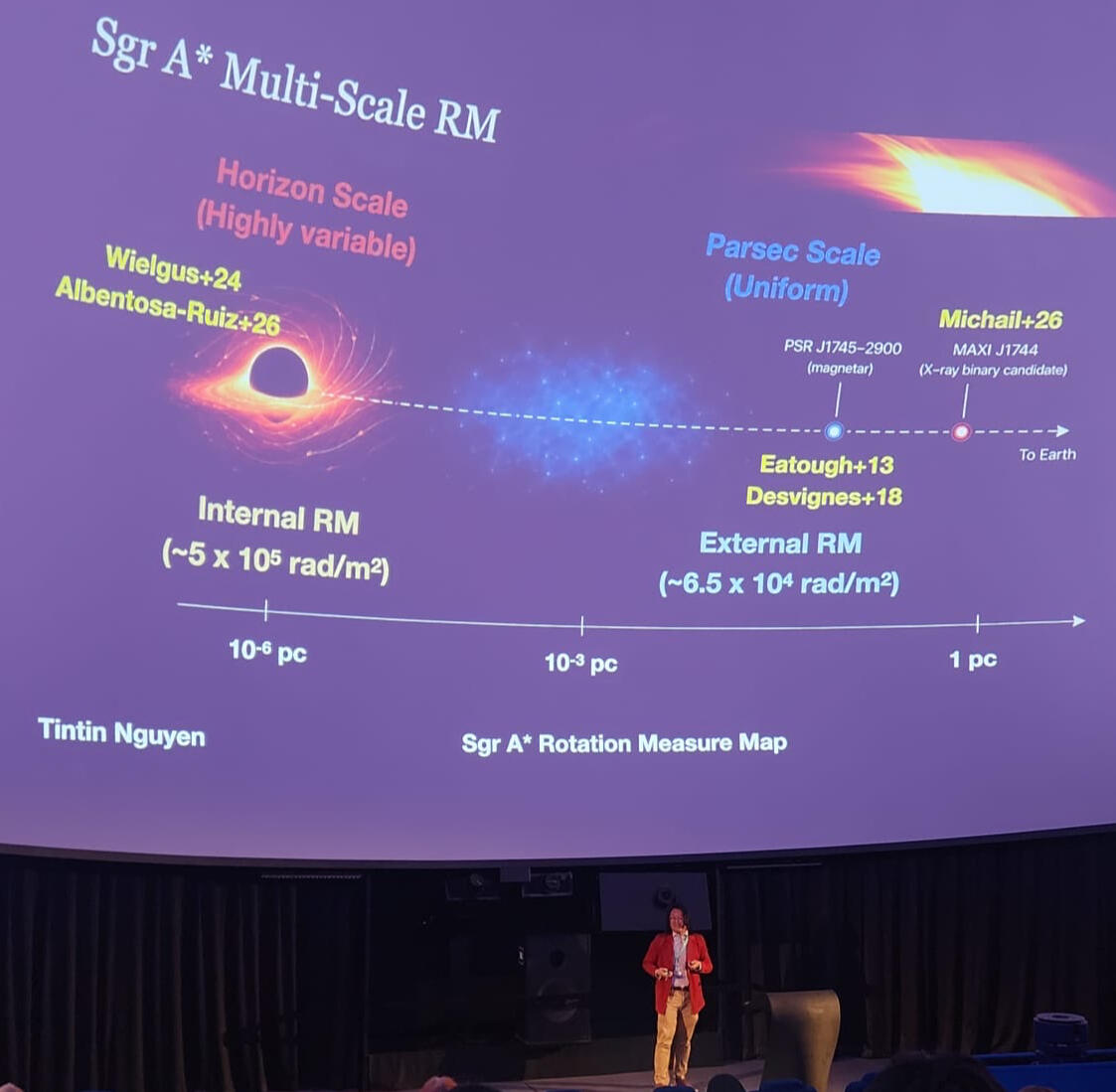
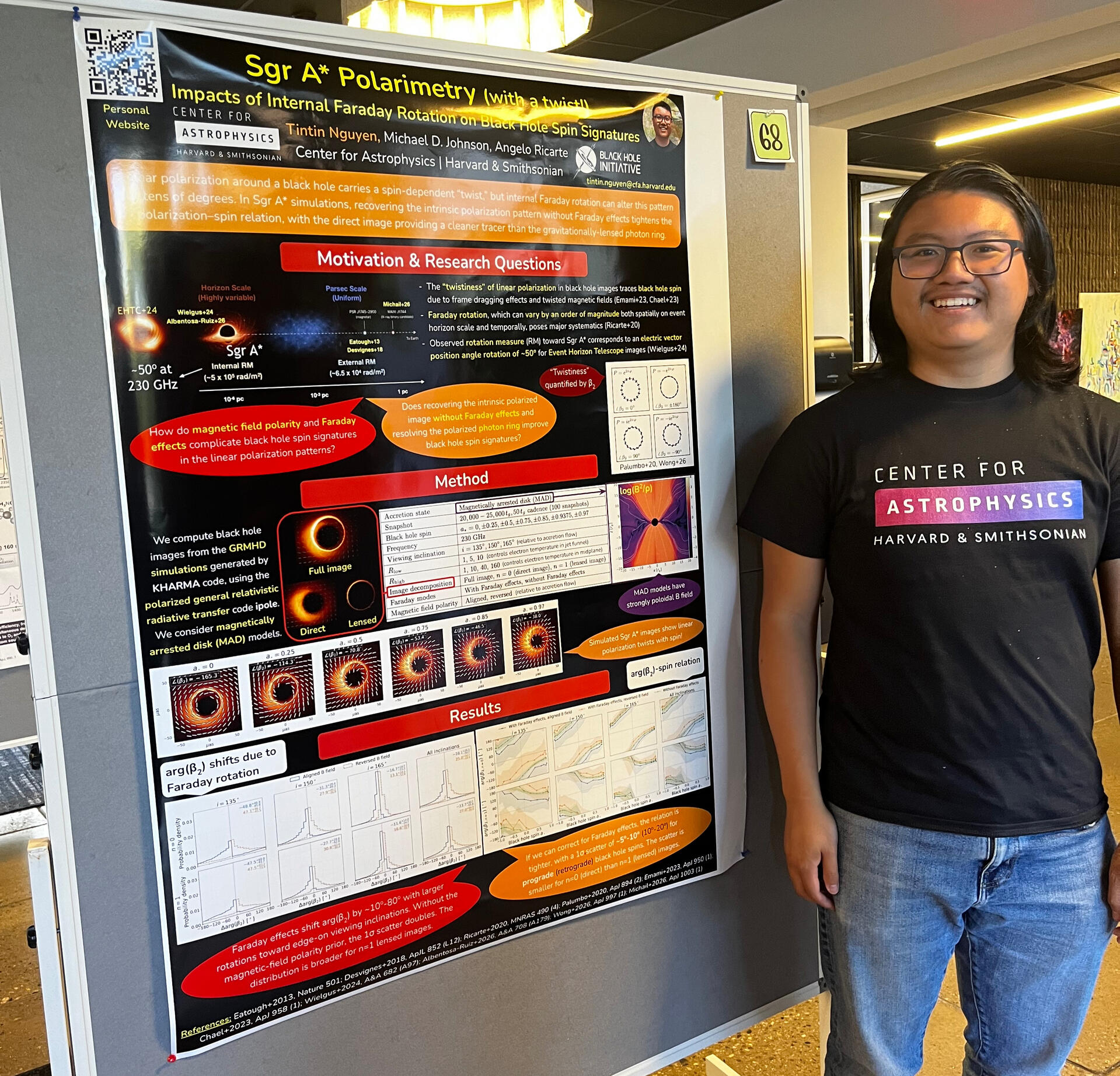
Polarized emission induced by the hot plasma swirling around black holes carries a lot of exciting information! The linear polarization image patterns reveal the near-horizon magnetic fields threading through the accretion flow. As spacetime twists the magnetic field structure and energy flow, it leaves an interesting imprint on the polarization pattern, suggesting potential pathways in measuring black hole spin with polarimetric observations. In Bernshteyn+26, we investigate signatures of magnetic field structure and black hole spin in strongly lensed images of photon rings using a semi-analytic dual-cone emission model in Kerr spacetime.However, much of this rich polarimetric information is lost due to the systematic uncertainty from Faraday rotation, a light propagation effect through ionized plasma which rotates the plane of linear polarization. Currently, I'm analyzing GRMHD simulations of Sgr A* to understand the impact of Faraday rotation to the "twistiness" of linear polarization in black hole images and its relation to black hole spin. I'm also investigating how to use spatially resolved rotation measure maps as both a mitigation strategy to Faraday systematics in polarimetric black hole images and an observation probe of plasma physics in black hole accretion flows.In addition, I'm interested in carrying out simultaneous multi-band rotation measure observations of Sgr A* with radio telescopes to better characterize the spatial and temporal structure of Faraday screens. Theoretically, I'm also working on relating polarization pattern to spacetime properties, encoded by the Penrose-Walker constant.
Fly Me To The Moon: Hunting for Intermediate Mass Black Hole Binaries
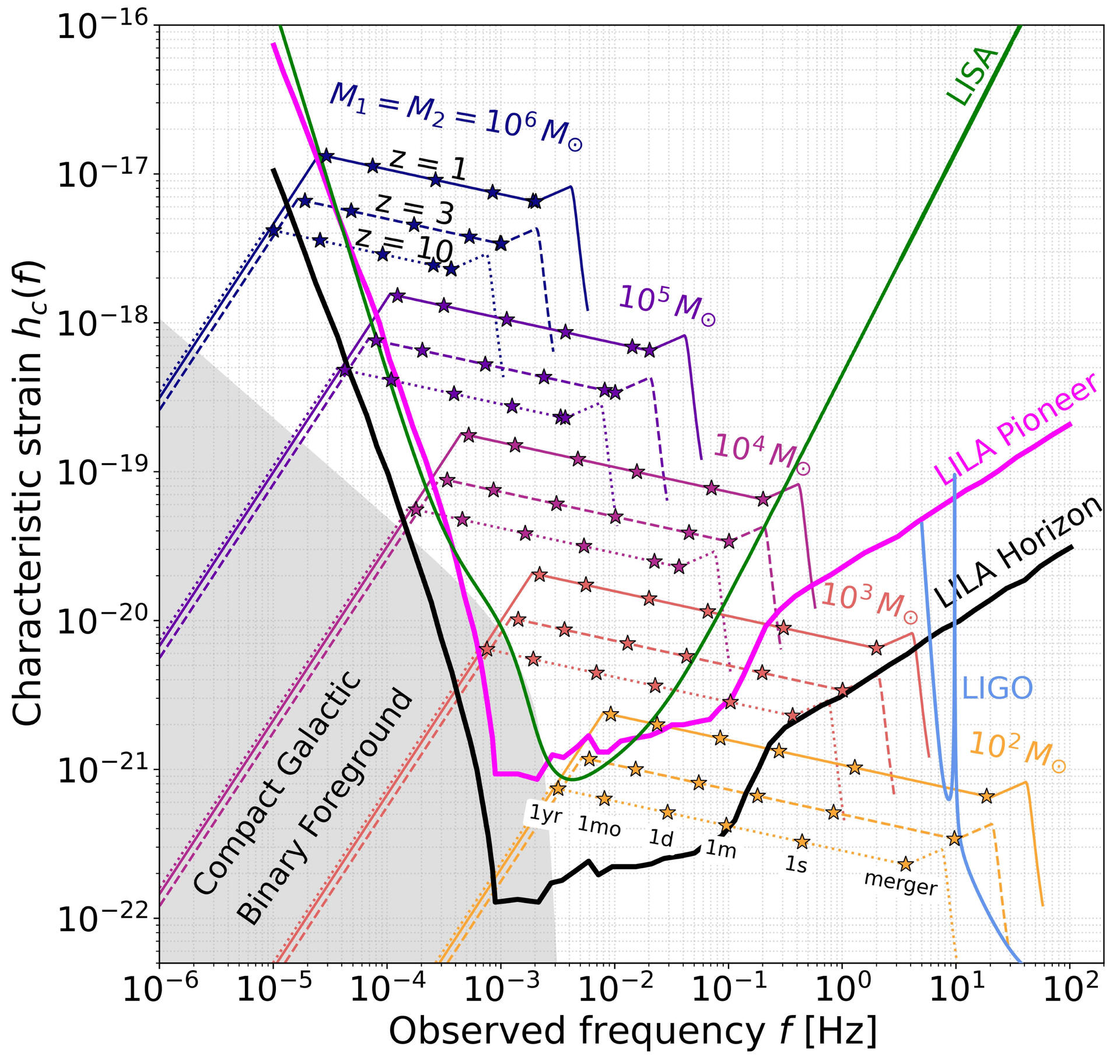
The Laser Interferometer Lunar Antenna (LILA) is a proposed future gravitational-wave detector which would fill the frequency band gap between ground detectors (like LIGO) and LISA. I've designed a pipeline to compute signal-to-noise ratio for black hole binary inspiral and merger events detectable with LILA.In Nguyen+26, we evaluate LILA observational horizon in discovering black hole binaries across different masses, mass ratios, eccentricities, and redshifts, highlighting LILA sensitivity to intermediate-mass black holes back to the black hole formation epoch (z~20), critical for bridging the gap between earliest seeds and current observed supermassive black hole populations. We demonstrate LILA's capability in providing early warning for multi-messenger follow up, multi-band synergy with next-generation ground detectors, and potentials in probing astrophysical environments and evolutionary pathways of binary black holes.In the future, I'm excited to extend this work to make demographic-level predictions for LILA, such as event rates and detectable black hole mass function, using the semi-analytical black hole seeding and evolution model SEROTINA. I'm generally interested in characterizing the spin evolution of massive black hole binary population and their implication to feedback and galaxy evolution with space gravitational-wave detectors like LISA and LILA. I'm also broadly interested in the potentials of multi-band gravitational wave detections with next-generation detectors like LISA, LILA, Cosmic Explorer, and Einstein Telescope.
Testing Cosmic Censorship: Kerr Naked Singularities
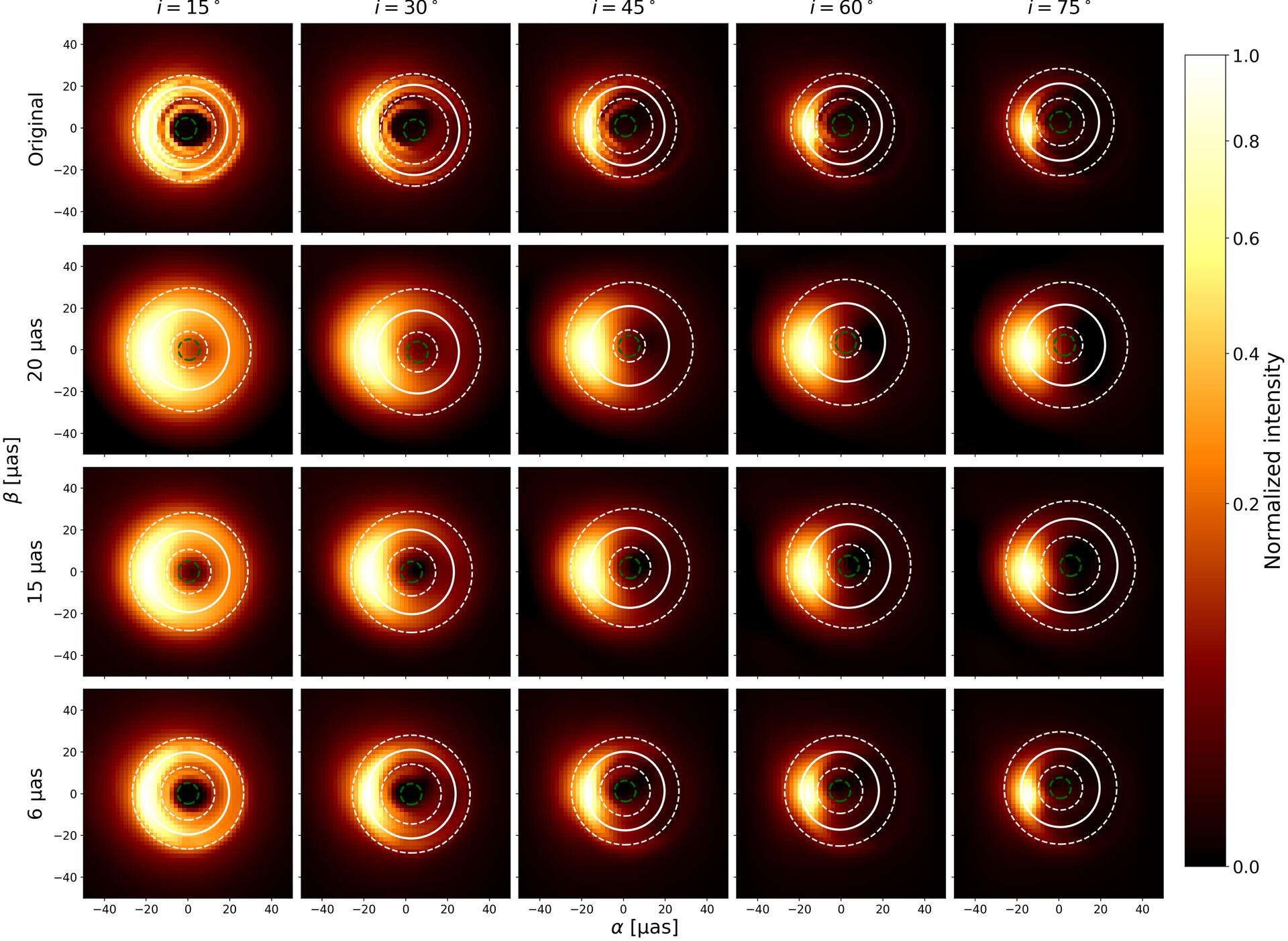
In Kerr spacetime, if a black hole spins faster than allowed, then its event horizon vanishes, leaving behind a naked singularity! I first had this "eureka" moment for myself while playing around with a ray tracing program in 2021 and this soon transformed to become a major interest of mine over the years! While the weak cosmic censorship conjecture prevents the existence of naked singularities from gravitational collapse, horizonless spacetimes have enjoyed renewed interests in the EHT era, as current and future VLBI imaging could further advance experimental tests of cosmic censorship.In Nguyen+23, we studied the morphology of Kerr naked singularity shadows, image features formed by strong gravitational lensing of light orbiting the compact object multiple times, across different spins and viewing inclinations. In Suzuki+26, we extended this study to analyze photon ring substructures using the first GRMHD simulations ever performed on Kerr naked singularities. Currently, I'm building on this exciting result to connect these Kerr naked singularity simulations to EHT image features, such as the emission ring geometry and the central brightness depression.
JWST High-Redshift AGNs Host Overmassive Black Holes
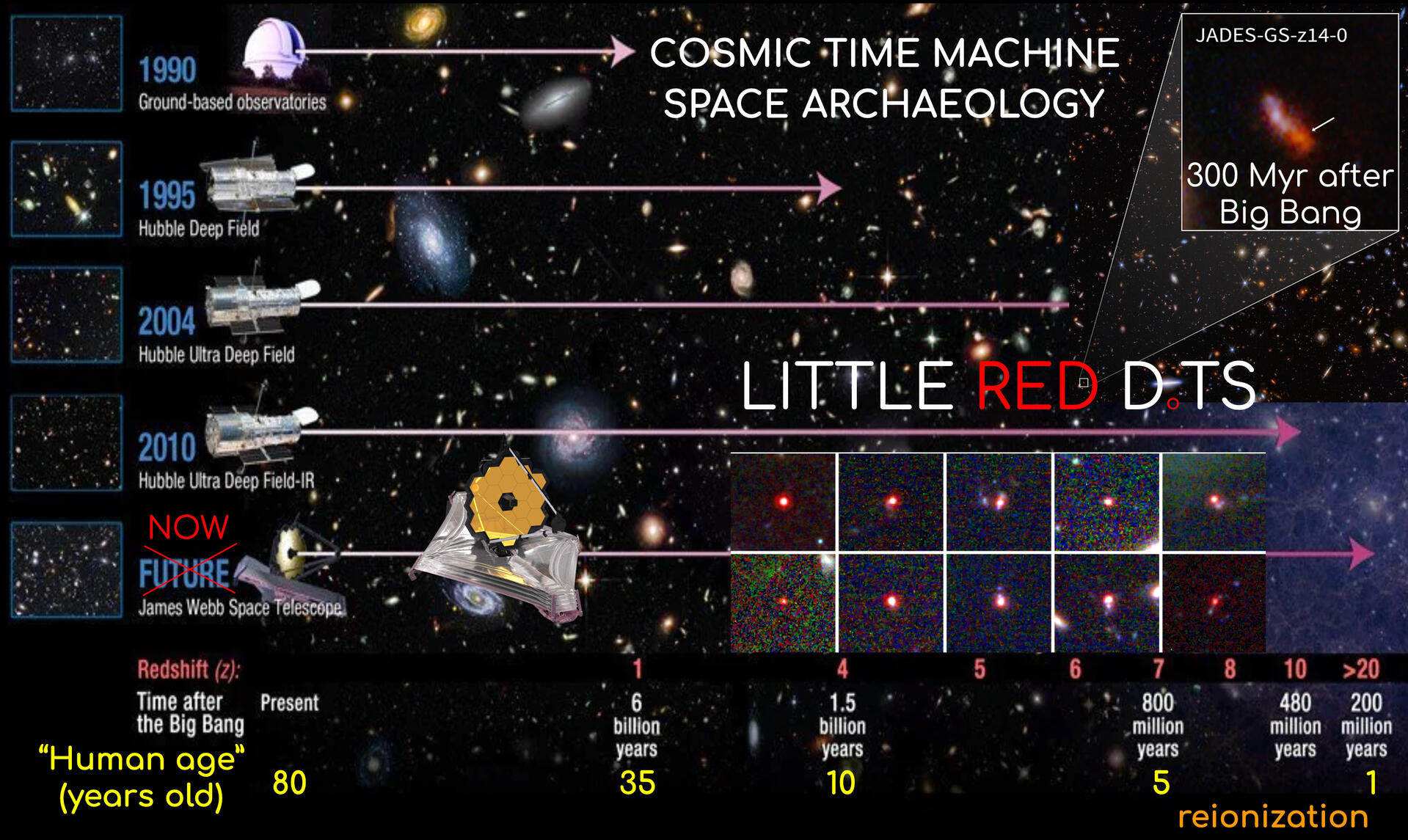
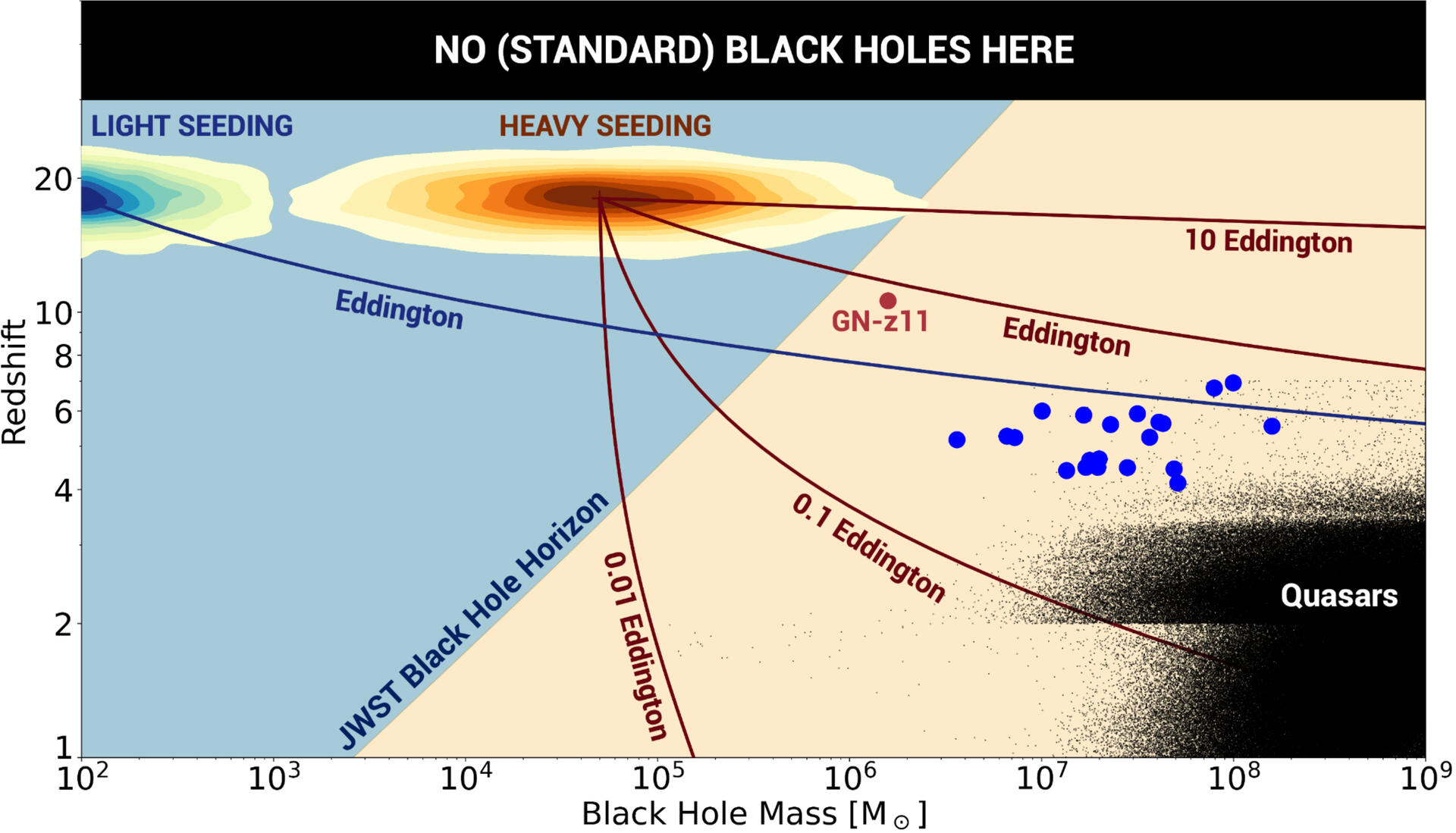
JWST has expanded our observational horizons towards detecting fainter and more distant AGNs (z > 10), as well as revealing the starlight of their host galaxies. JWST has unveiled a myriad of z~4-7 AGNs, many of which are found in the mysterious Little Red Dots, which seem to host supermassive black holes as heavy as ~1-10% of their host galaxy stellar masses. I developed a statistical model accounting for selection effects, observational uncertainties, and the stellar mass function to probe high-redshift scaling relation between supermassive black holes and their host galaxies.In Pacucci & Nguyen+23, we show that these active galaxies host black holes which are 10-100x more massive with respect to their host galaxy stellar mass, in comparison to the local universe, which cannot be fully explained by selection effects. These overmassive black holes most likely have to either originate from heavy seed (e.g., direct collapse) or light seed (e.g., pop III stars) with episodic super-Eddington accretion. Since then, our findings have motivated novel models of black hole seeding and evolution.There are some nice articles written about this work: CfA Press Release, AstroBites, phys.org, Astronomy, Sky & Telescope, Big Think, Scientific American. See also AAS 243 Meeting press conference.
Previous projects
Null Geodesics in Arbitrary Spacetime
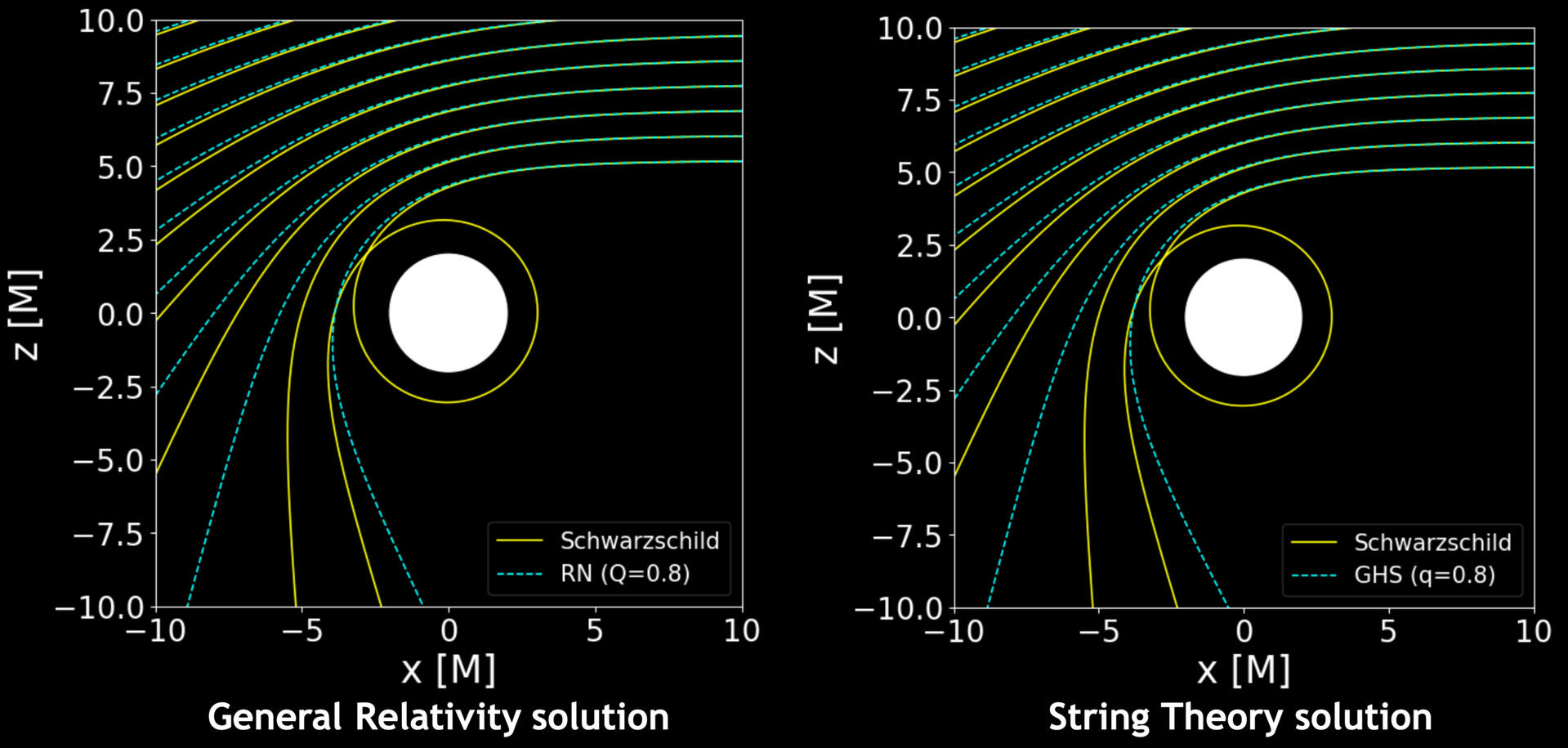
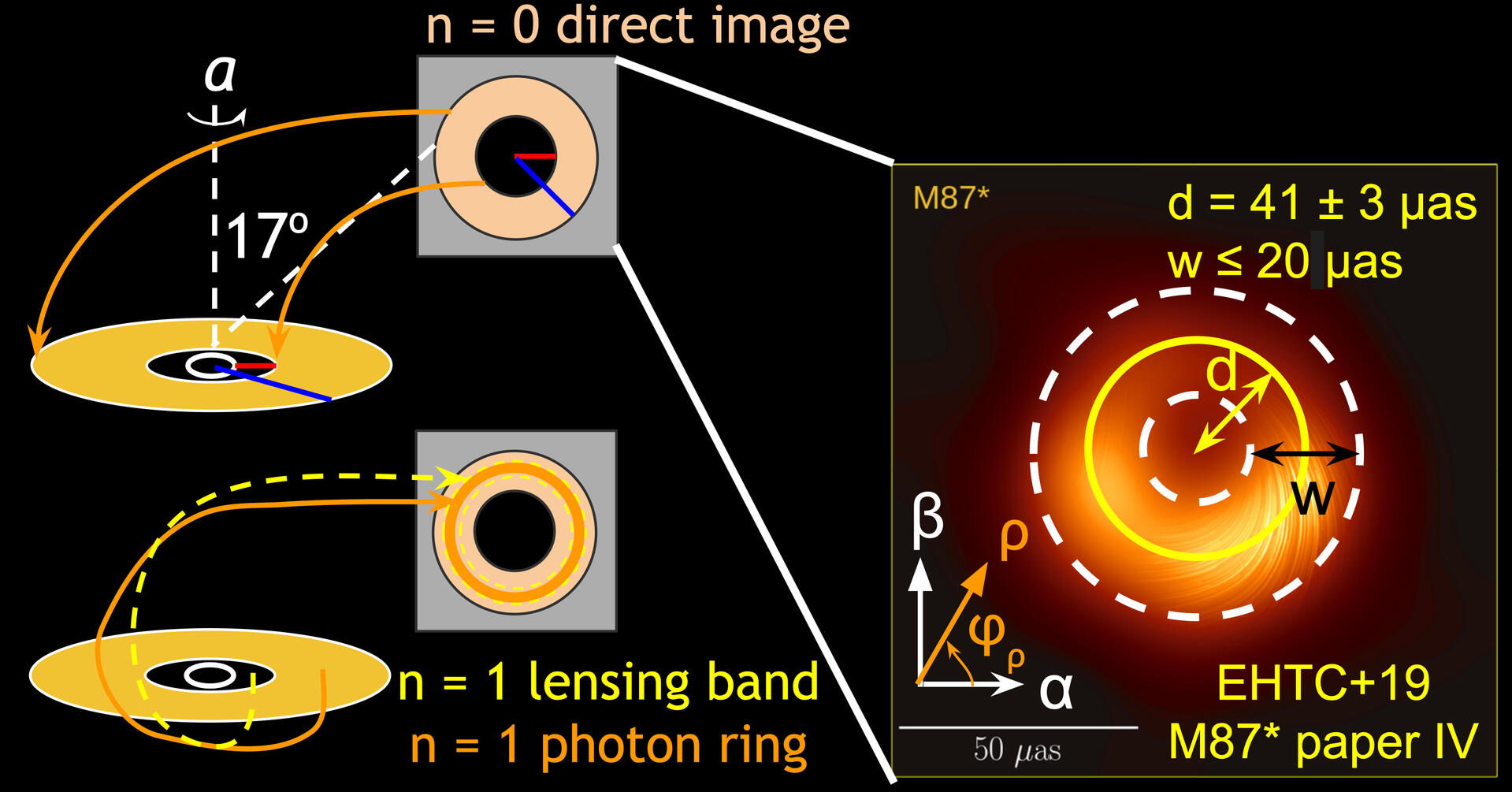
I programmed a ray tracing algorithm to investigate gravitational lensing in generic spherically symmetric spacetimes, with applications to charged black holes in General Relativity (Reissner–Nordström) and String Theory (Garfinkle-Horowitz-Strominger) and how they deviate from the neutral black hole solution (Schwarzschild). I also helped develop the differential geometry software package FADGE, which can do geodesic integration in arbitrary spacetimes with an adaptive stepsize control algorithm and automatic differentiation supported by Google's JAX. One application of FADGE I've explored is the photon ring of M87* with a thin disk model.
Emulating Black Hole Images with Convolutional Autoencoder
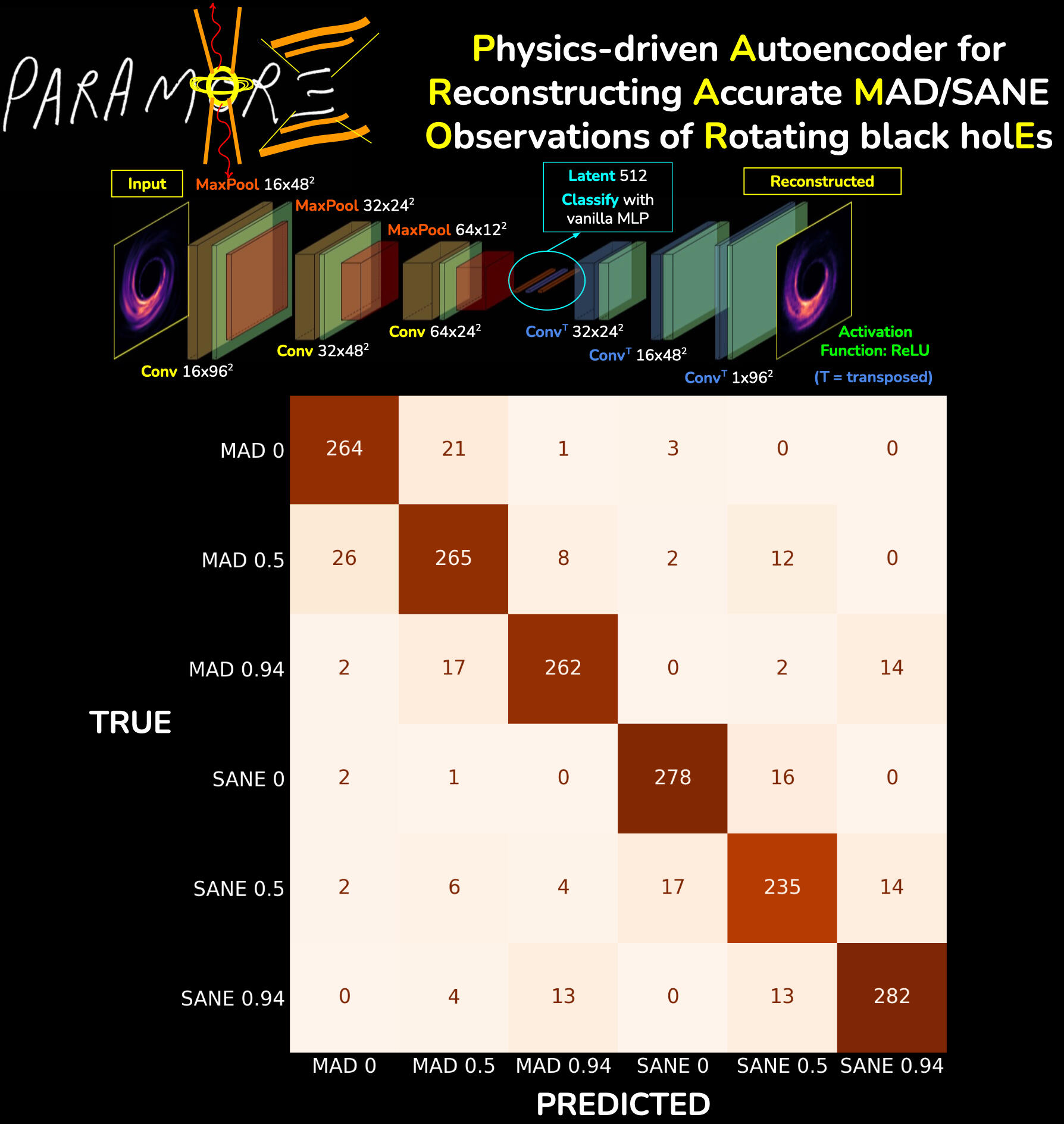
I trained a convolutional autoencoder to emulate GRMHD simulated black hole snapshots, enabling rapid generation of synthetic images with robust black hole shadow and photon ring feature reconstruction. I also trained an additional neural network to classify black hole images into different spins and accretion modes based on their latent representations. The project report can be found here.
Signal Processing of LIGO Gravitational Wave Data
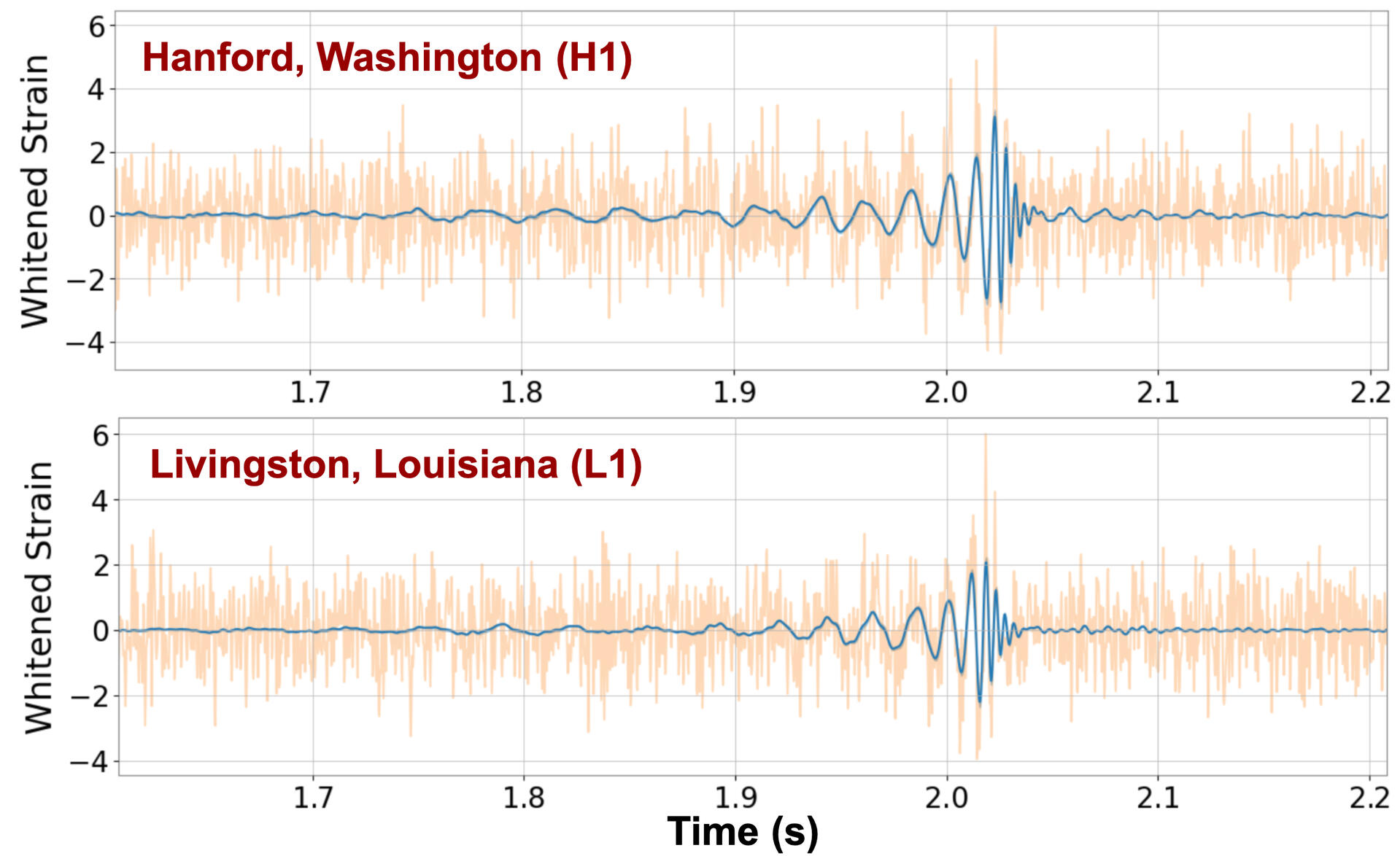
I reconstructed gravitational waveforms from GW150914 using standard tools in matched filtering and parameter estimation, as well as exploring applications of topological data analysis in characterizing LIGO detection. The project examined systematic biases in gravitational waveform modeling and parameter inference. The project report can be found here.
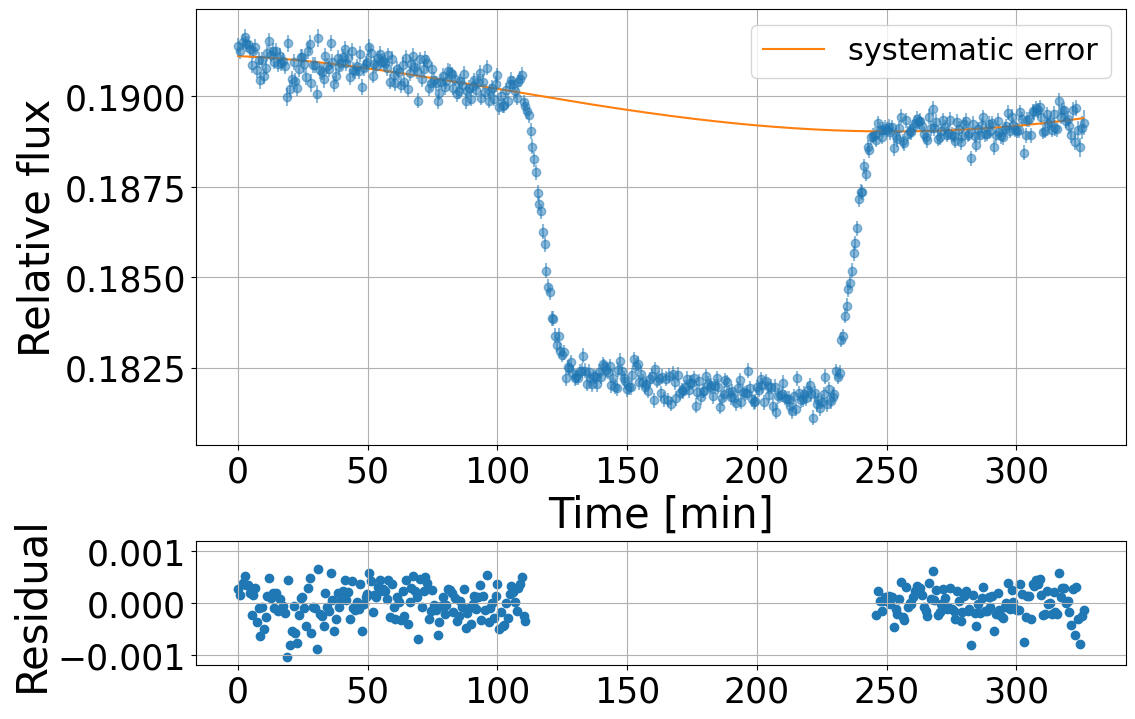
Observations of an Eclipsing EL CVn Binary
I obtained photometric data of WASP 0845+53, an EL CVn binary consisting of a main-sequence A star and a proto-Helium white dwarf, using Steward Observatory 61'' telescope (Mt. Bigelow, AZ). By analyzing its light curve during a primary eclipse event, I inferred the binary parameters such as period and stellar luminosities. This project found interesting evidence that the star is a blue straggler and the mass transfer is stellar wind-dominant. The project report can be found here.
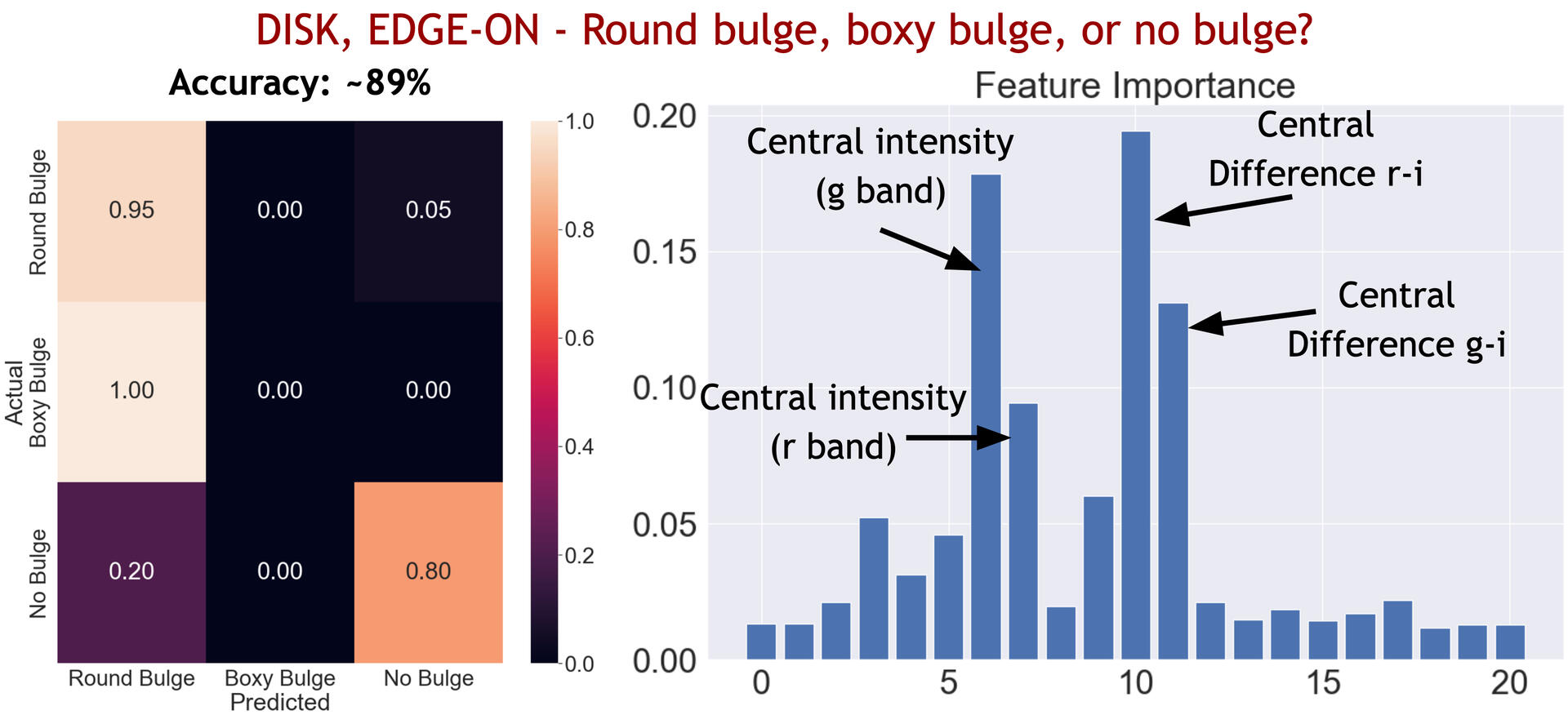
Classifying Galaxy Morphology with Random Forest
I trained a random forest on galaxy images in the Galaxy Zoo project to classify them into 10 groups based on extracted geometric and photometric features, such as eccentricity, form factor, intensity profiles, Gini coefficient, and central brightness. The project report can be found here.
Talks/posters
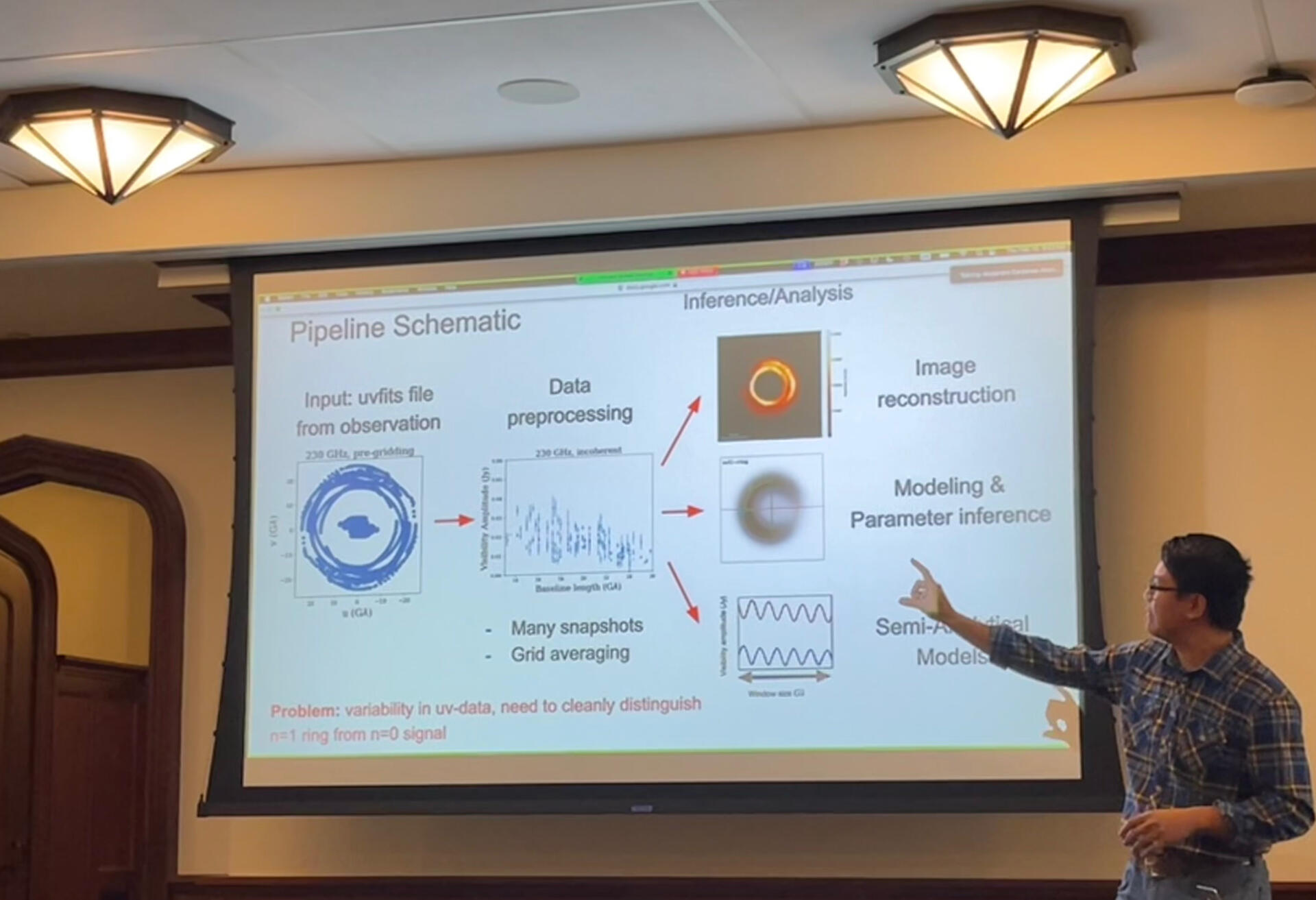
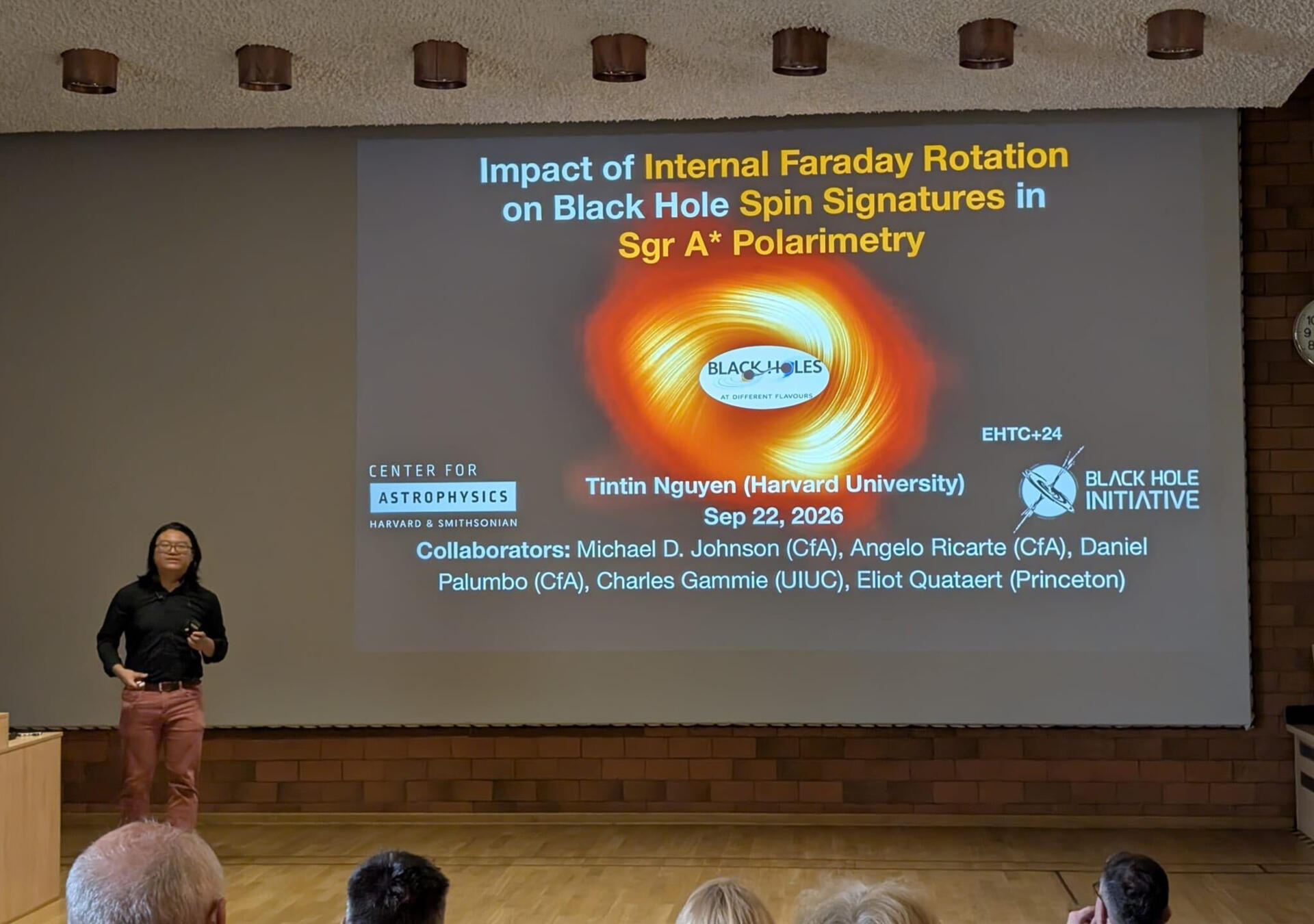
Personal ResearchImpact of Internal Faraday Rotation on Black Hole Spin Signatures in Sgr A* Polarimetry
WE-HERAEUS-EAS Workshop "Black Holes at Different Flavours", Warsaw (Poland), September 2026
Theory Working Group Meeting, Event Horizon Telescope Collaboration, virtual, Sep 2026
CfA Science Meeting, Center for Astrophysics | Harvard & Smithsonian, Cambridge (MA), Aug 2026
SCEECS Summer School "Plasmas Around Black Holes and Neutron Stars", Ensenada (Mexico), Aug 2026
SAO-EHT Group Meeting, Black Hole Initiative, Harvard University, Cambridge (MA), Jun 2026
IAU Symposium 405: Traversing the Galactic Center in Space and Time, Brno (Czechia), May 2026Generating and Interpreting Black Hole Images with a Convolutional Autoencoder
SAO-EHT Group Meeting, Black Hole Initiative, Harvard University, Cambridge (MA), Jun 2025
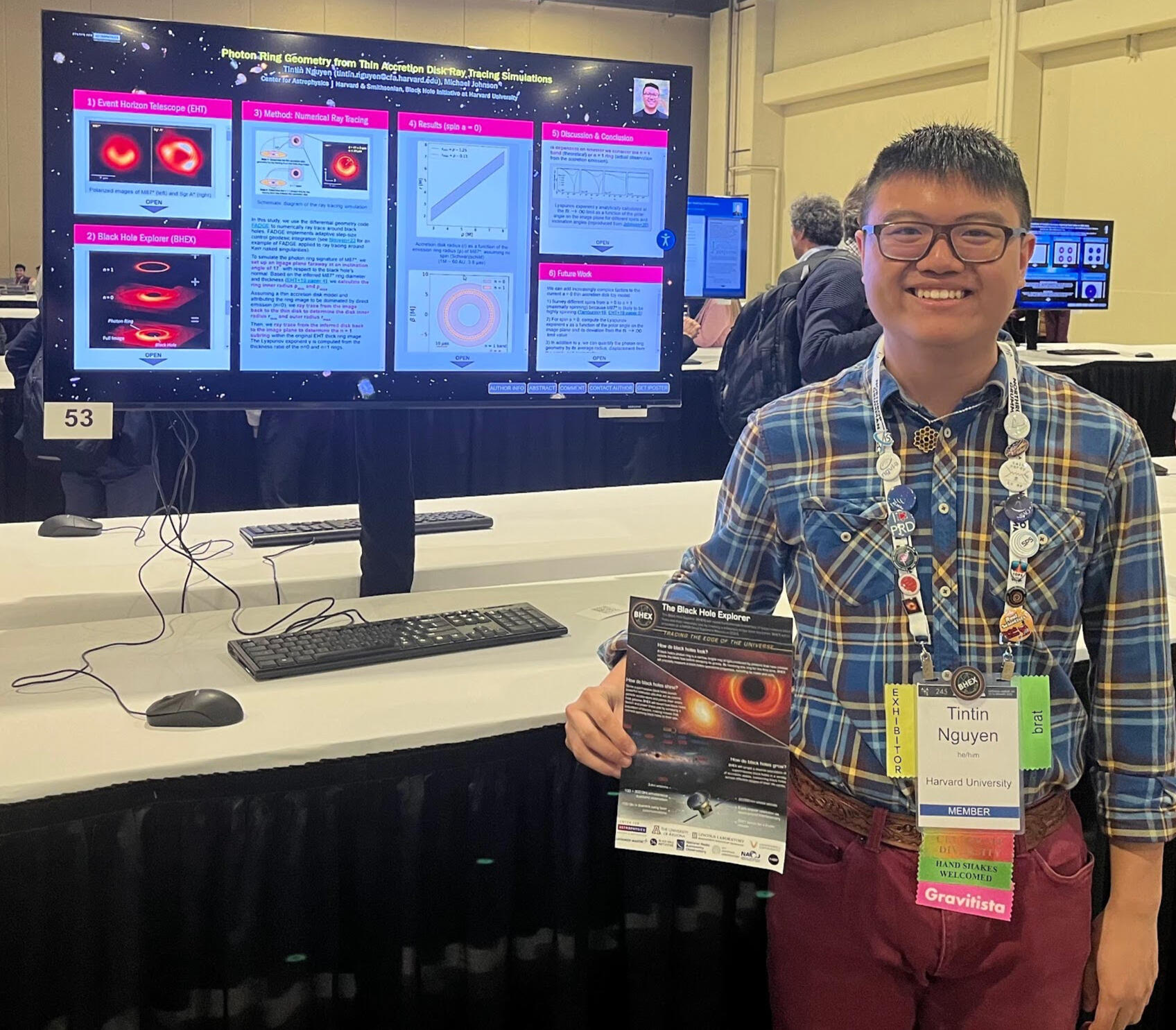
Arizona-EHT Group Meeting, Steward Observatory, The University of Arizona, Tucson (AZ), May 2025Photon Ring Geometry from Thin Accretion Disk Ray Tracing Simulations (poster)
American Astronomical Society Meeting, National Harbor (MD), Jan 2025Black Hole Explorer Modeling & Imaging
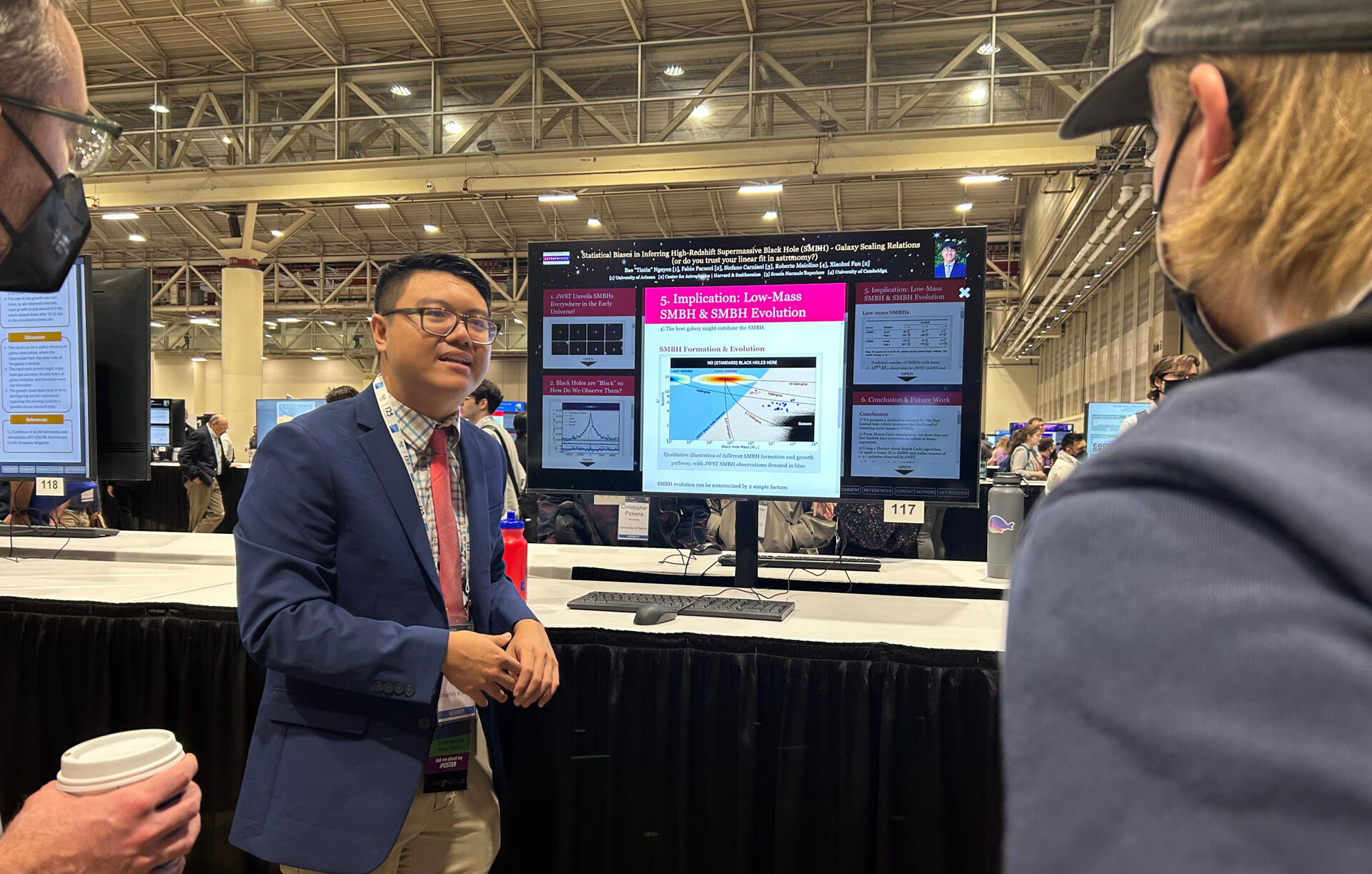
Photon Ring Workshop, Nashville (TN), Feb 2024, co-present with A. Cárdenas-Avendaño, D. Chang, F. Roelofs, P. TiedeStatistical Biases in Inferring High-Redshift Black Hole - Galaxy Scaling Relations (poster)
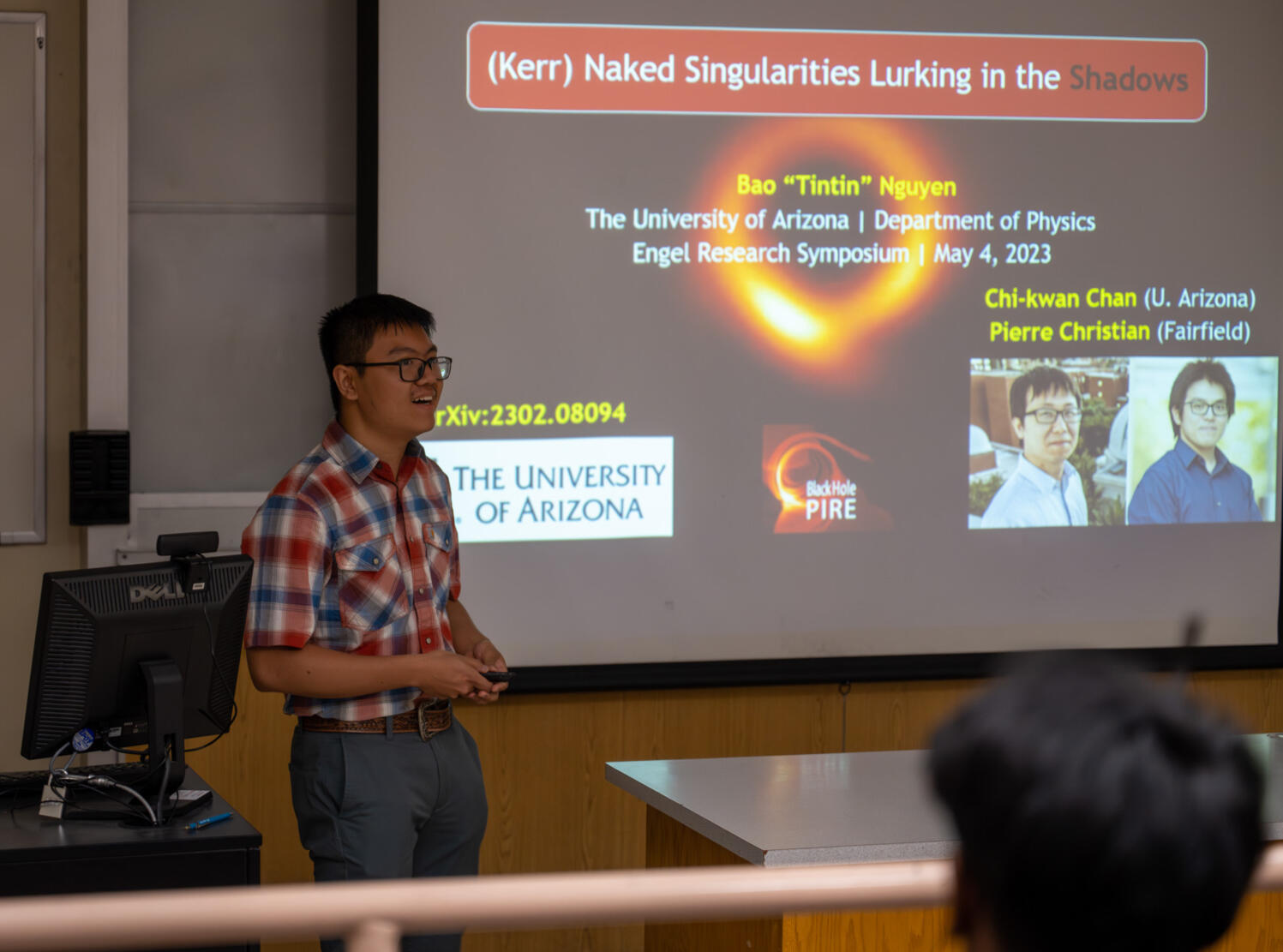
American Astronomical Society Meeting, New Orleans (LA), Jan 2024Kerr Naked Singularities Lurking In The Shadows (talk)
Lucy Engel Undergraduate Symposium, Tucson (AZ), May 2023
American Physical Society Meeting, Minneapolis (MN), Apr 2023
Gravitational Physics Working Group Meeting, Event Horizon Telescope Collaboration, virtual, Mar 2023Null Geodesics and Observational Signatures of Kerr Naked Singularities (talk)
American Physical Society Meeting, New York City (NY), Apr 2022
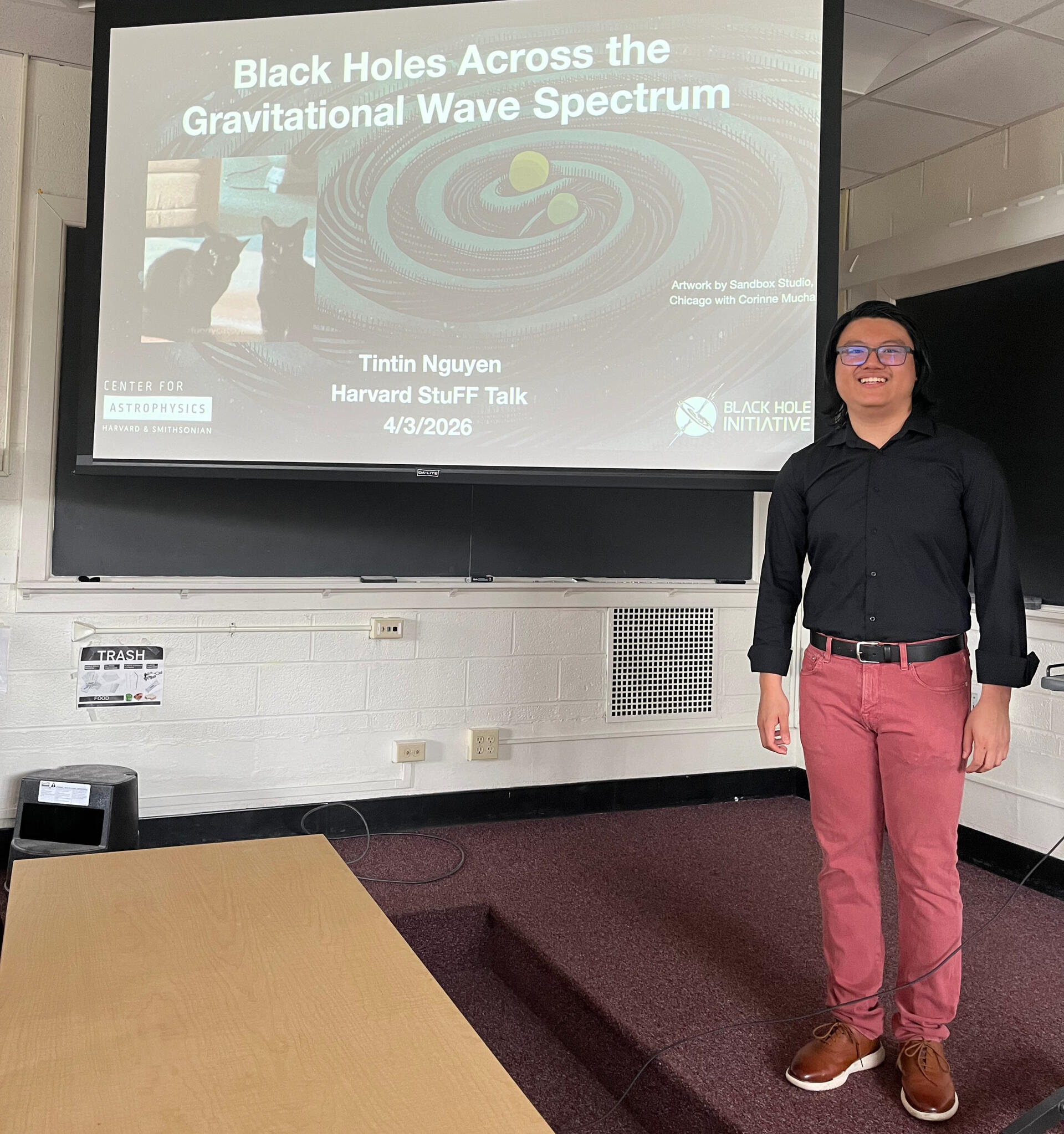
Review TalksBlack Holes Across the Gravitational Wave Spectrum
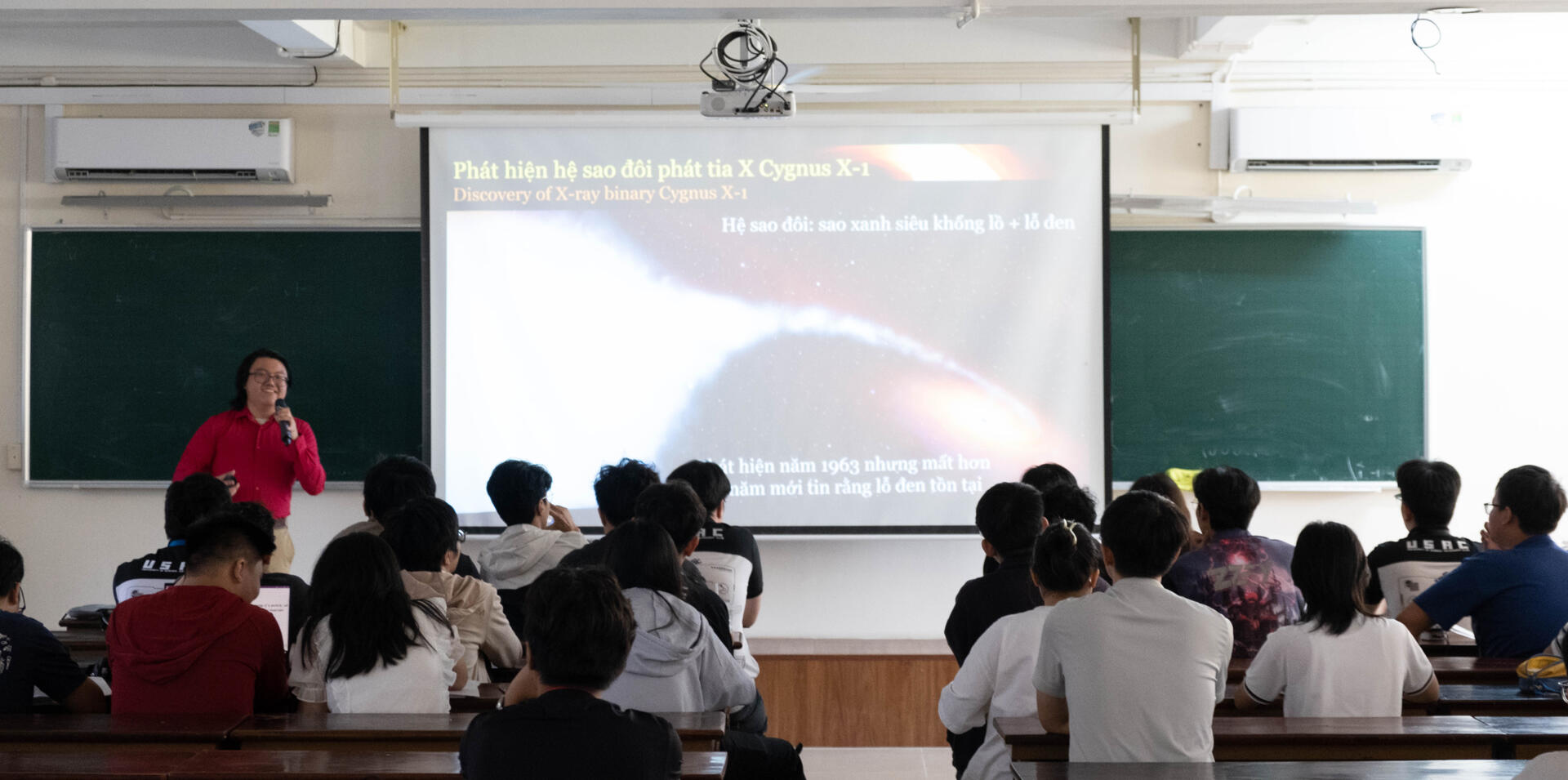
Student-Faculty Forum, Department of Astronomy, Harvard University, Cambridge (MA), Apr 2026Lỗ đen trong ánh sáng và trường hấp dẫn: câu chuyện về các sứ giả
(Black Holes in Light and Gravity: A Multi-Messenger Story)
Presentation given in Vietnamese
Academic Seminar, Faculty of Physics - Engineering Physics, University of Science, Vietnam National University, Ho Chi Minh City (Vietnam), Mar 2026Spiraling Into The Abyss: Accretion Around Black Holes (talk)
Computation & Data Initiative Meeting, Theoretical Astrophysics Program, The University of Arizona, Tucson (AZ), Apr 2023Graph Theory: From a Recreational Puzzle to the Technological Revolution (talk)
Undergraduate Teaching Assistant Seminar, Department of Mathematics, University of Arizona, Tucson (AZ), Apr 2022
Resources
Below are some resources that might be helpful for astronomy & physics students, many of them I helped develop and many of them which were extremely helpful for me in the past.Undergraduate Research
Astronomy & Physics summer internships that accept international undergraduates in the US - This is a running list that I initiated in 2024 and is currently maintained by Thomas Nguyen (University of Arizona)
Research opportunities and deadlines (mostly summer programs)
How to email faculty members to ask for research opportunities
How to write research statement for applications
Organize timeline for applying to research
Design and present research poster (also a talk on how to present research in general)
University of Arizona resources (with lots of generally useful resources): TIMESTEP, Undergraduate Research website, Undergraduate Research Ambassadors, Center for Career Readiness
Applying to Graduate Programs (biased towards Physics & Astronomy PhD programs in the US)
AstroBites: timeline, prepare to apply, application, CV, statement of purpose, grad school decisions, choose PhD advisor, grad school visit
TIMESTEP Academic & Career Planning Resources: GRE requirements, application template
MIT Physics Grad App Assistance Program
Caltech FUTURE Ignited Program is a really great program designed for students who're interested to pursue a PhD in 1-2 years (so apply when you're a sophomore/junior). They also have an Accountability Partner Program and good general resources.
Ask reference letter writers early if they can write you a letter (~3 months before application due)!!! It's quite important to keep them organized about your deadlines. Besides email reminders, I also make a spreadsheet summarizing every info they'd need, here's an example.
Most programs have application fee waivers if students meet certain eligibility (e.g., certain background, has financial aid, attend certain programs/conferences, etc)!!! I had 7/12 programs waive my application fee, saving ~$600! Look this up on the program website or email them to inquire about this early!
List of questions to ask graduate programs when you visit
Please remember that PhD programs are very competitive and the admissions results are not reflective of your potentials and who you are! Applying to graduate schools can be extremely stressful and emotionally draining, so give yourself some grace and take it easy! Also, grad app can be a very confusing process, especially if you're applying from overseas and nobody in your family has done it. I really want this whole process to be more transparent, so please email me if you have any question about this.
Teaching/Mentoring
Graduate Student Mentoring Handbook: A Guide for Grad Students
Inclusive and equitable teaching in Physics and Astronomy
Exploring Culturally Responsive Pedagogy: Teachers’ Perspectives on Fostering Equitable and Inclusive Classrooms
Miscellaneous
Very comprehensive resource list of equity & inclusion in Astronomy
So you want to be an astronomer from the legendary u/Andromeda321
Resources for Early Career Astronomers (Floor Broekgaarden's website)
Logan Pierce's website (more than just grad school app!)
Friends Don't Let Friends Make Bad Graphs (data visualization tips)
Coursera and EdX have fantastic free online courses in Astronomy, Data Science, etc. My favorites are Astro 101: Black Holes, [From the Big Bang to Dark Energy (https://www.coursera.org/learn/big-bang) and Using Python for Research.
World Science U has some really cool free online courses on theoretical astrophysics topics like black holes, cosmology, gravitational waves, etc
Learning General Relativity: Tensor Algebra YouTube series, Tensor Calculus YouTube series, George Keeling's website, tensor tricks, important equations, the metric tensor, my personal note on geodesic equation through the least action principle
Gravitational Wave course by K. Thorne, M. Bondarescu, Y. Chen
JWST Galaxies and Black Holes in the First Billion Years course lecture slides at 54th Saas-Fee Advanced Course
Gravity-related conferences, job openings, general news
Black Holes related review/classic papersA list of AGN/quasar review papersGravitational waves/black hole binaries
GW150914 (first GW detection): discovery paper, properties, GR test
GW170817 (first neutron star merger detection): discovery paper, ApJ focus issue on multi-messenger, neutron star radii & equation of state
GW231123 (heaviest merger, 137+101 M⊙)
GW250114 (highest SNR so far ~80): Testing Hawking's area theorem & Kerr nature, black hole spectroscopy and tests of GR
GR tests with LIGO/Virgo/KAGRA O3 run
"Mass gap": GW190814 (23 BH + 2.6 ? M⊙), GW230529 (3.6 ? + 1.4 NS M⊙),
Merging compact binary demographics in LIGO/Virgo/KAGRA O4 run
NANOGrav 15 year dataset: evidence for stochastic background, supermassive black hole binary constraints, ApJ focus issue
Circumbinary accretion: from binary stars to massive binary black holes (Annual Reviews)
Deci-Hz gravitational wave on the Moon and beyond
Black hole binary astrophysics lecture notes
Black holes, gravitational waves and fundamental physics: a roadmap
Horizon-Scale Imaging
Event Horizon Telescope: M87* (first image, polarization, 2017-2021 variability), Sgr A* (first image, polarization)
Next-generation Event Horizon Telescope: science goals, array design, fundamental physics, ETHER targets, black hole spin measurement, polarimetry & accretion flow, photon rings
Black Hole Explorer: motivation & vision, photon ring, other SPIE papers, universal interferometric signatures of photon ring, demographic targets
X-ray
Measuring black hole spin with X-ray reflection spectroscopy
X-ray black hole binaries (Annual Reviews)
X-ray supermassive black holes (Annual Reviews)
Ultra-Luminous X-Ray sources (Annual Reviews)
Black hole spin measurement (mostly X-ray) (Annual Reviews)
AGN
Gamma-ray from AGN (Annual Reviews)
Obscured AGN (Annual Reviews)
AGN variability (Annual Reviews)
AGN relativistic jets (Annual Reviews)
Observational evidence of AGN feedback (Annual Reviews)
AGN outflows and feedback (Annual Reviews)
Revisiting AGN unified model (Annual Reviews)
GR(R)MHD simulations of AGN disks and jets (Annual Reviews)
Black hole formation/evolution/cosmological scale
Assembly of first massive black holes (Annual Reviews)
Quasars and IGM at Cosmic Dawn (Annual Reviews)
Supermassive black hole and host galaxy coevolution (Annual Reviews)
Theoretical Modelling of Early Massive Black Holes (54th Saas-Fee advanced course lecture by Marta Volonteri)
First JWST high-z AGN discoveries: First JWST/NIRSpec census, JADES, CEERS, UNCOVER, EIGER/FRESCO (which coins the phrase "Little Red Dots"!), z~8.5 UNCOVER, z~8.6 CEERS 1019, z~10 UHZ-1 Chandra + JWST, GN-z11, overmassive black holes in z~4-7 JADES & CEERS active galaxies
Others
Intermediate-mass black holes (Annual Reviews)
Hot accretion flows around black holes (Annual Reviews)
Tidal disruption events (Annual Reviews)
Outreach & Leadership
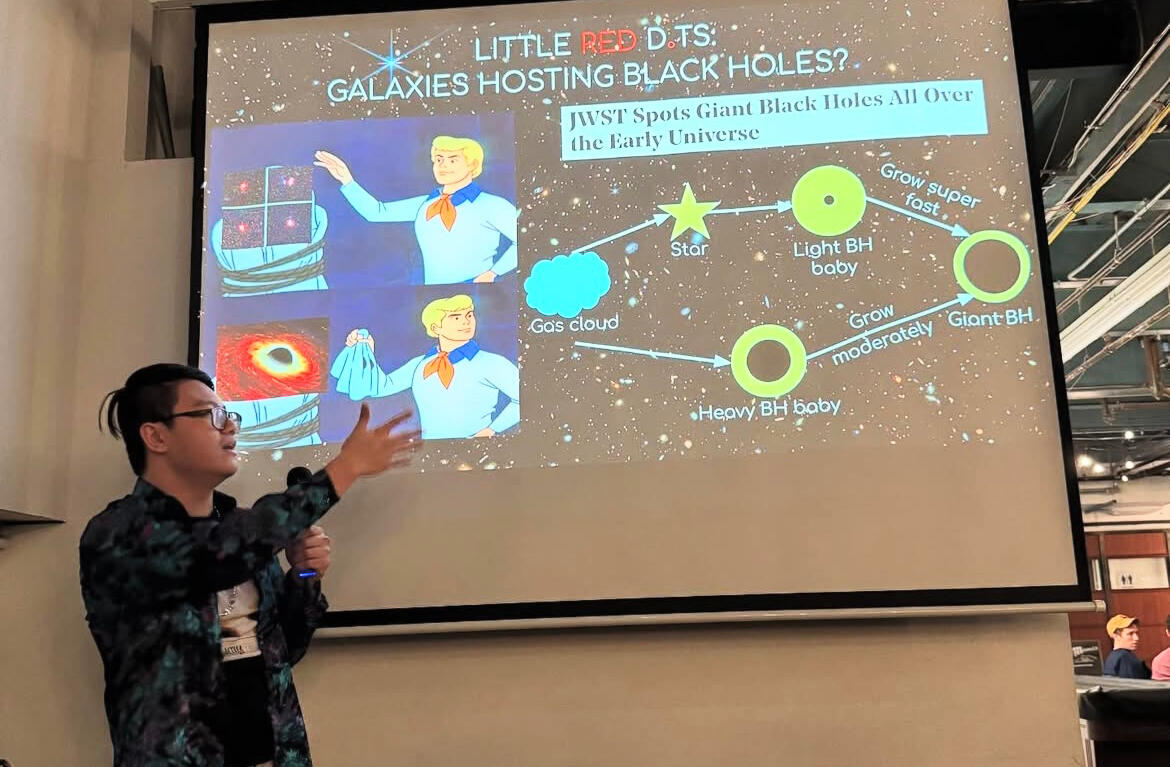
Astronomy on Tap Boston
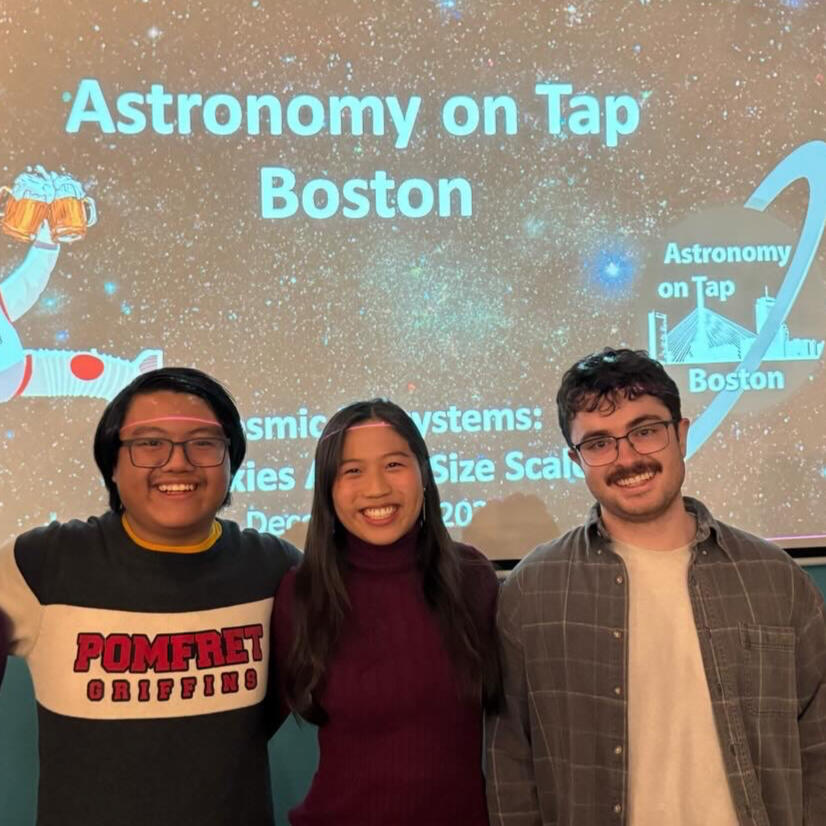
Since 2024, I've been one of the lead organizers of Astronomy on Tap Boston, an outreach initiative bringing space-themed talks from local professional astronomers to the pub, with a side of astronomy-related news, trivia and games! I have helped organized 8 events and I also frequently host trivia and occasionally present the Astro News segment (e.g., Lunar Exploration, JWST Little Red Dots) during our events. My favorite event themes among those I organized include Dark Side of the Force (queue Imperial March), Rubin Observatory, Cosmic Ecosystems, Radio Astronomy, Beyond the Outer Rim, and Lunar Exploration.
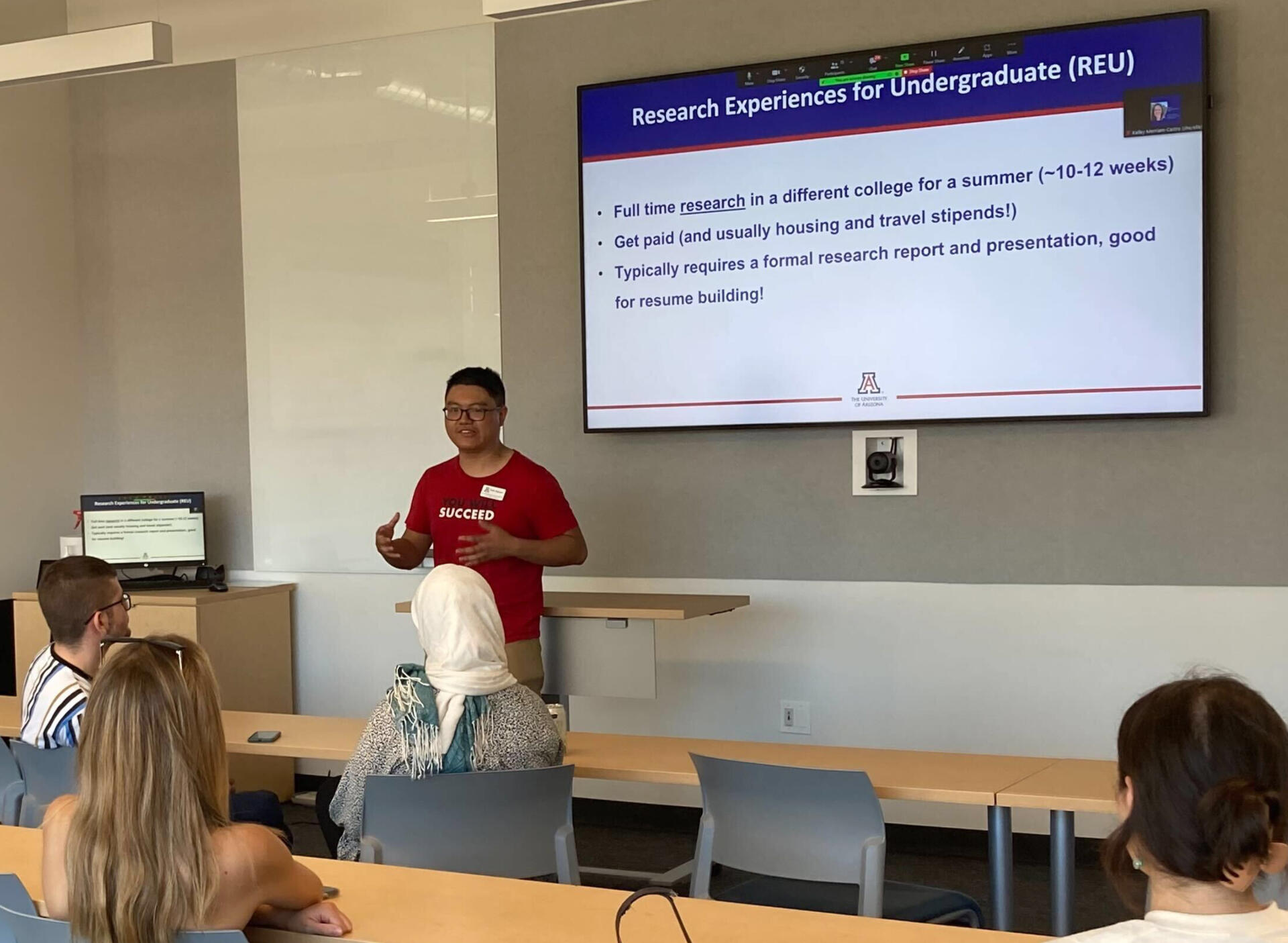
Undergraduate Research Ambassador
Between 2022 and 2024, I was one of the lead undergraduate research ambassadors at the University of Arizona. I provided personalized help for undergraduate students who seek research opportunities and contributed resources to the Center for Career Readiness website. I also led over 25 workshops and student panels on finding and applying to research opportunities, as well as giving research presentations.
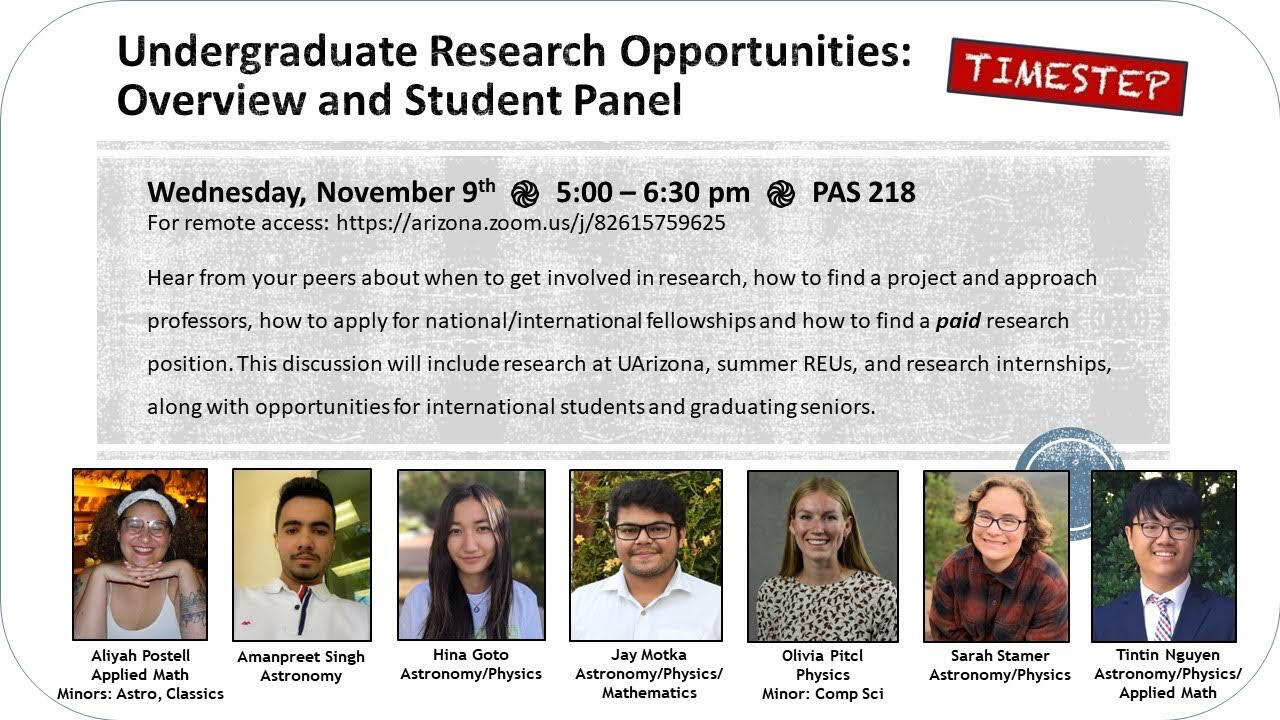
Tucson Initiative for Minoritized Student Engagement in STEM Program (TIMESTEP)
Between 2022 and 2024, I was one of the student leaders of TIMESTEP, a program aiming to improve access to educational and professional opportunities for undergraduate students in the physical sciences at the University of Arizona. I led multiple student panels to share how to navigate the Astronomy & Physics program, get involved in undergraduate research, and present research at a conference.
About me
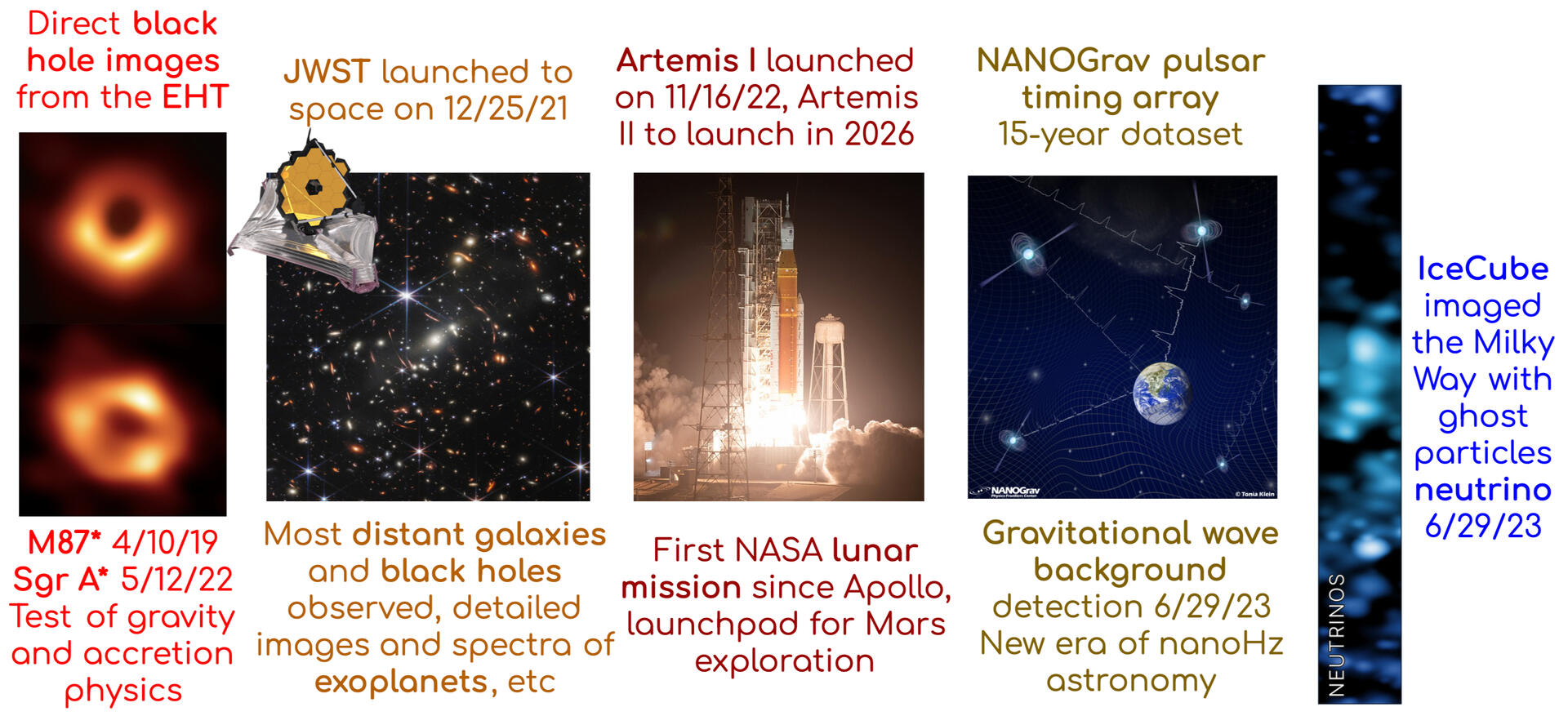
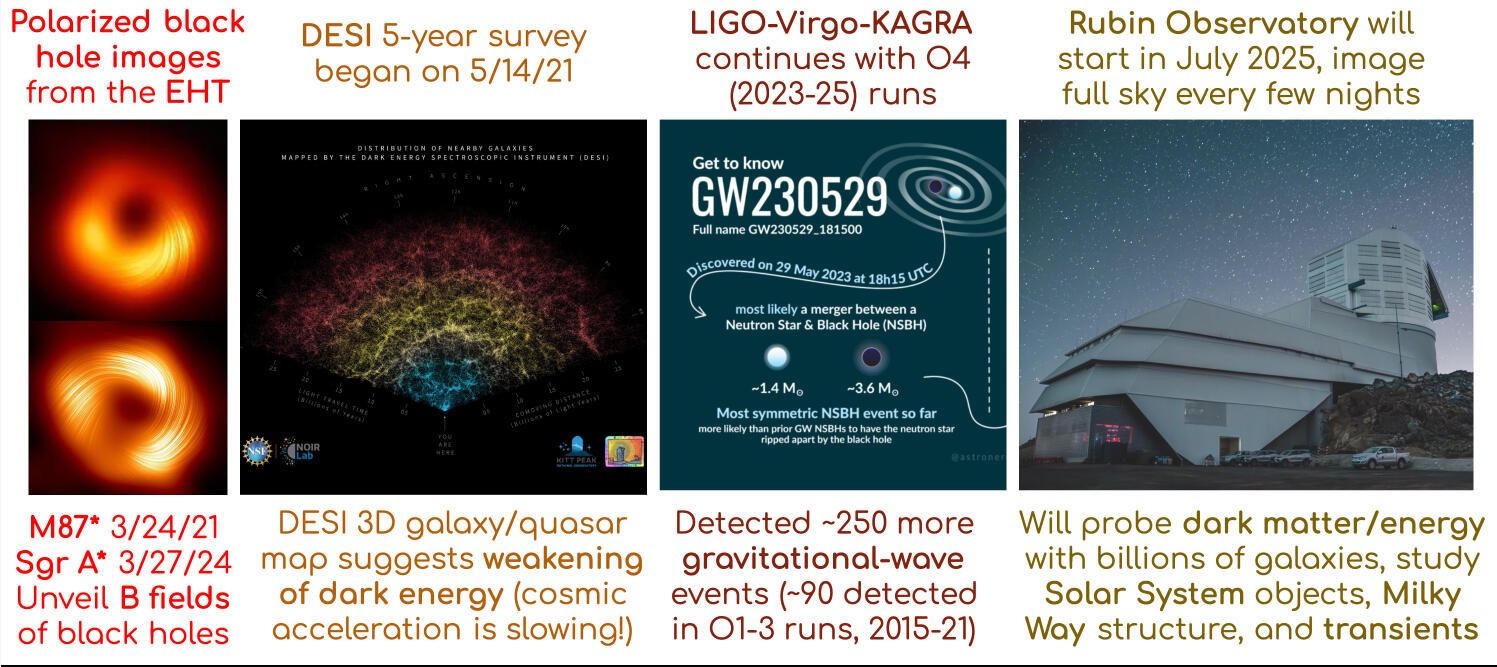
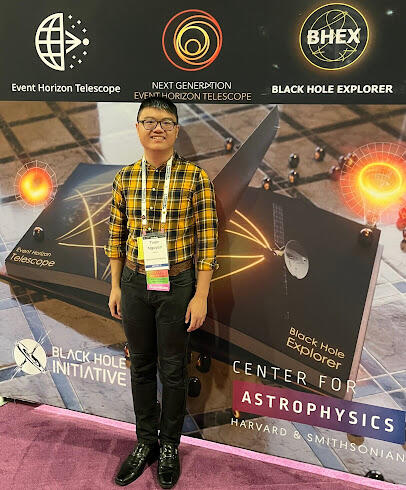
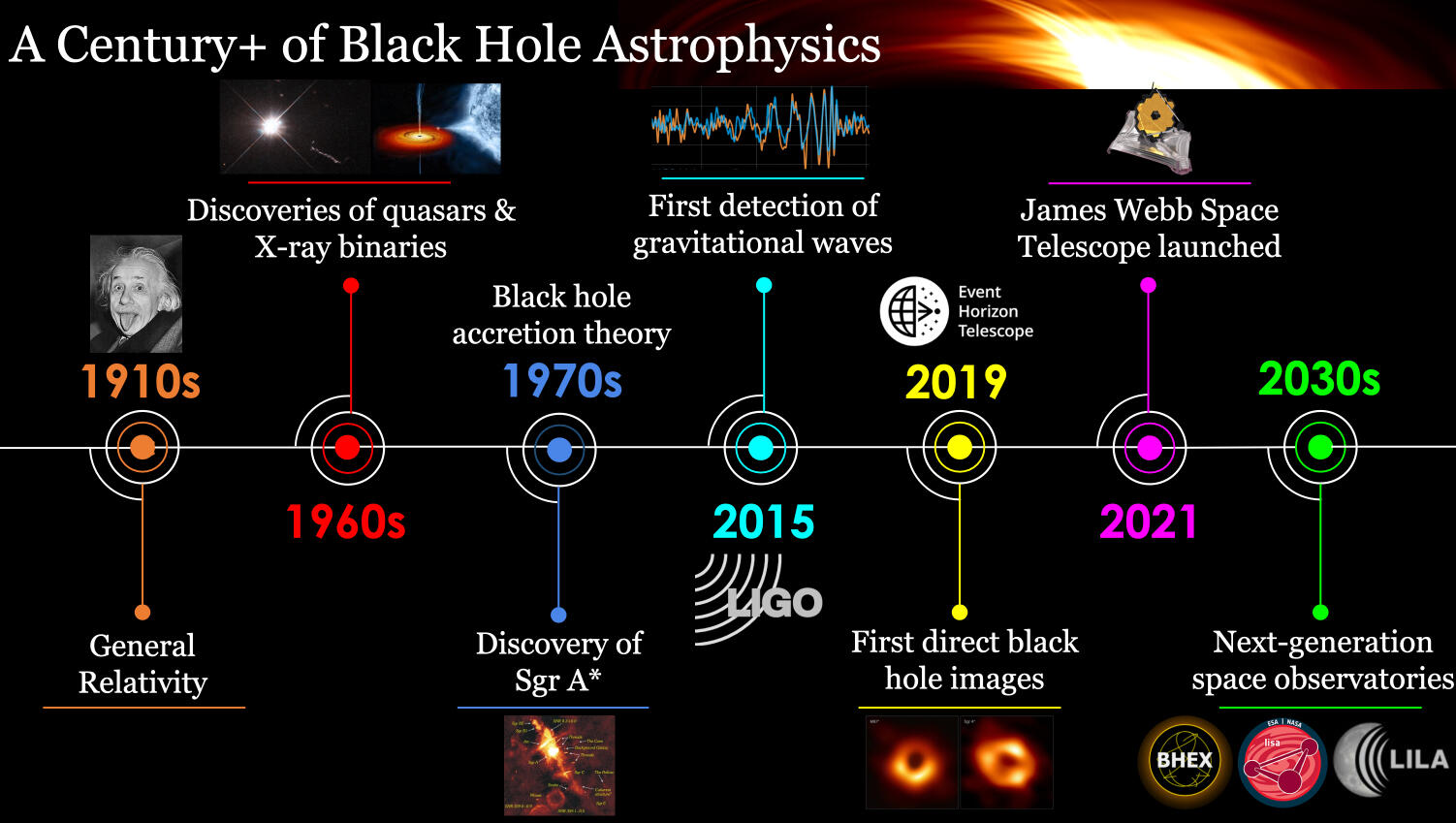
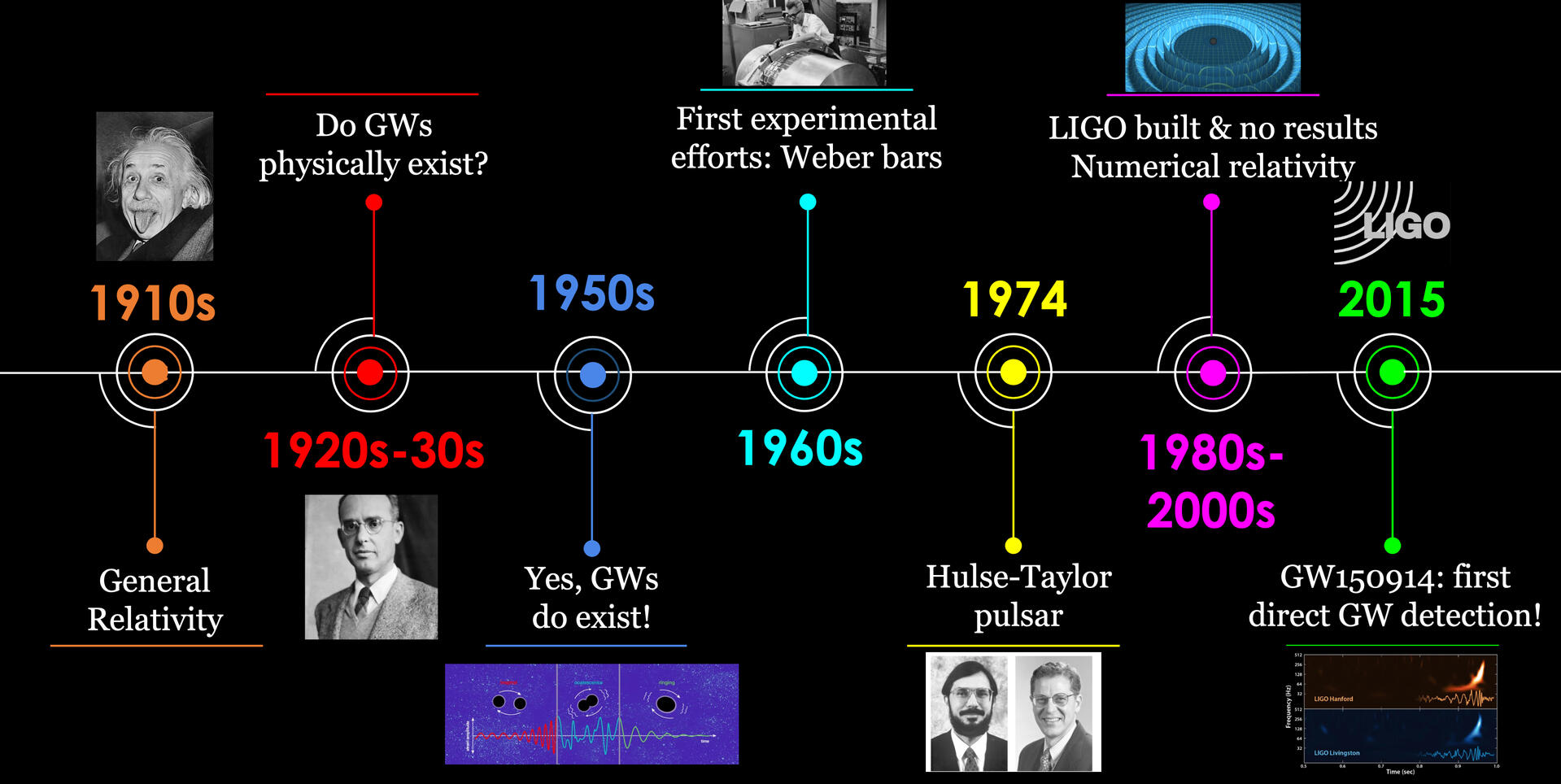
Currently, I'm an Astronomy Ph.D. student at Harvard, advised by Michael Johnson, the Black Hole Explorer mission PI. I previously was an undergraduate student at the University of Arizona, advised by CK Chan and Pierre Christian, with a summer working at the CfA as a research intern under Fabio Pacucci. I'm broadly interested in astrophysical black holes of all kinds and forms, and more on my research is on this site.Spending my first 16 years of my life in my hometown Ho Chi Minh City (Vietnam), I moved to the US in 2018 to pursue a career in Astronomy. Many sources of inspiration brought me onto this path before college, in chronological order: a solar system toy model gift from my parents, space encyclopedia, Interstellar, LIGO first discovery of gravitational waves, middle school science fair projects on essential oil extraction and solar panel engineering, high school lab on metal flame test, Stephen Hawking's The Grand Design, Coursera Black Hole 101 online class, EHT first black hole images, PBS Space Time YouTube channel. When I saw the first EHT black hole image of M87*, I remember telling myself, "Black holes are real! They might be faraway, but I can study them!"Fast forward 8 years later after spending a few years in Connecticut and Arizona to pursue astronomy, I've felt so excited and fortunate to live in an unprecedented era of astronomy, highlighted by a few accomplishments in the (admittedly biased) graphics above. In my short lifetime, the Nobel Prize in Physics has been dedicated to cosmic X-ray sources (2002), cosmic neutrinos (2002), cosmic microwave background anisotropy (2006), accelerating expansion of the universe (2011), gravitational waves (2017), cosmology (2019), exoplanets (2019), and black holes (2020). In the past decade, gravitational wave detectors (LIGO/Virgo/KAGRA), the Event Horizon Telescope, and the James Webb Space Telescope have been pushing the frontiers of black hole research to multiple exhilarating directions. It's more exciting than ever to become an astronomer and I feel so privileged to be part of the astronomy scientific community!As a child, as much as I dreamed of becoming a scientist, I also aspired to be a teacher to follow in the inspiring footsteps of my grandparents, who taught English in their impoverished neighborhood, helping many generations of students study abroad. Inspired by Vietnamese pioneers like the first Asian astronaut Phạm Tuân and Kavli Prize laureate Jane Luu, as well as astronomers Nguyễn Trọng Hiền (Caltech/JPL) and Hoàng Chí Thiêm (KASI) who helped establish one of the first astronomy groups in Vietnam, my long term wish is to create more astronomy research opportunities and, ultimately, establish the first astronomy undergraduate program in Vietnam to enhance our representation in the field. Studying astronomy and doing astronomy research are privileges that I really wish to be more accessible opportunities to future generations in Vietnam.
my astrophysical journey
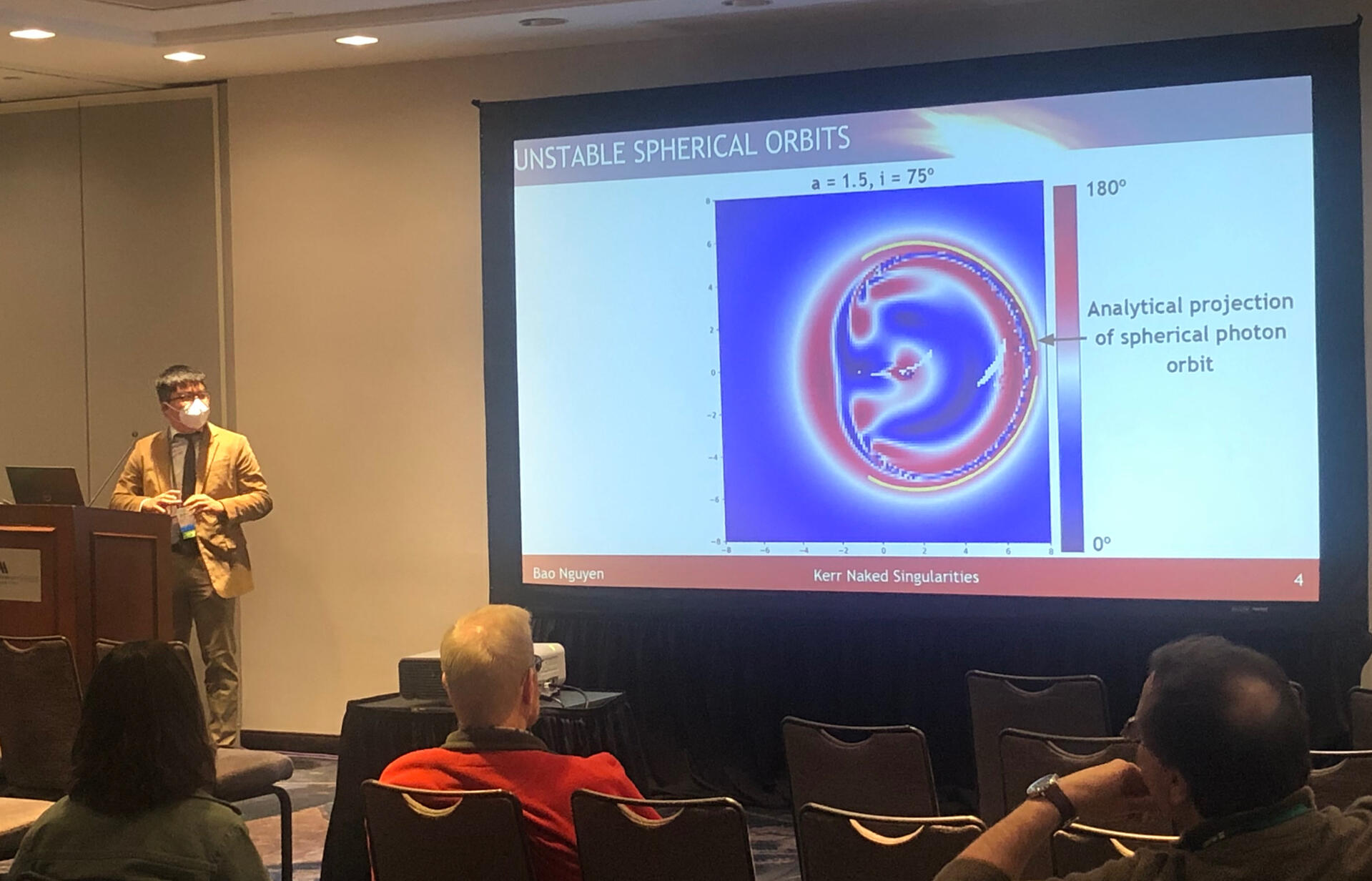
My first ever research conference! APS Meeting @ NYC (4/9-4/12/2022)
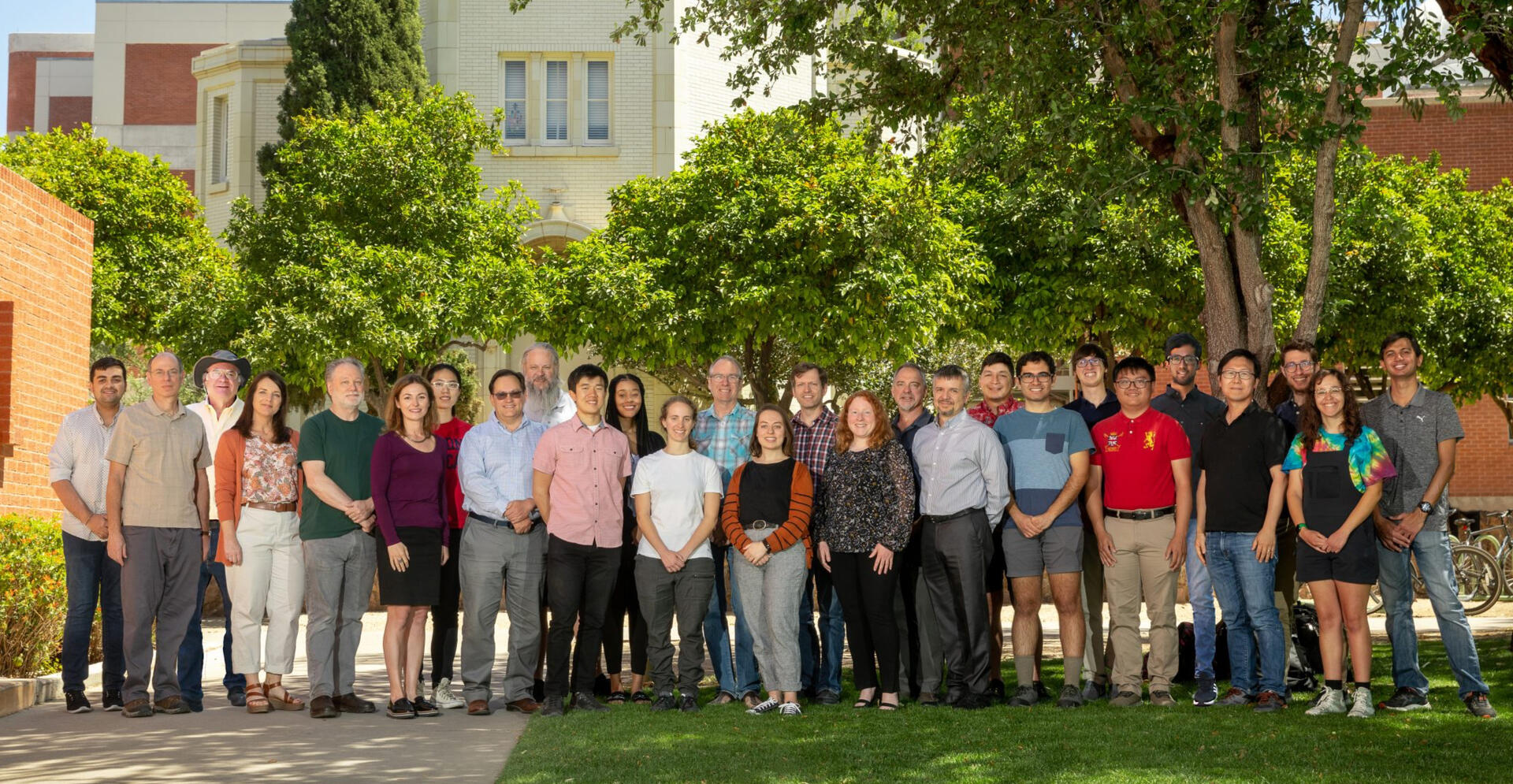
EHT team at U. Arizona after the first Sgr A* image (4/14/2022)
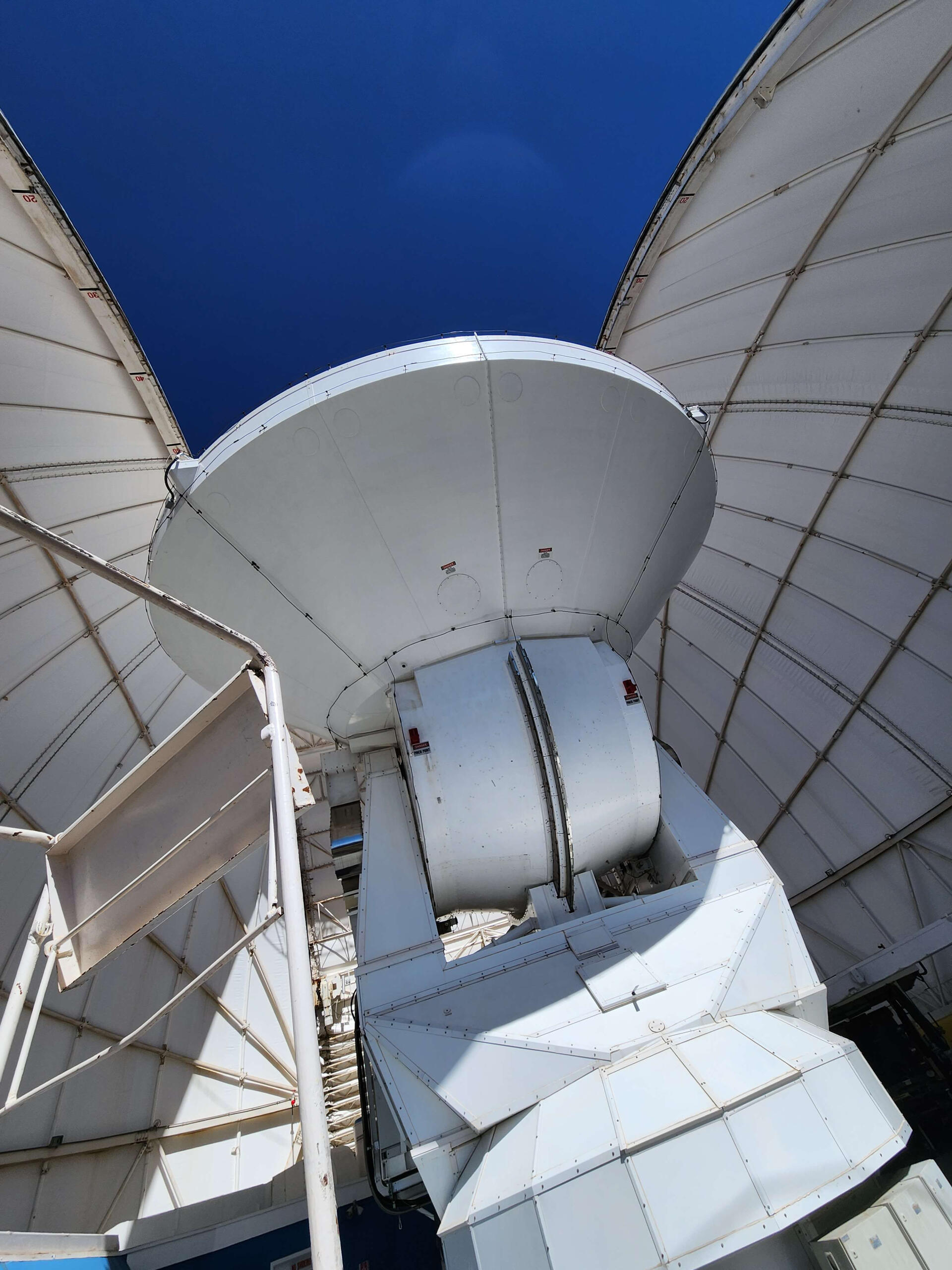
Arizona Radio Observatory 12m Telescope @ Kitt Peak, AZ (4/22/2023)
This was less than a year after a historic wildfire on Kitt Peak in June 2022.
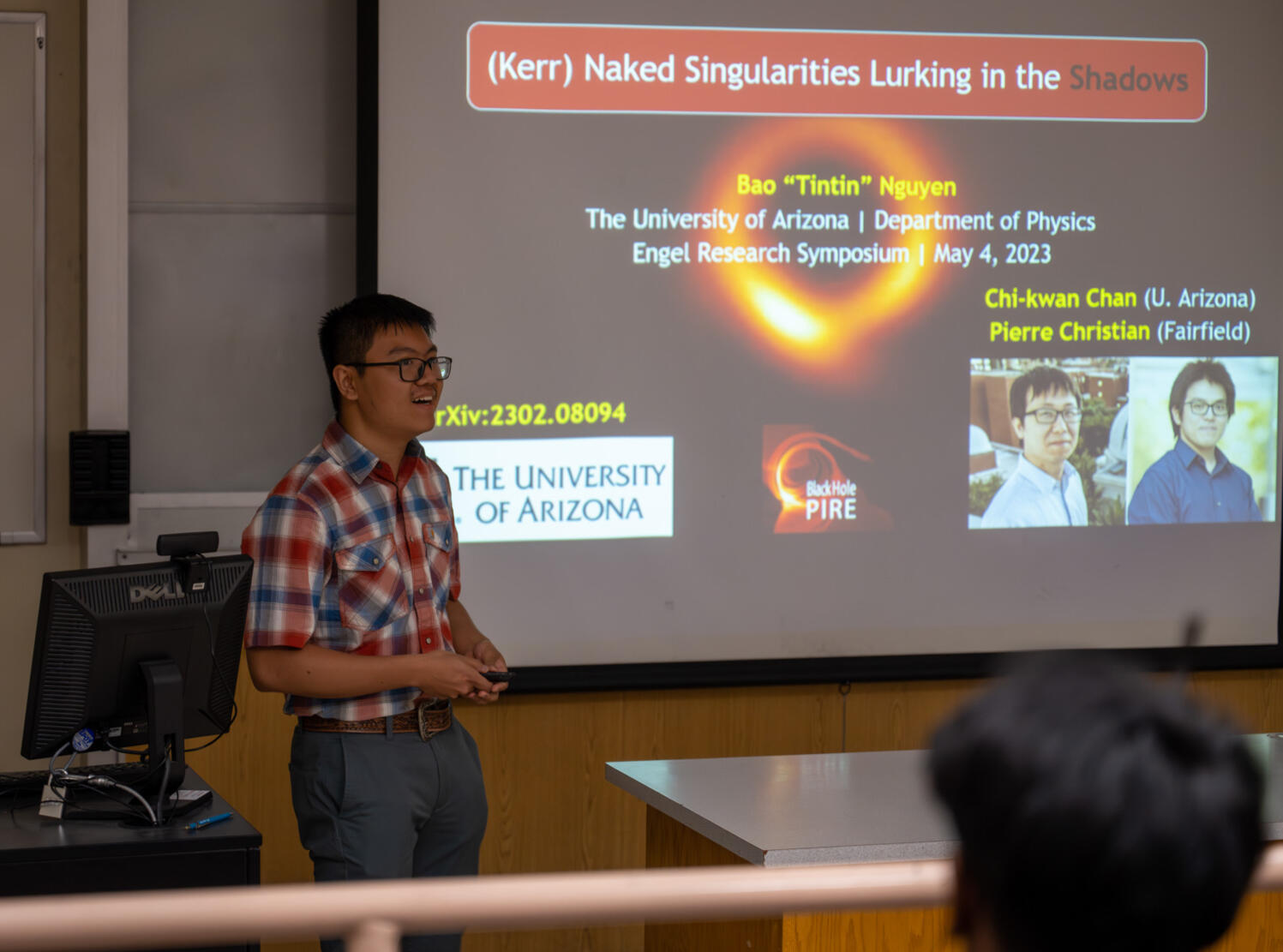
Engel Research Symposium @ U. Arizona Physics (5/4/2023)
Talk video
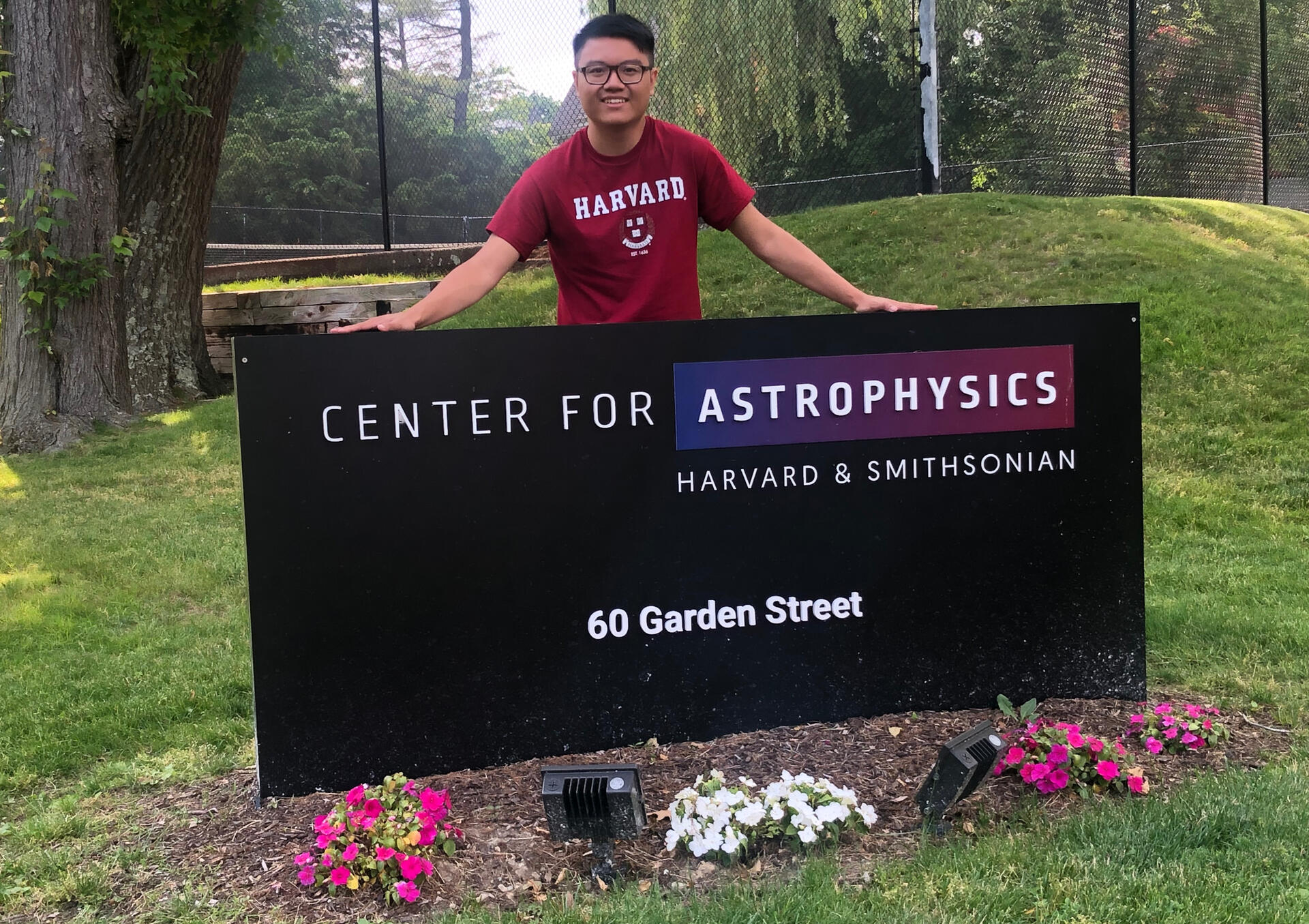
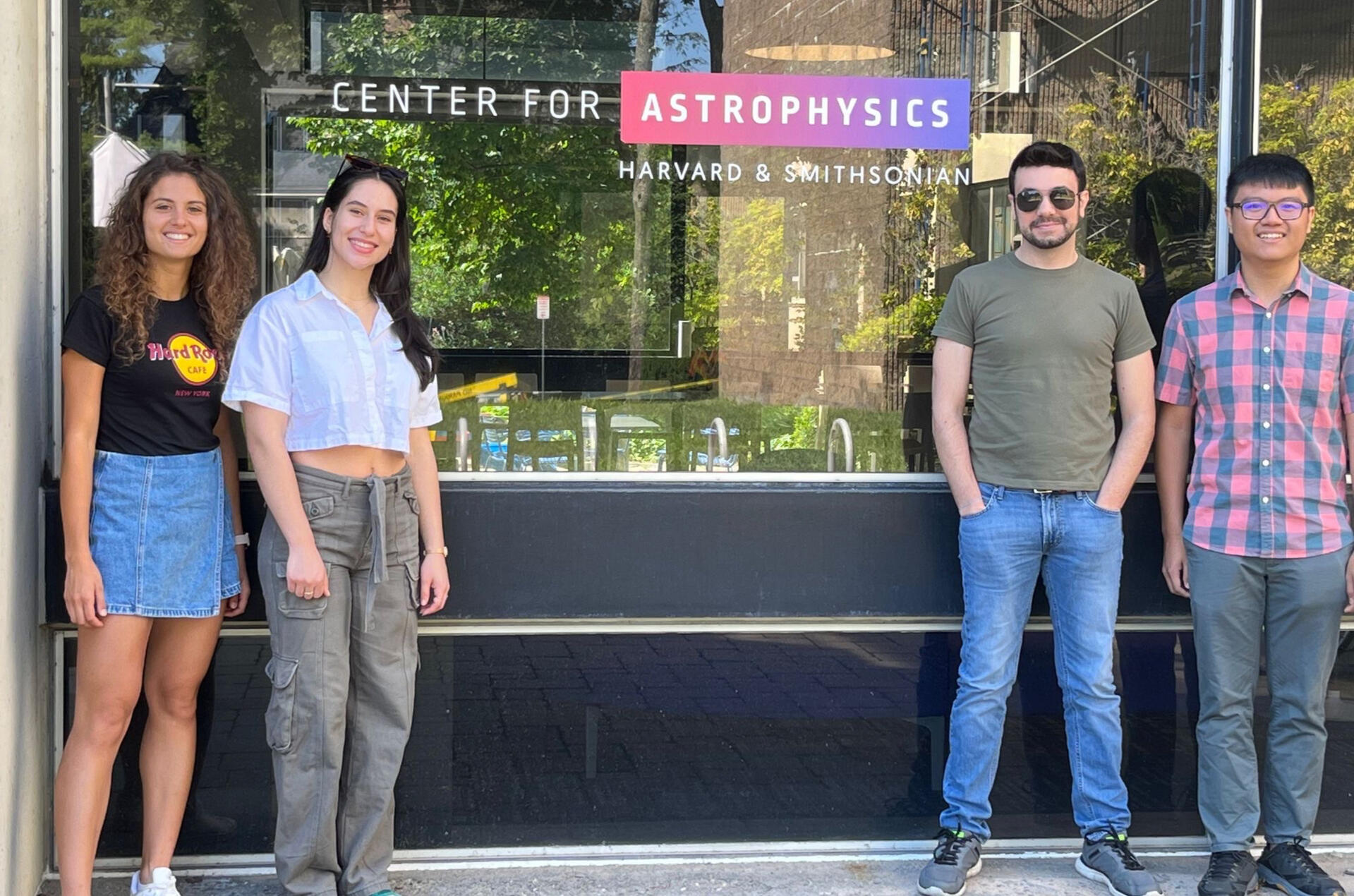
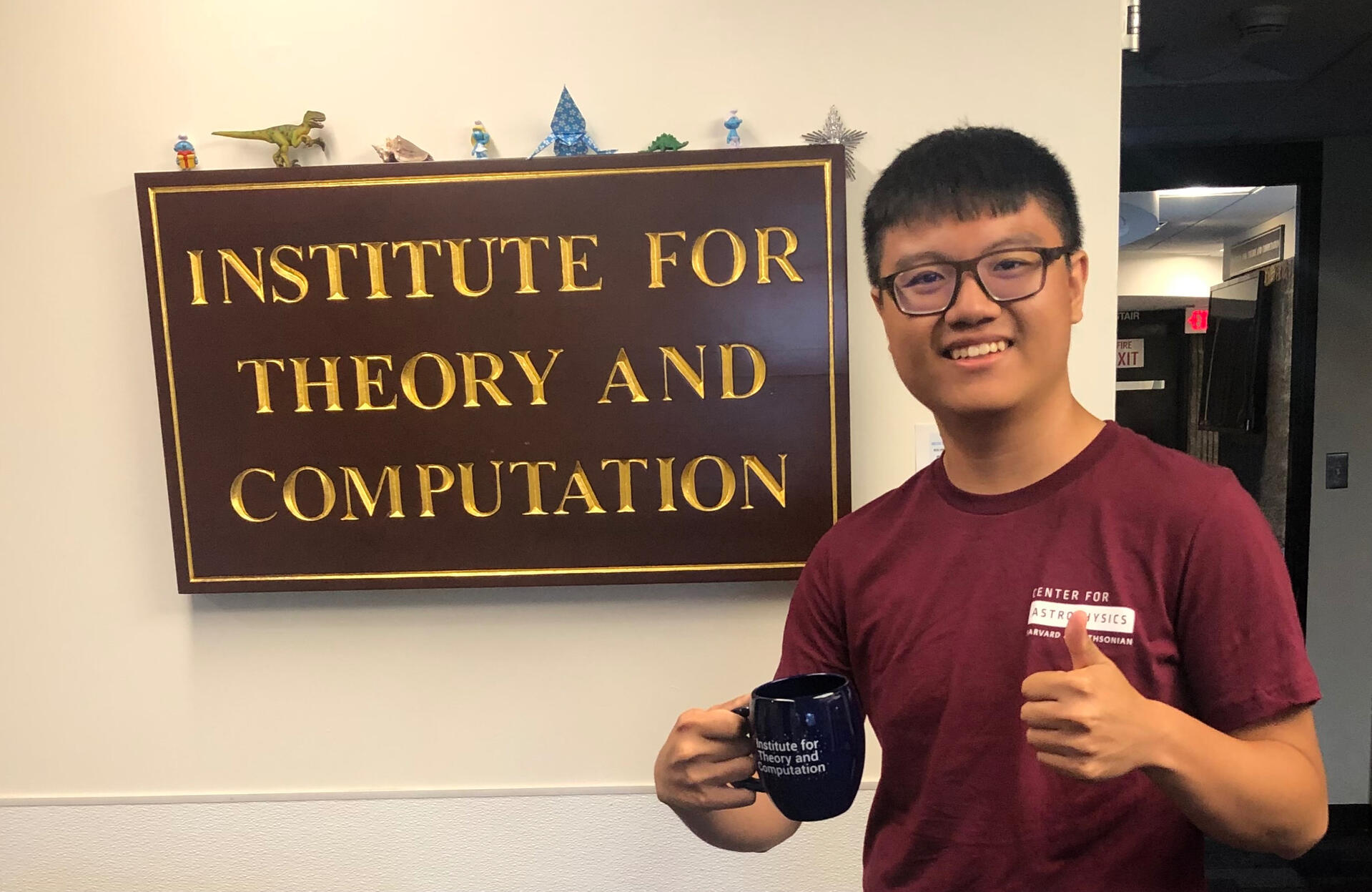
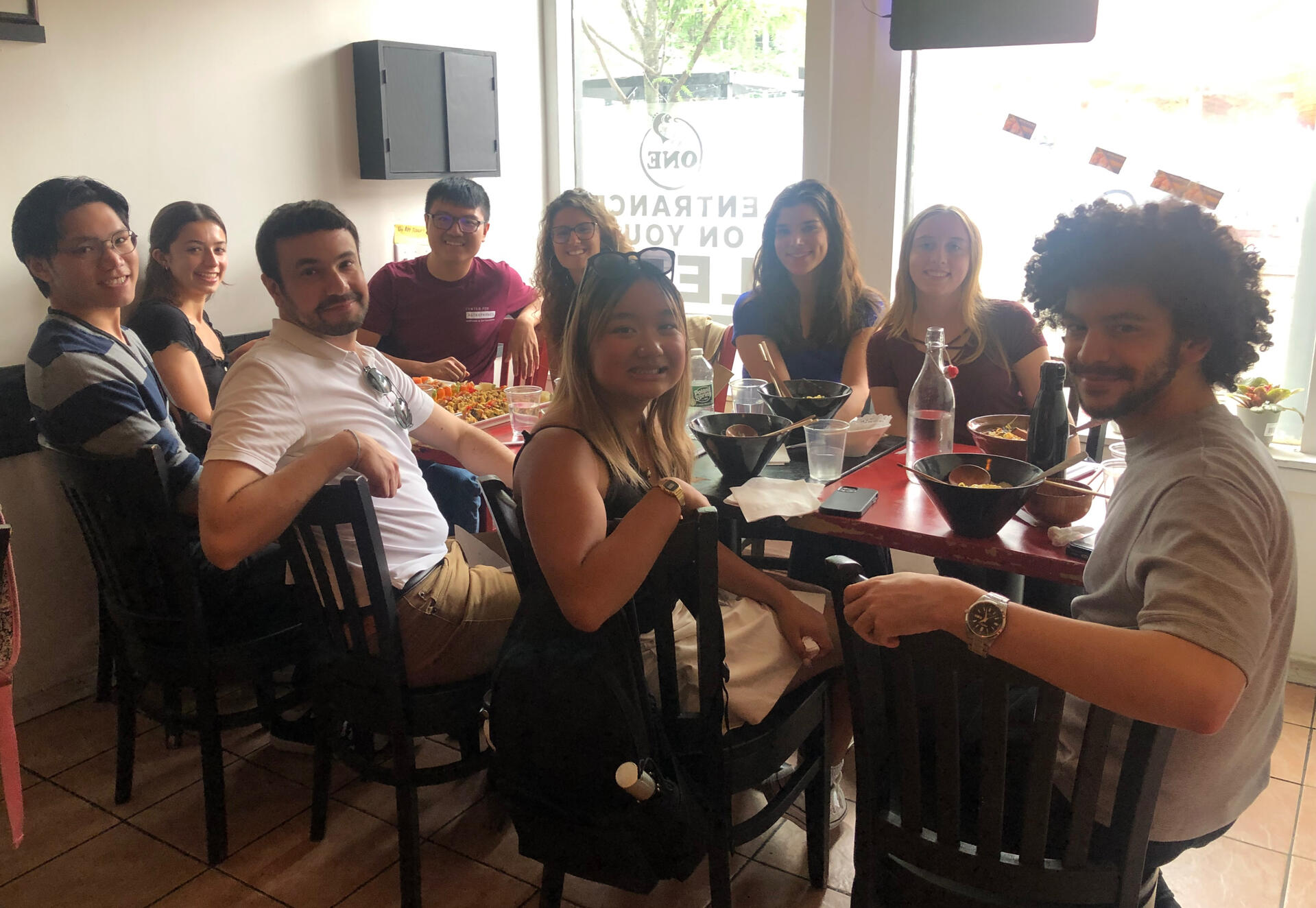
Undergraduate Internship with Fabio Pacucci @ CfA (Summer 2023)
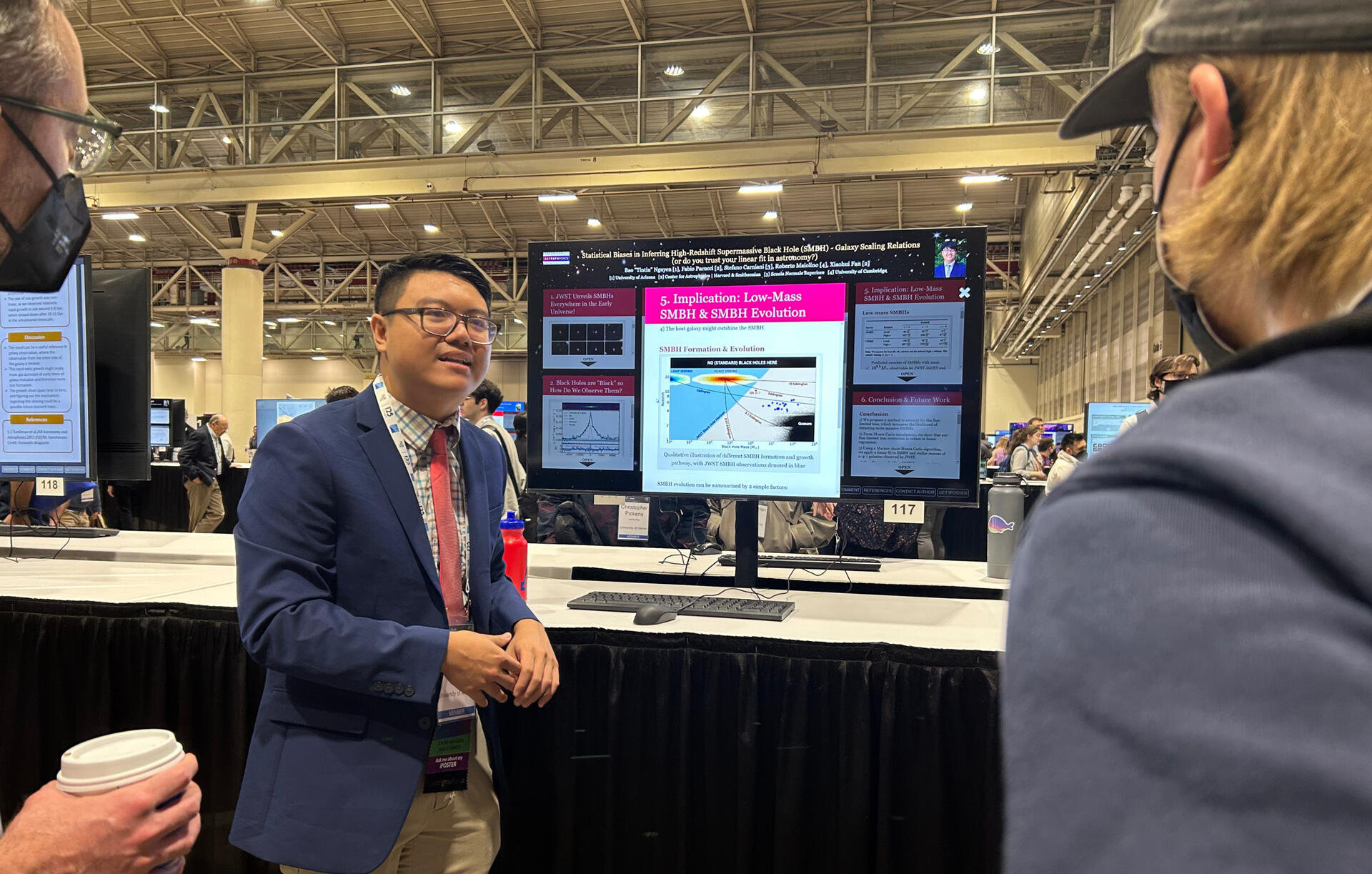
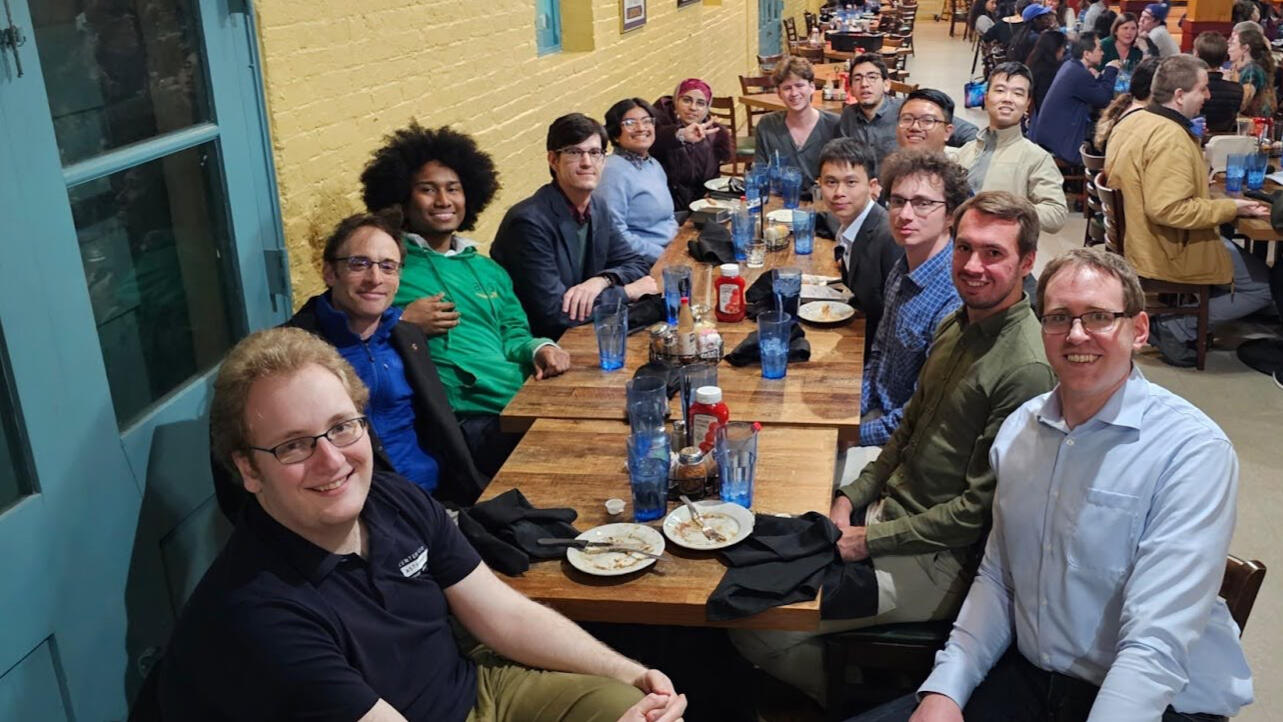
My first AAS Meeting & poster @ New Orleans (1/7-1/12/2024)
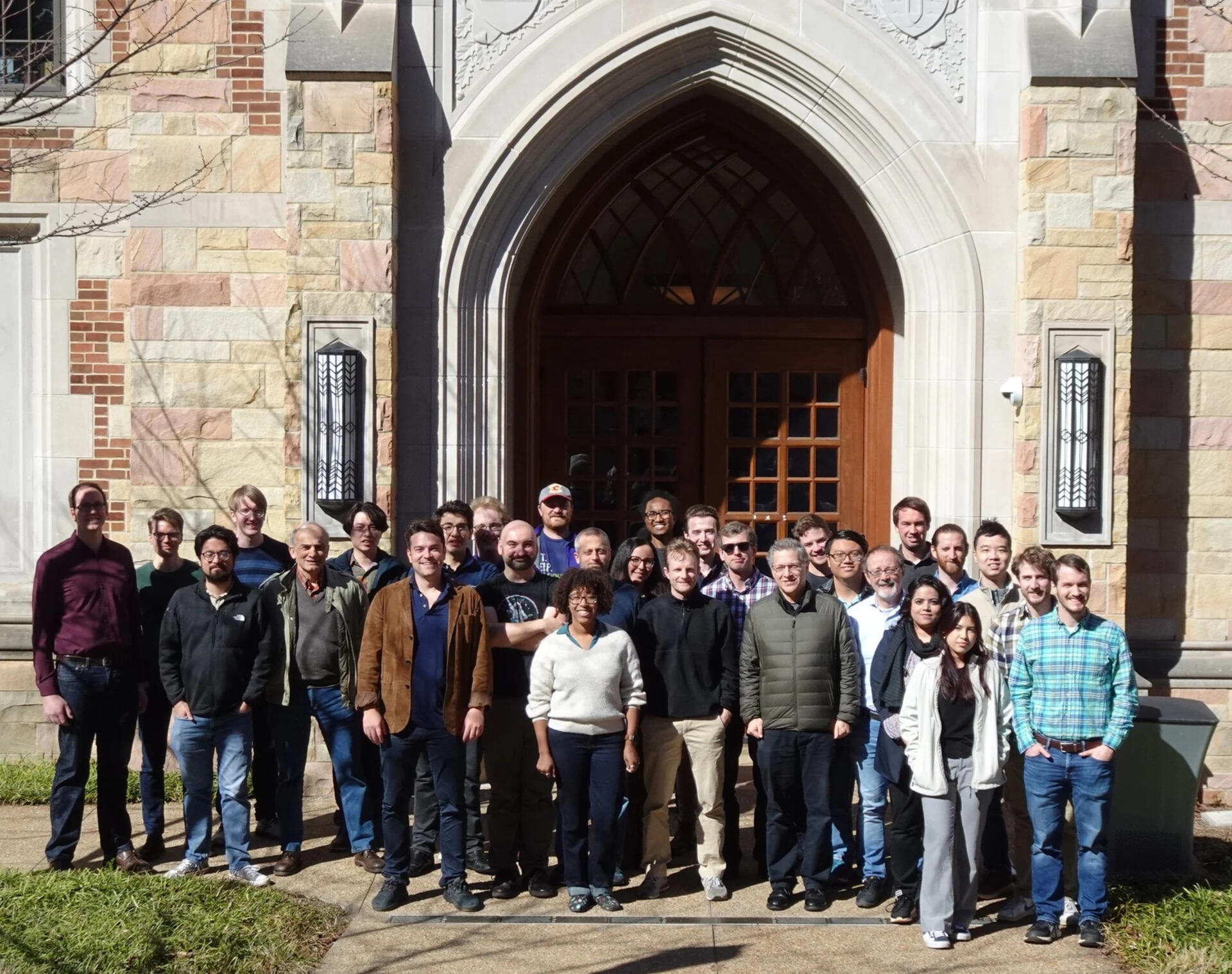
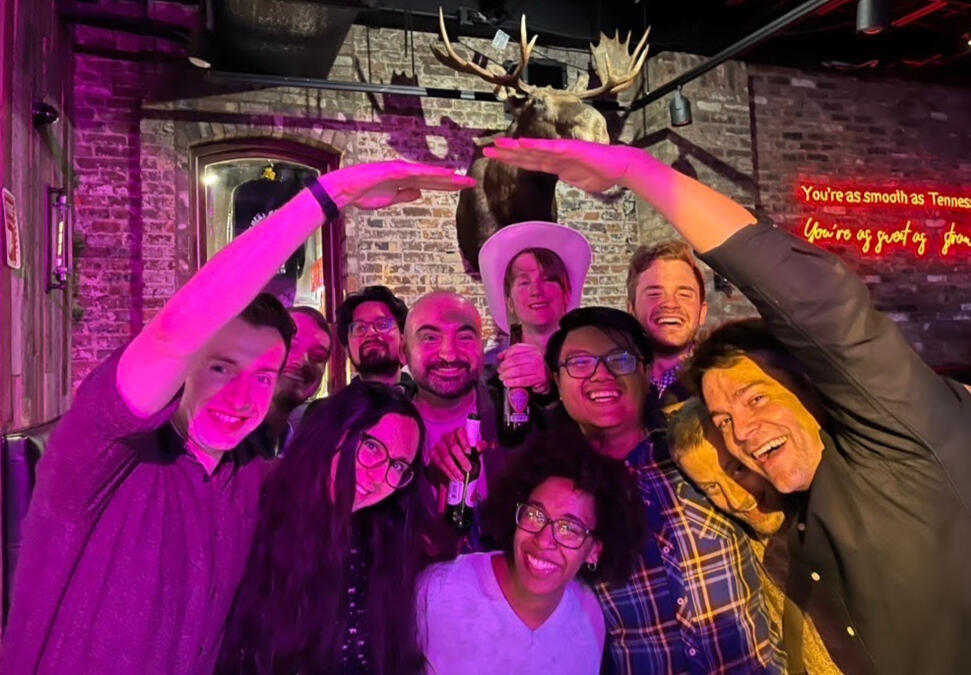
BHEX Photon Ring Science Workshop @ Vanderbilt (2/12-2/16/2024)
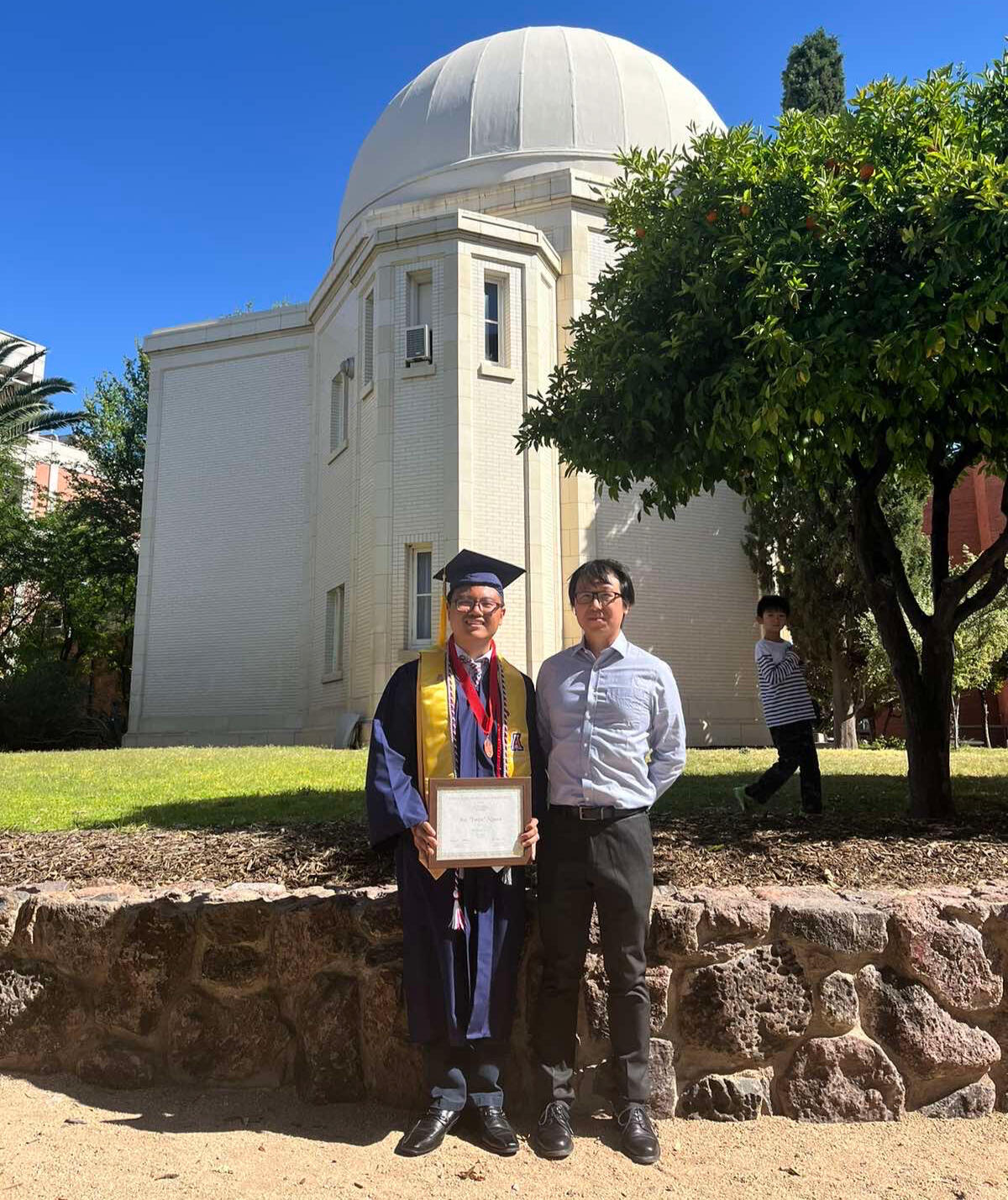
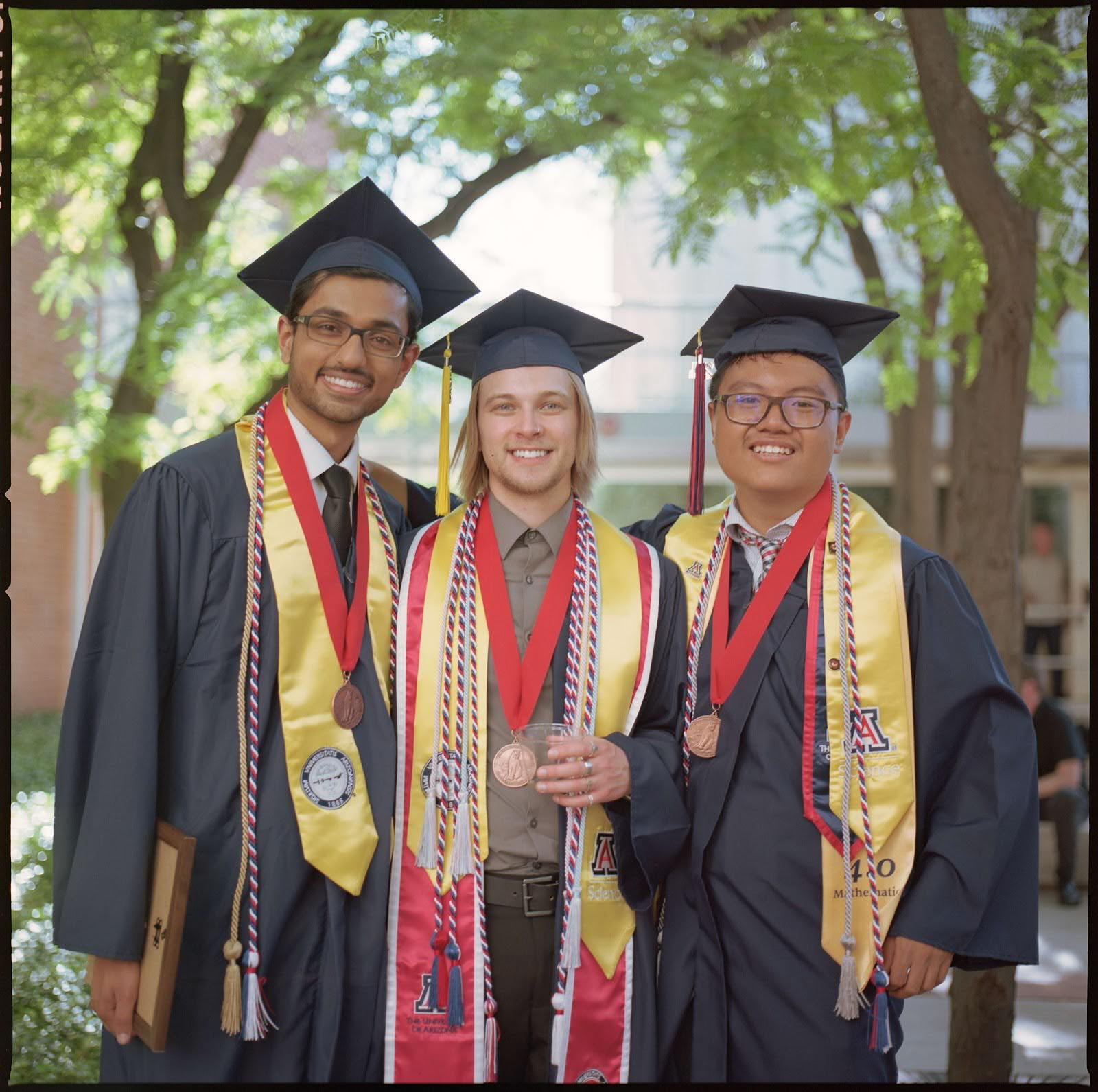
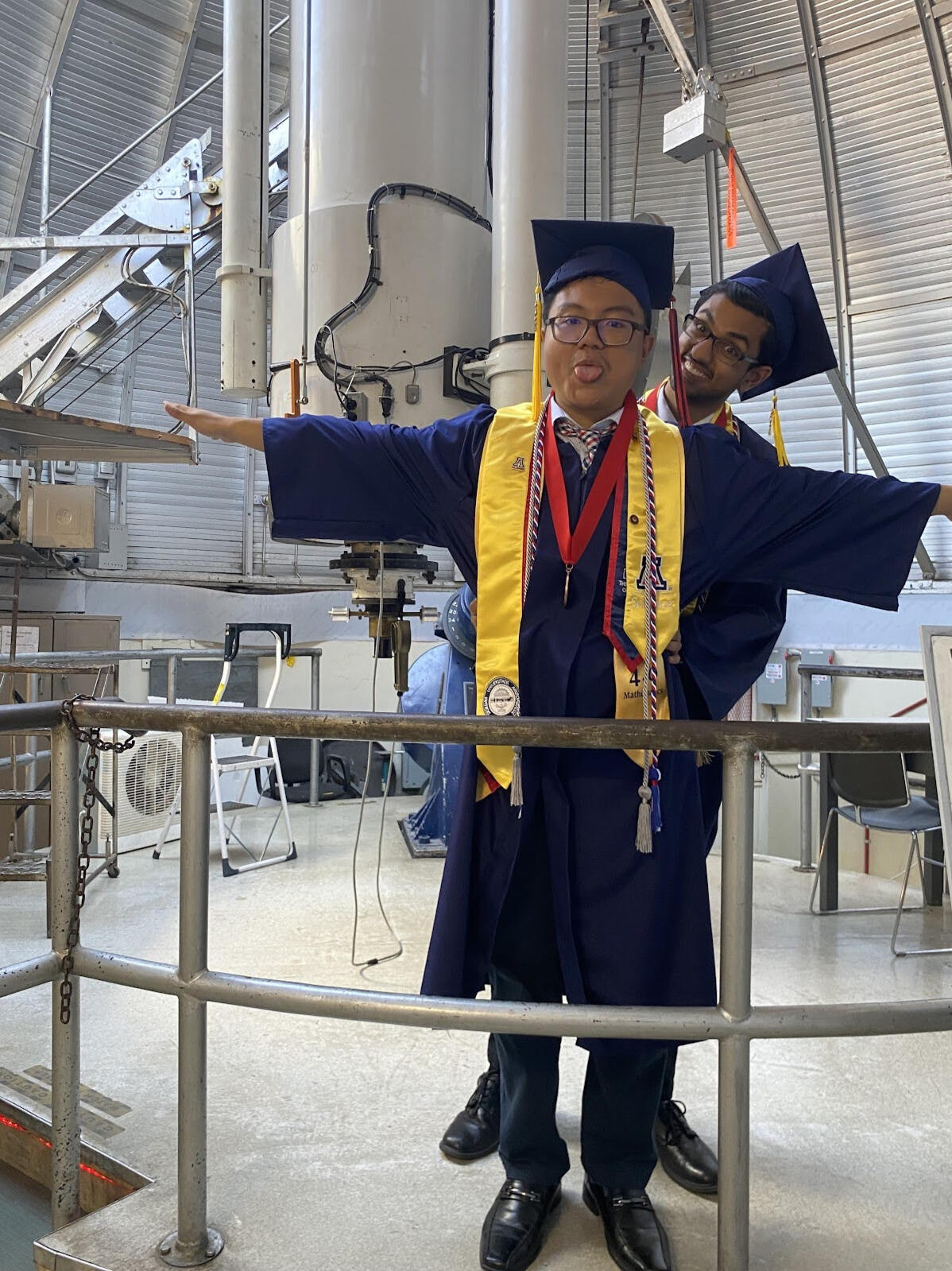
U. Arizona Astronomy Graduation (5/9/2024)
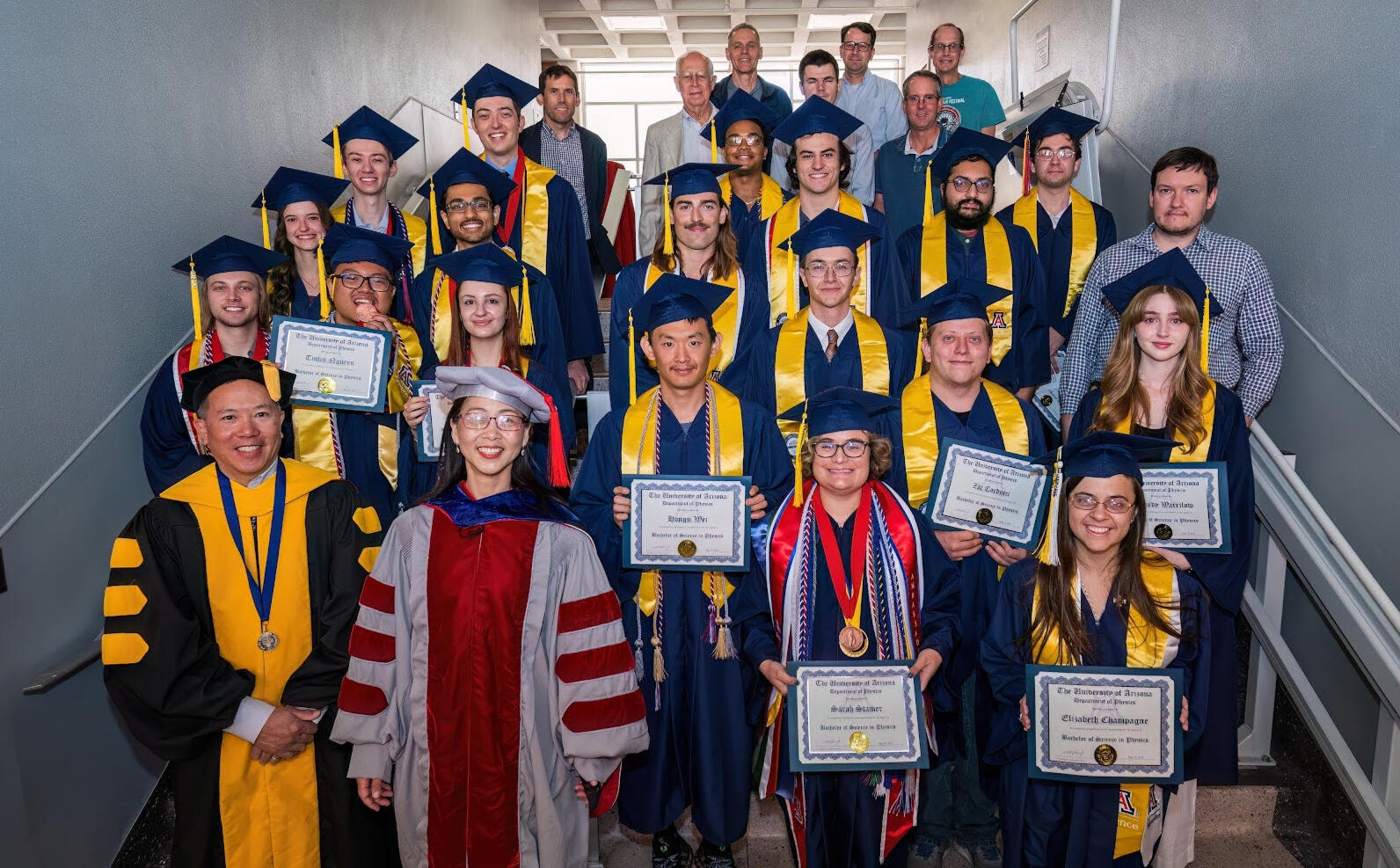
U. Arizona Physics Graduation (5/10/2024)
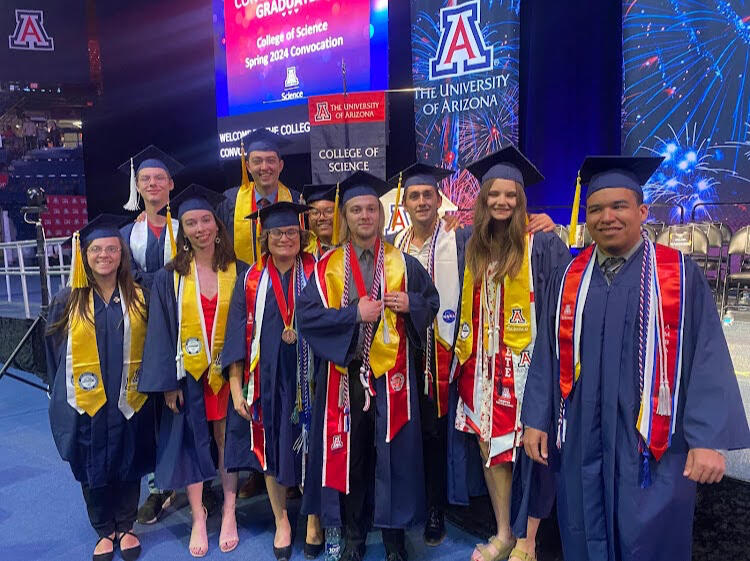
U. Arizona College of Science, with Astronomy majors (5/10/2024)
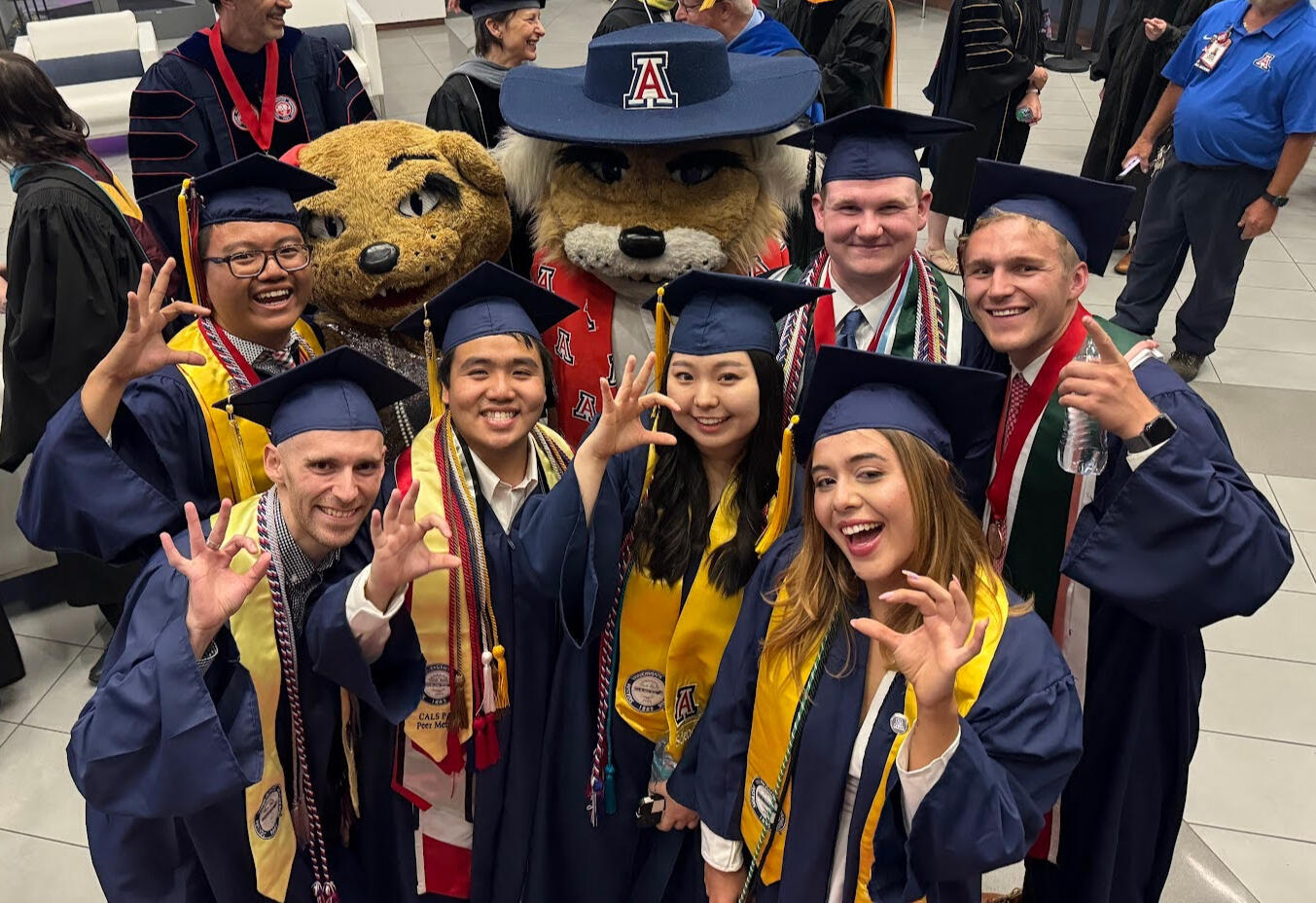
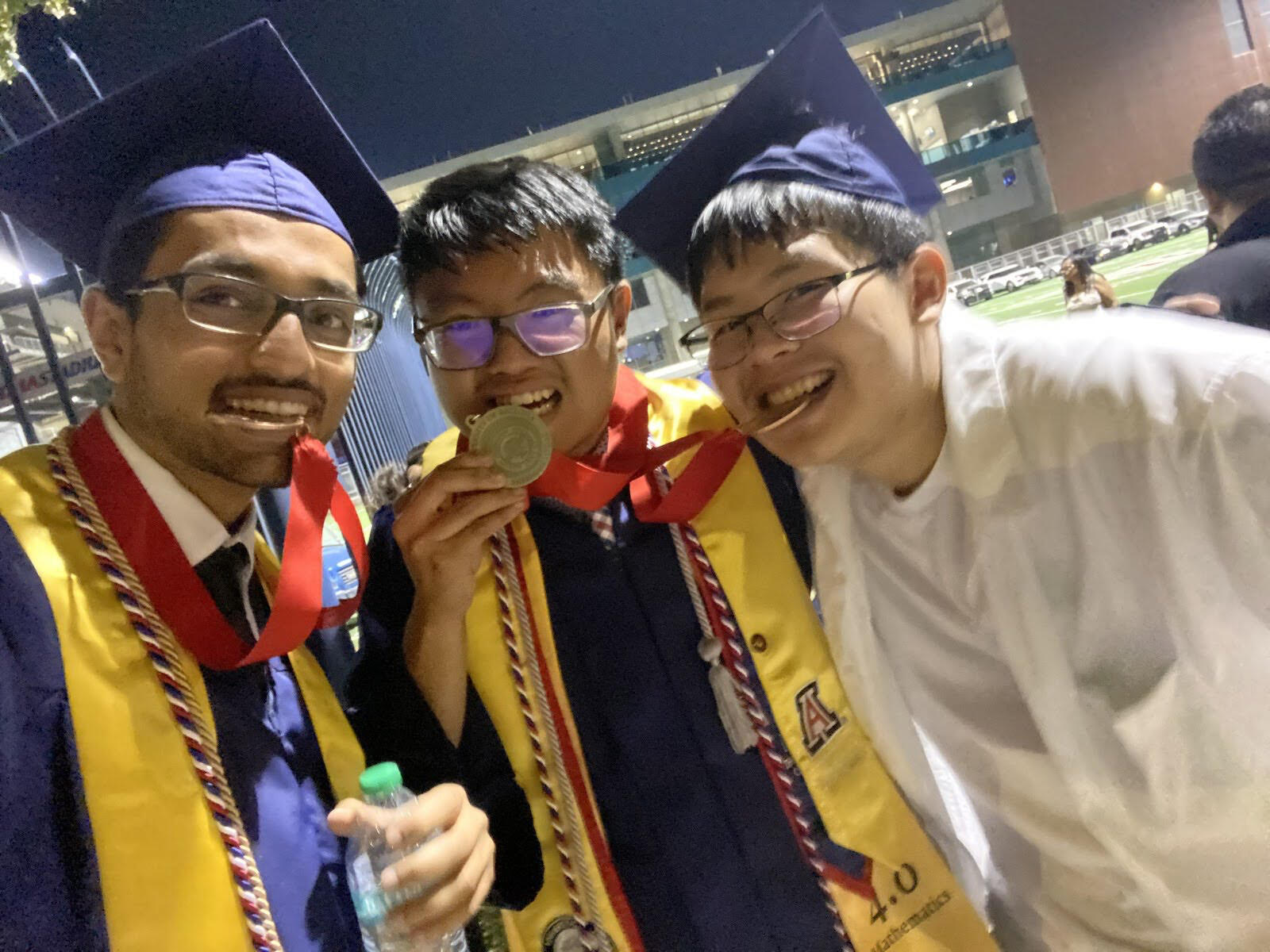
U. Arizona Commencement (5/10/2024)
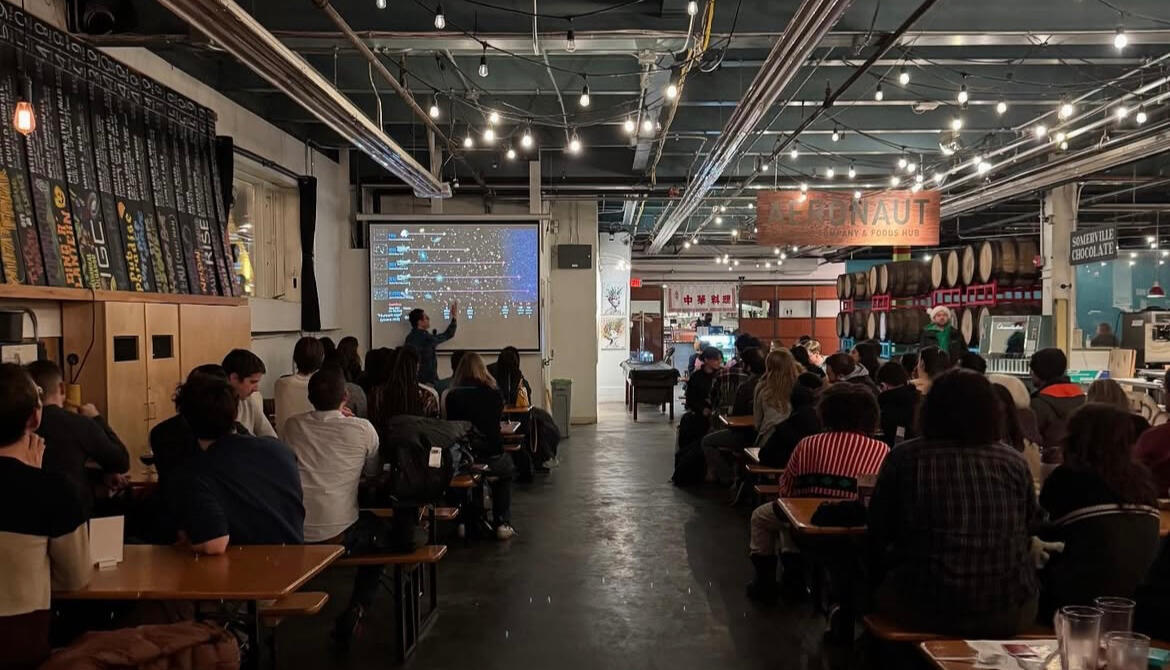
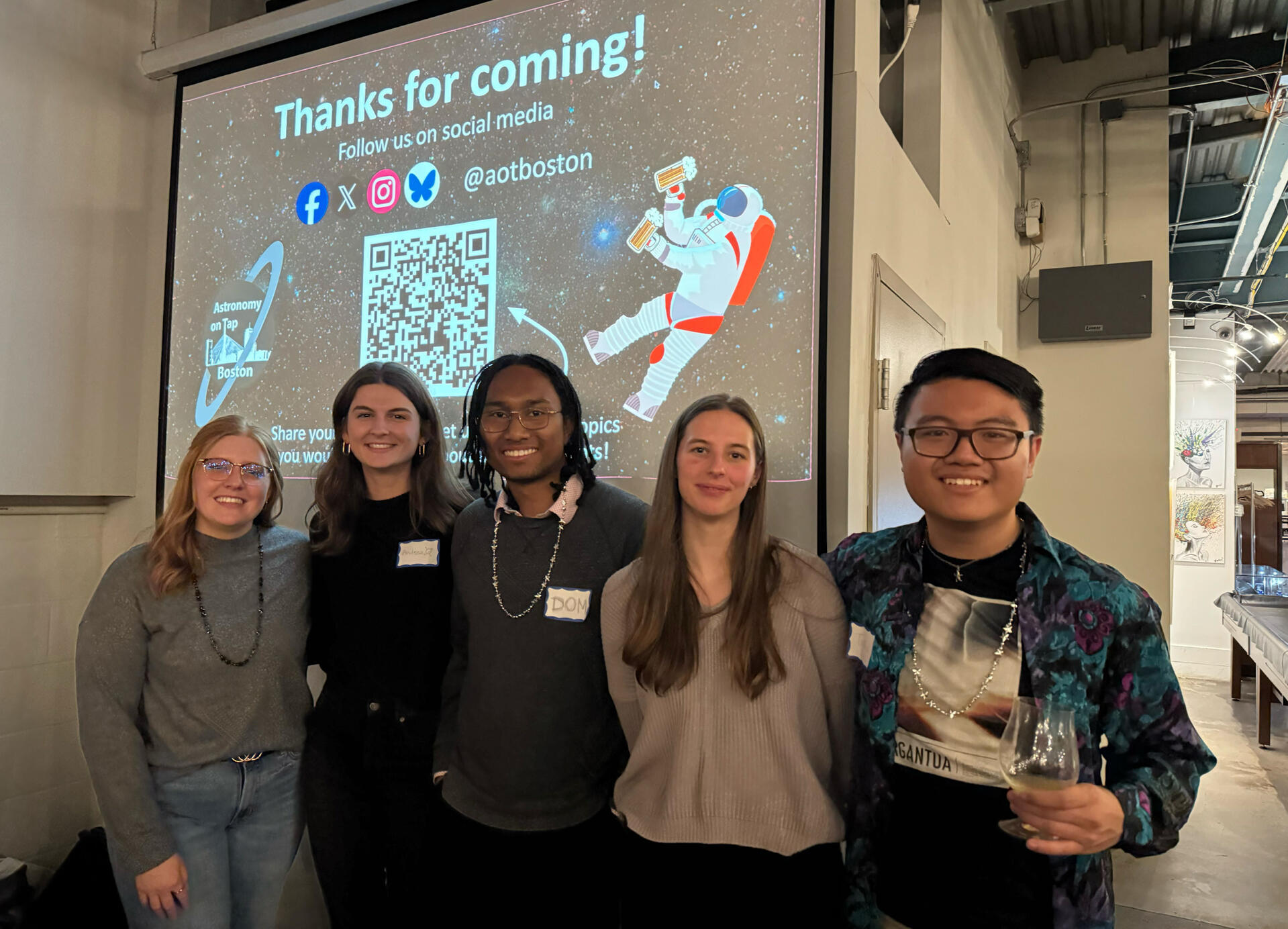
My first time organizing Astronomy on Tap Boston (12/14/2024)
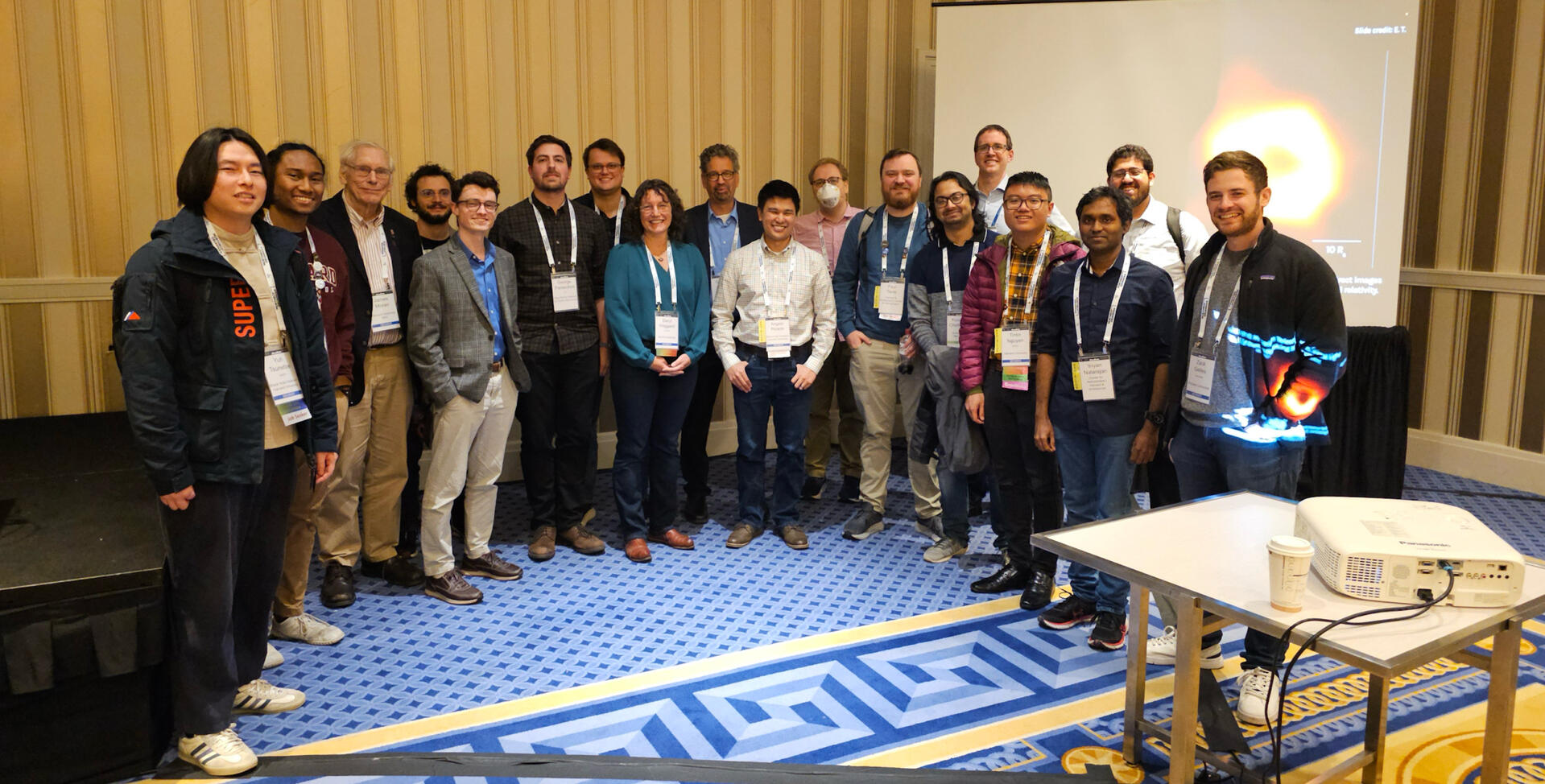
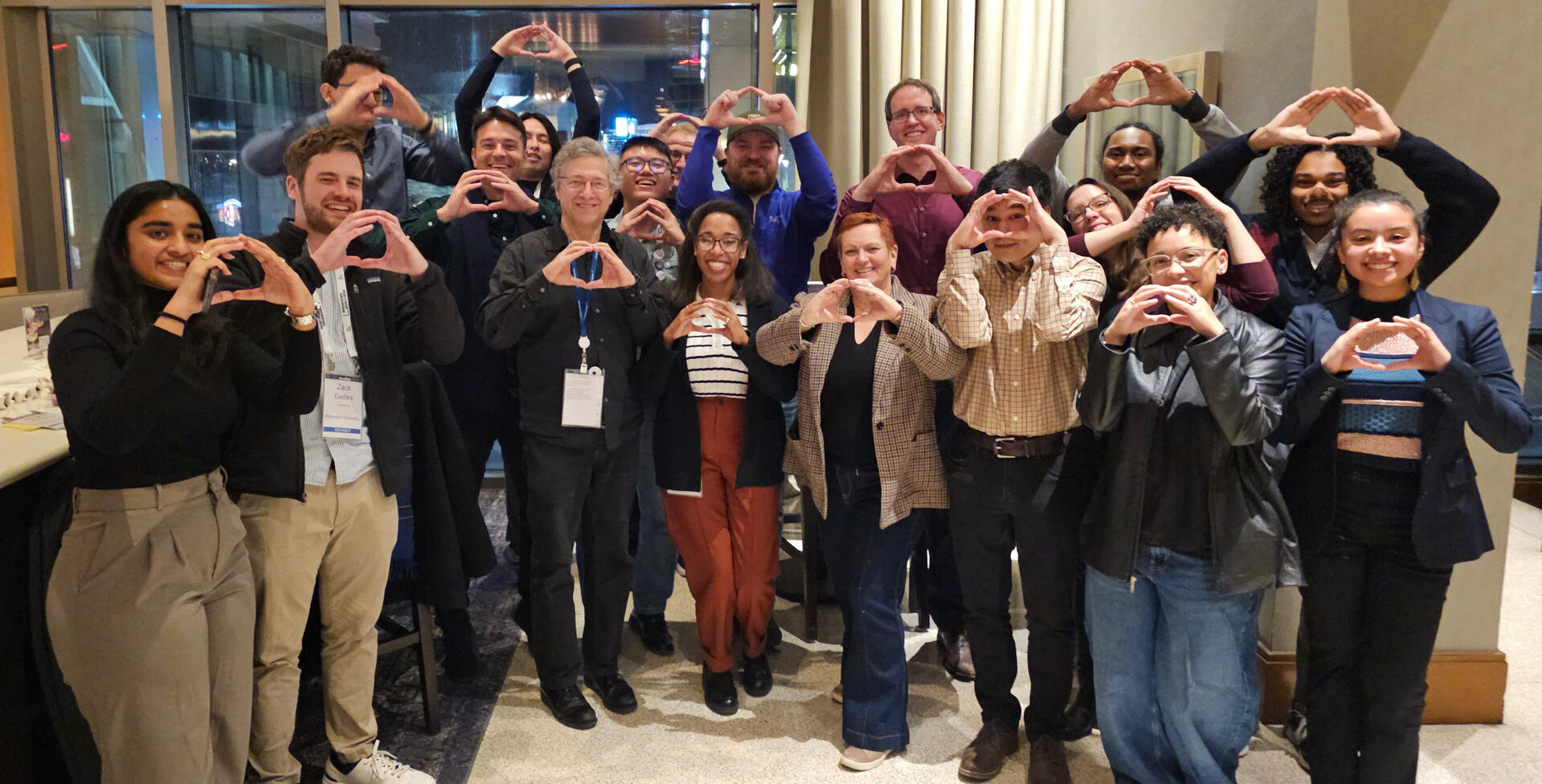
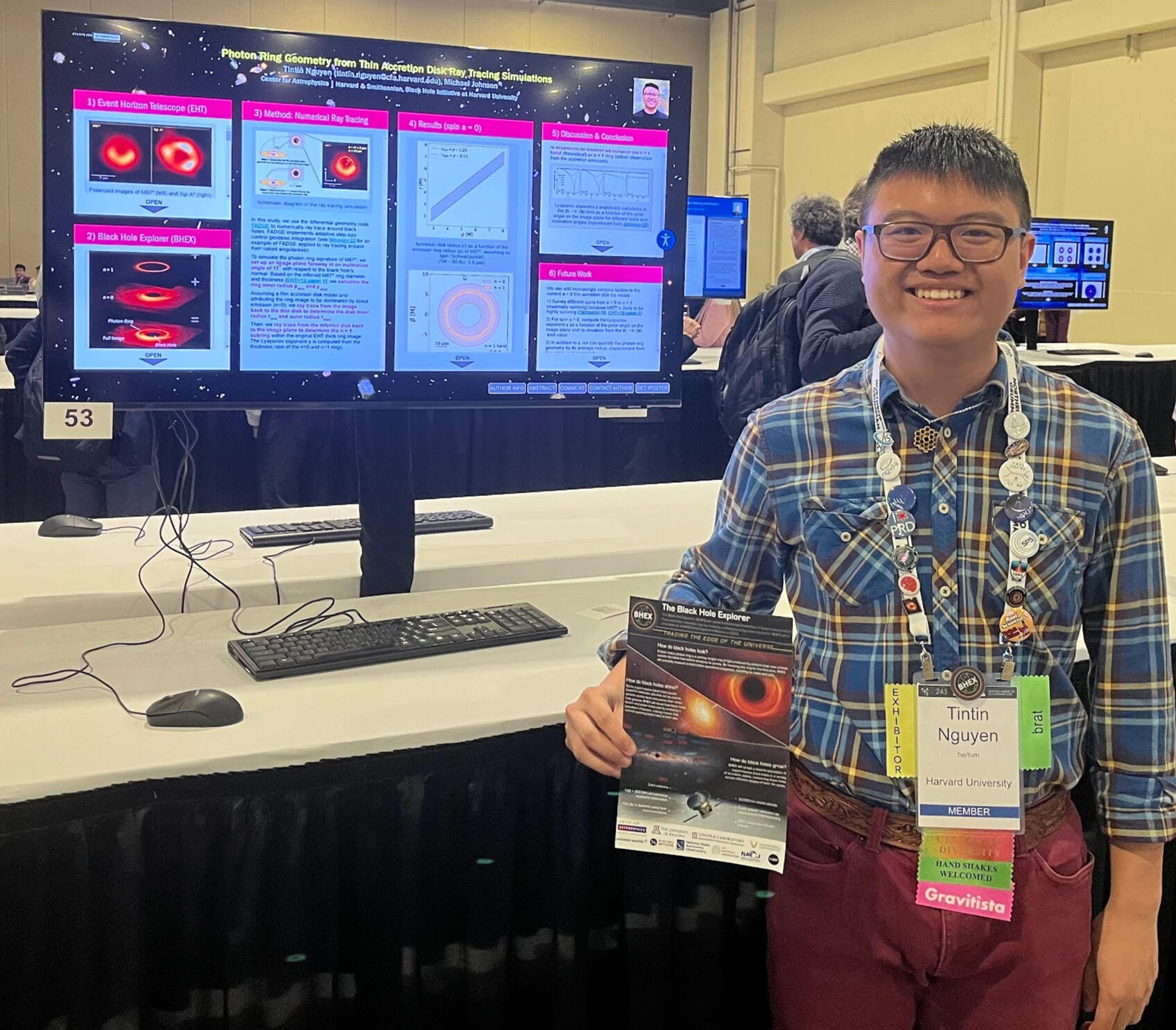
AAS Meeting & poster @ National Harbor, MD (1/12-1/16/2025)
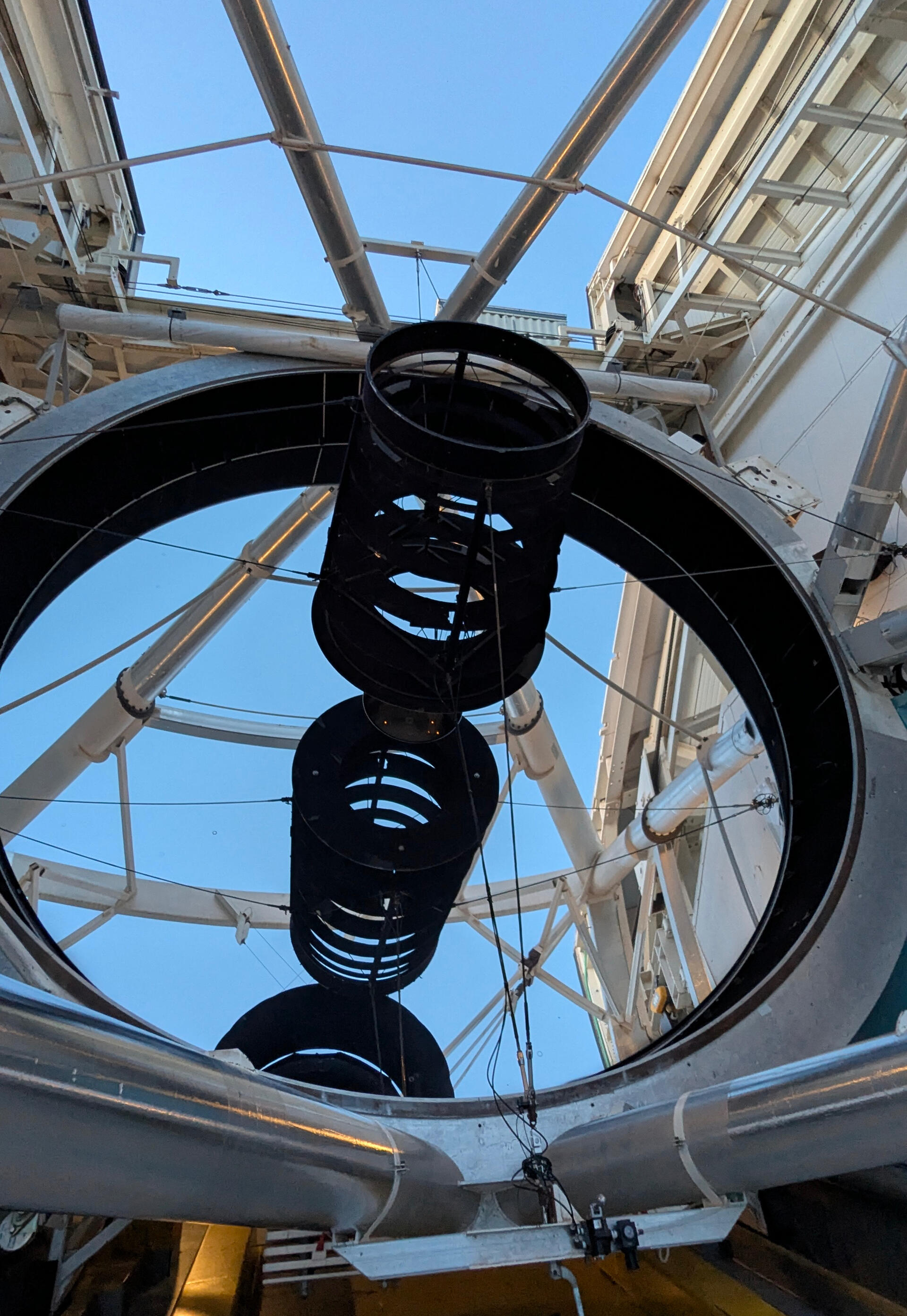
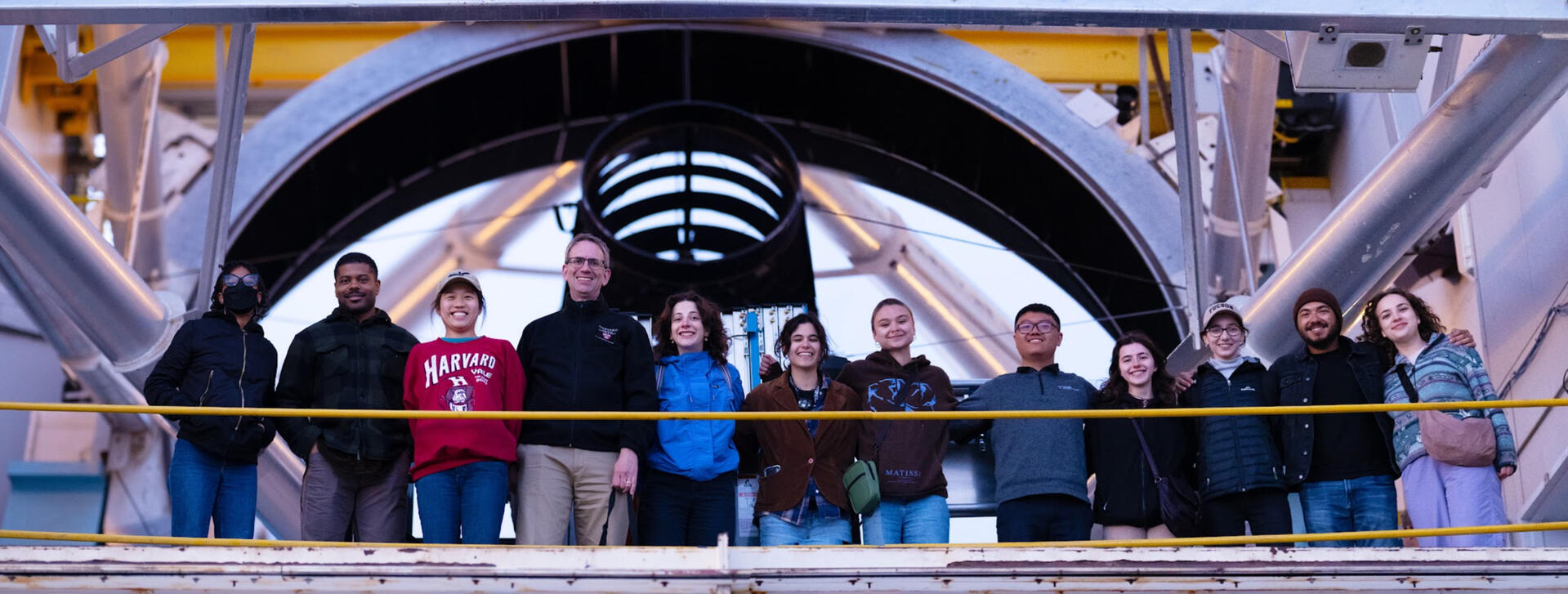
MMT Observatory @ Mt. Hopkins, AZ during Observational Astronomy class trip (5/18/2025)
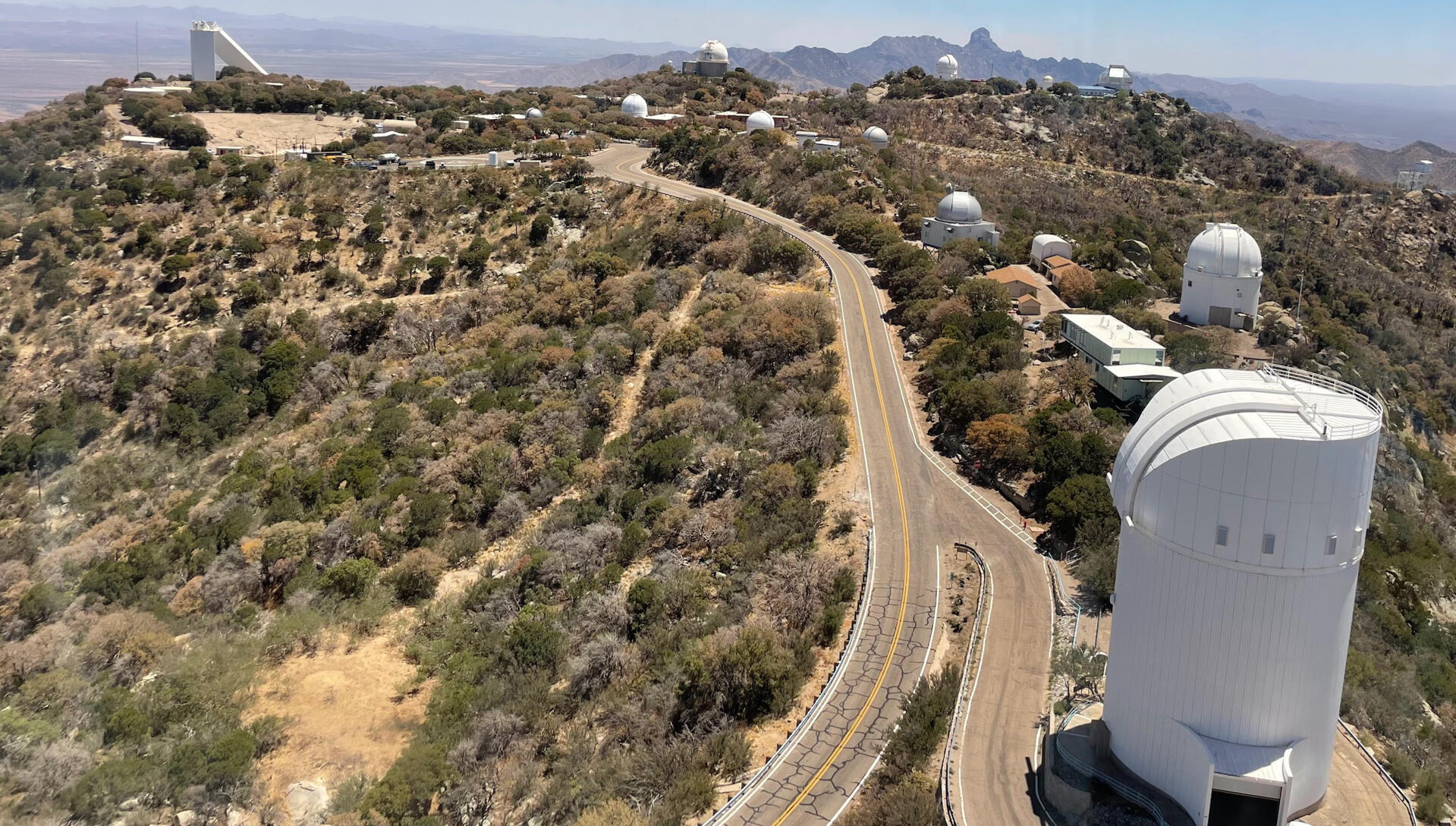
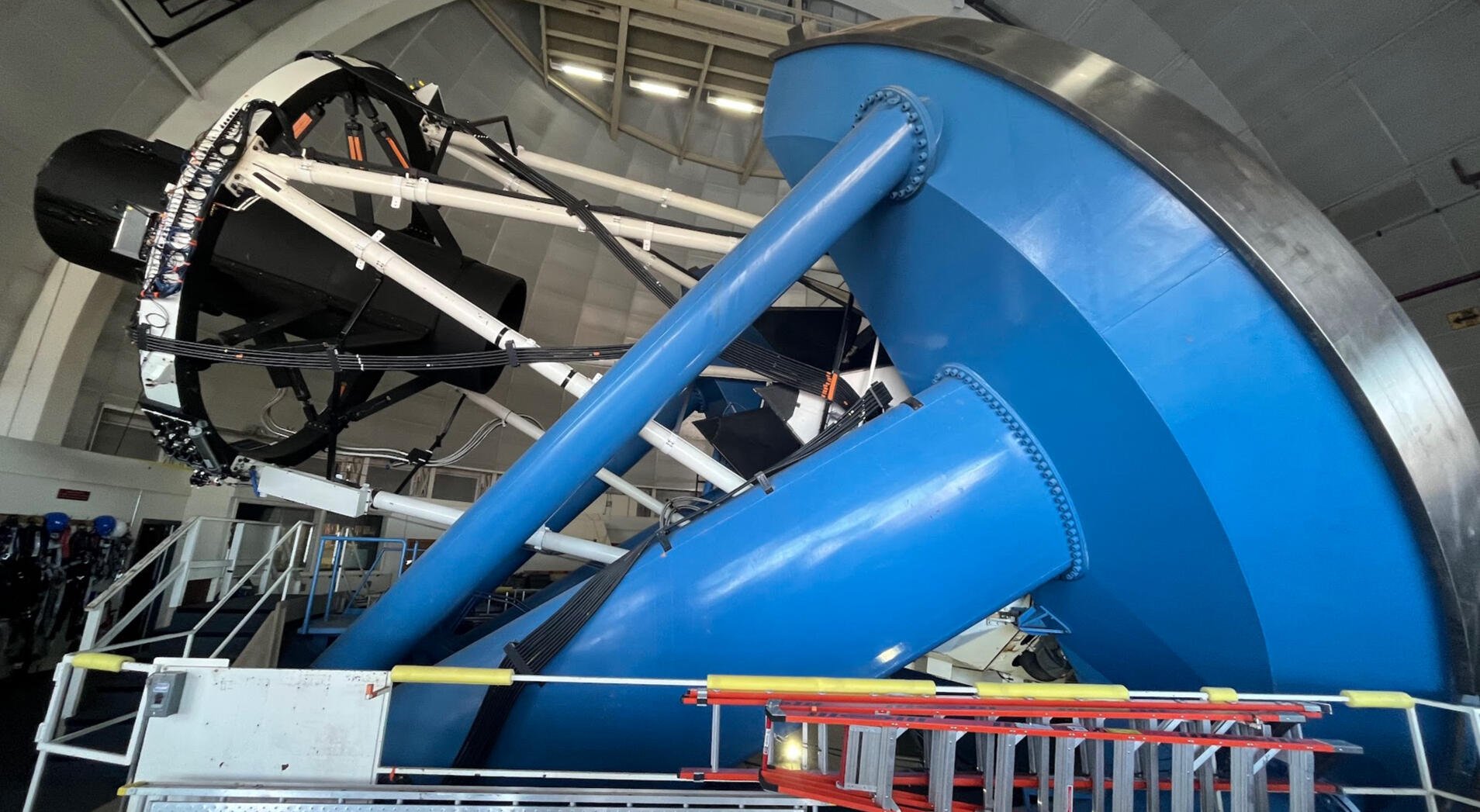
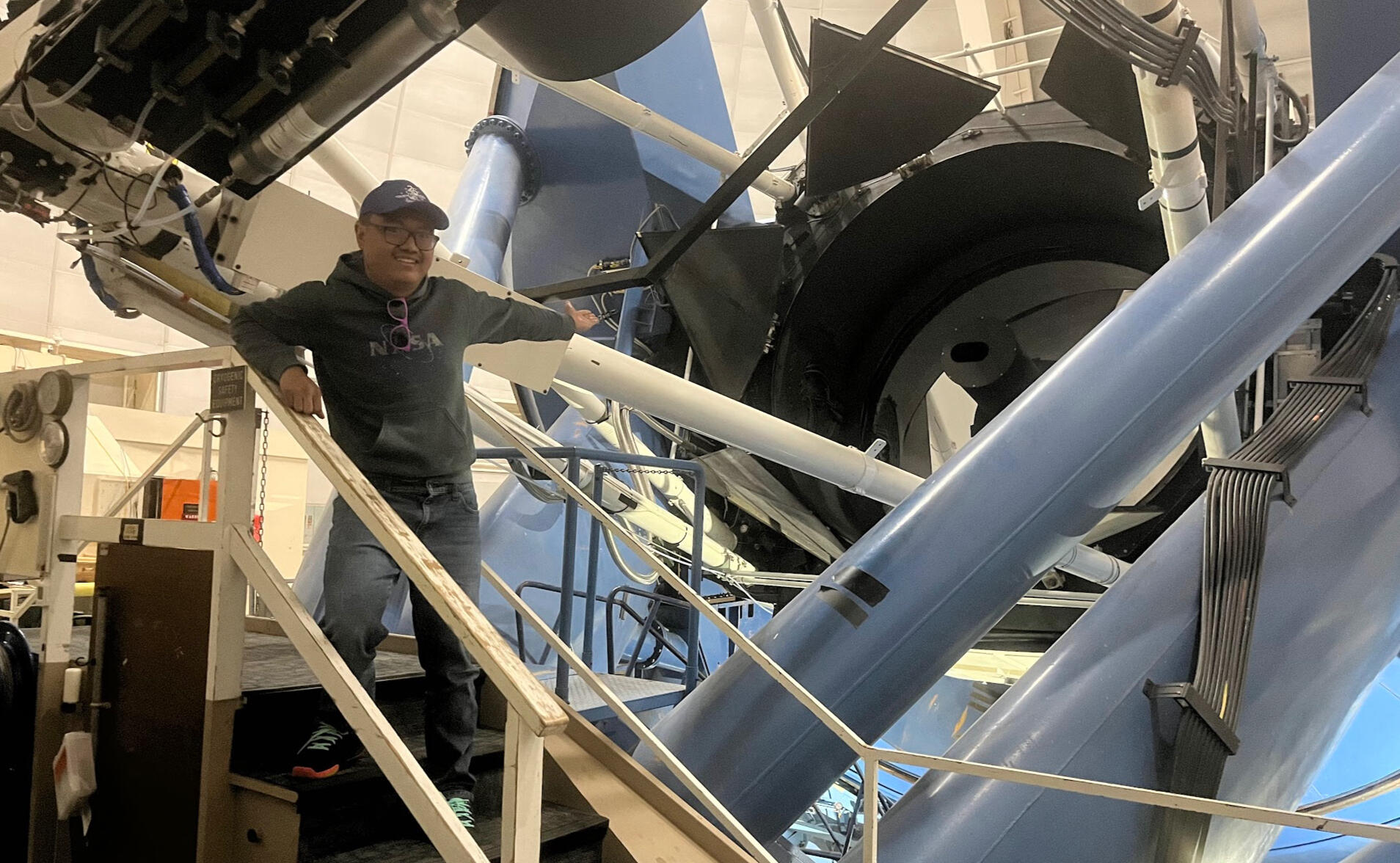
Mayall 4m Telescope, the host of DESI @ Kitt Peak, AZ (5/22/2025)
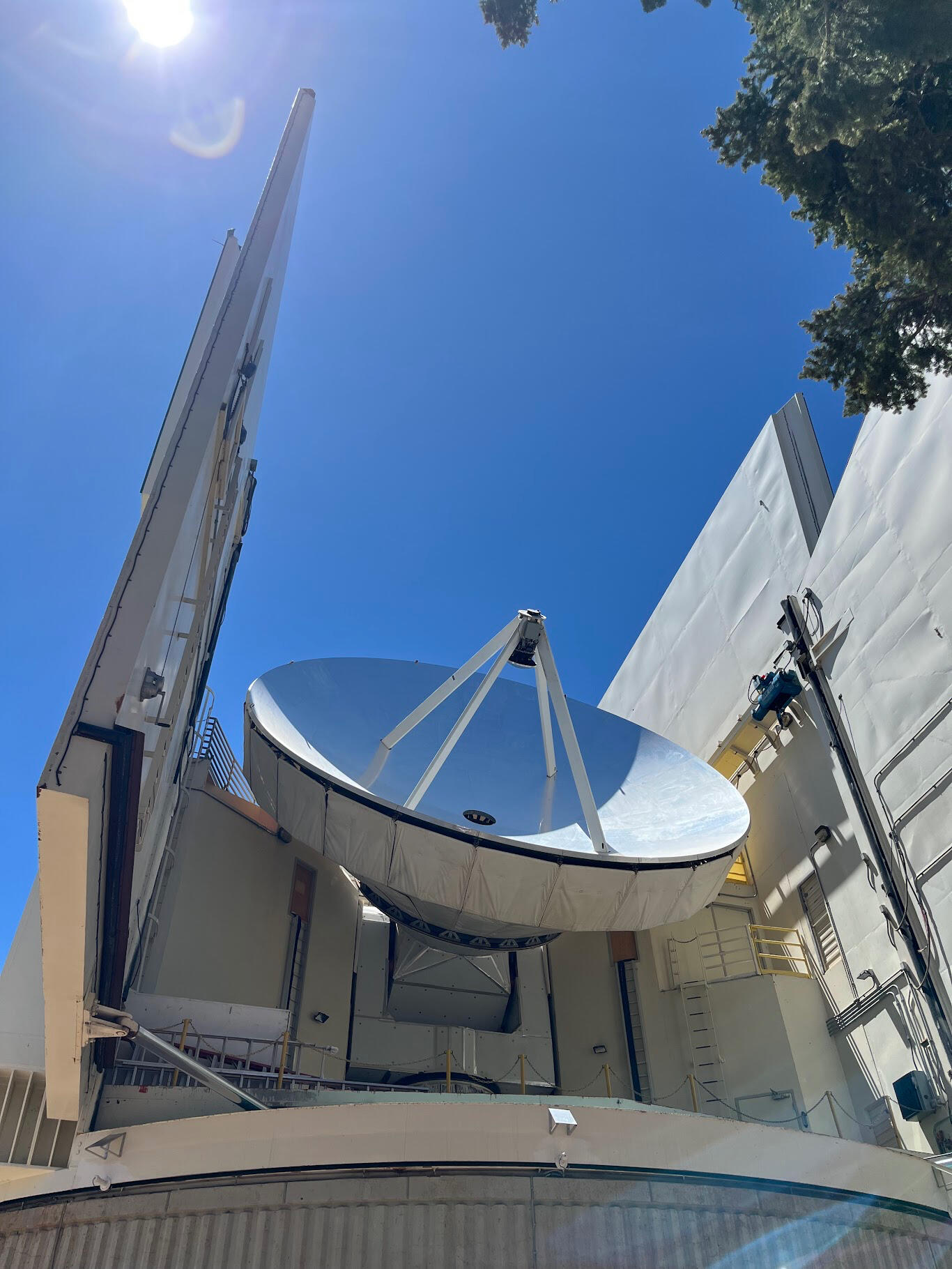
Submillimeter Telescope (SMT) @ Mt. Graham, AZ (5/23/2025)
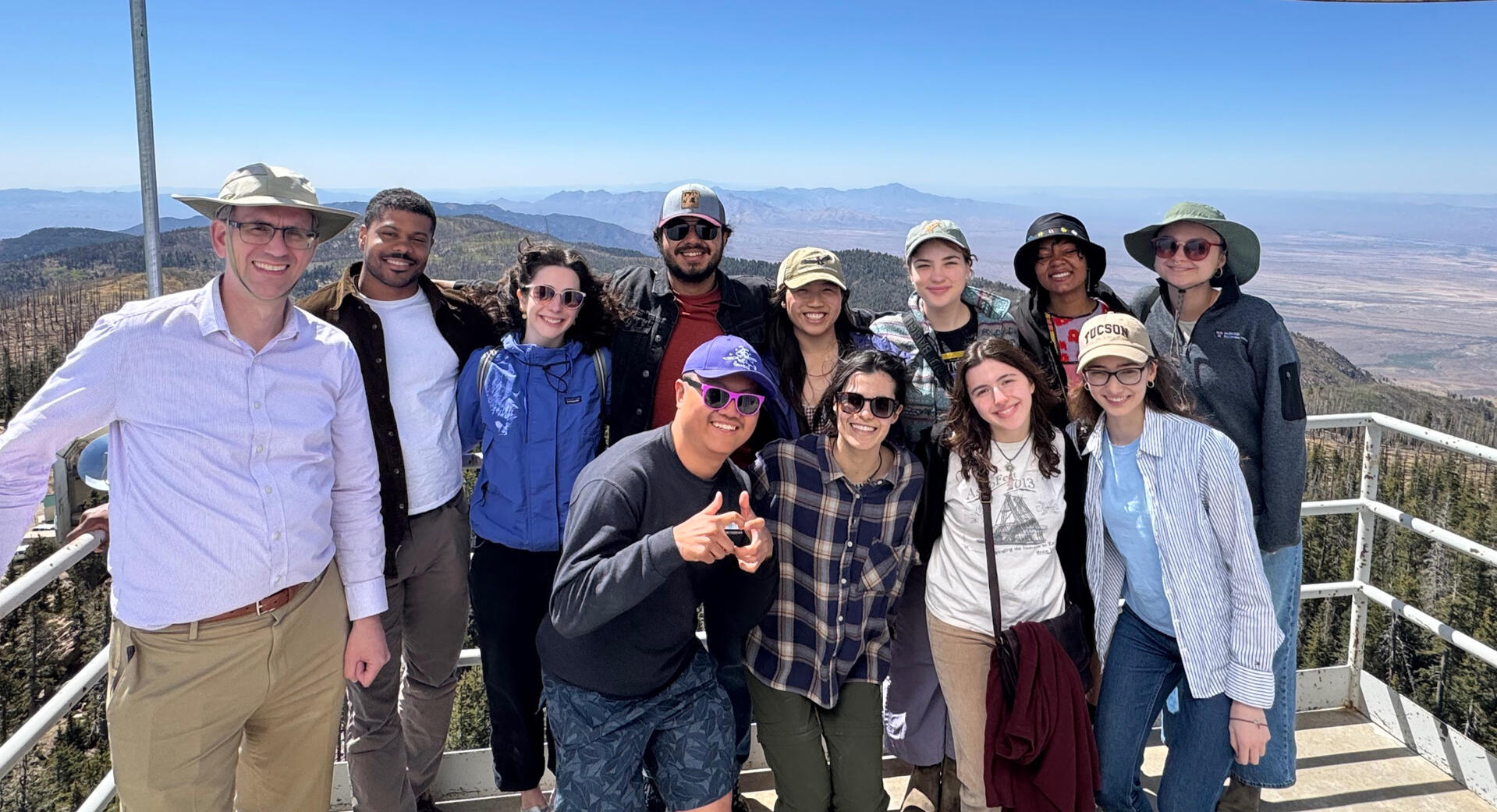
Taken outside the Large Binocular Telescope (LBT) @ Mt. Graham, AZ (5/23/2025)
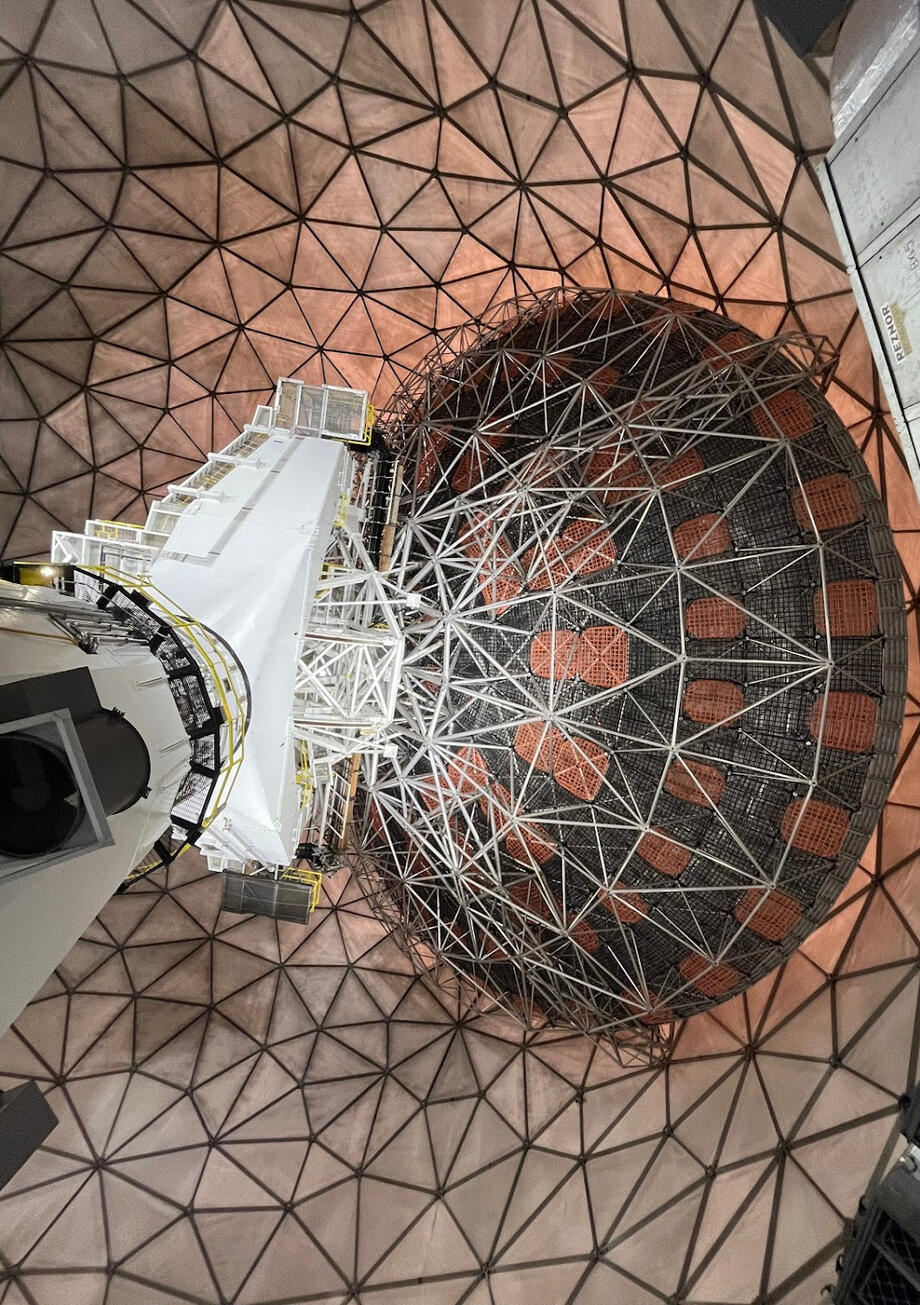
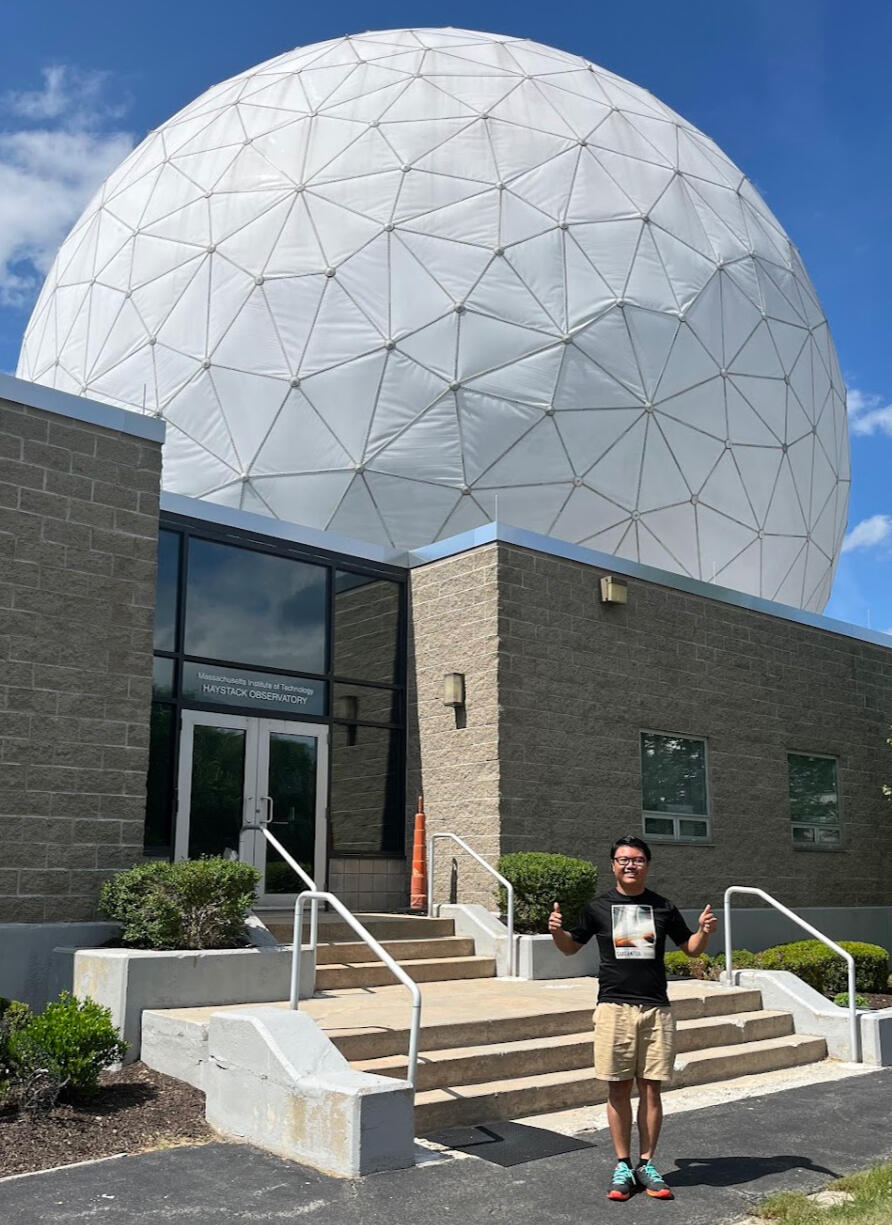
MIT Haystack Observatory in Westford, MA (7/1/2025)
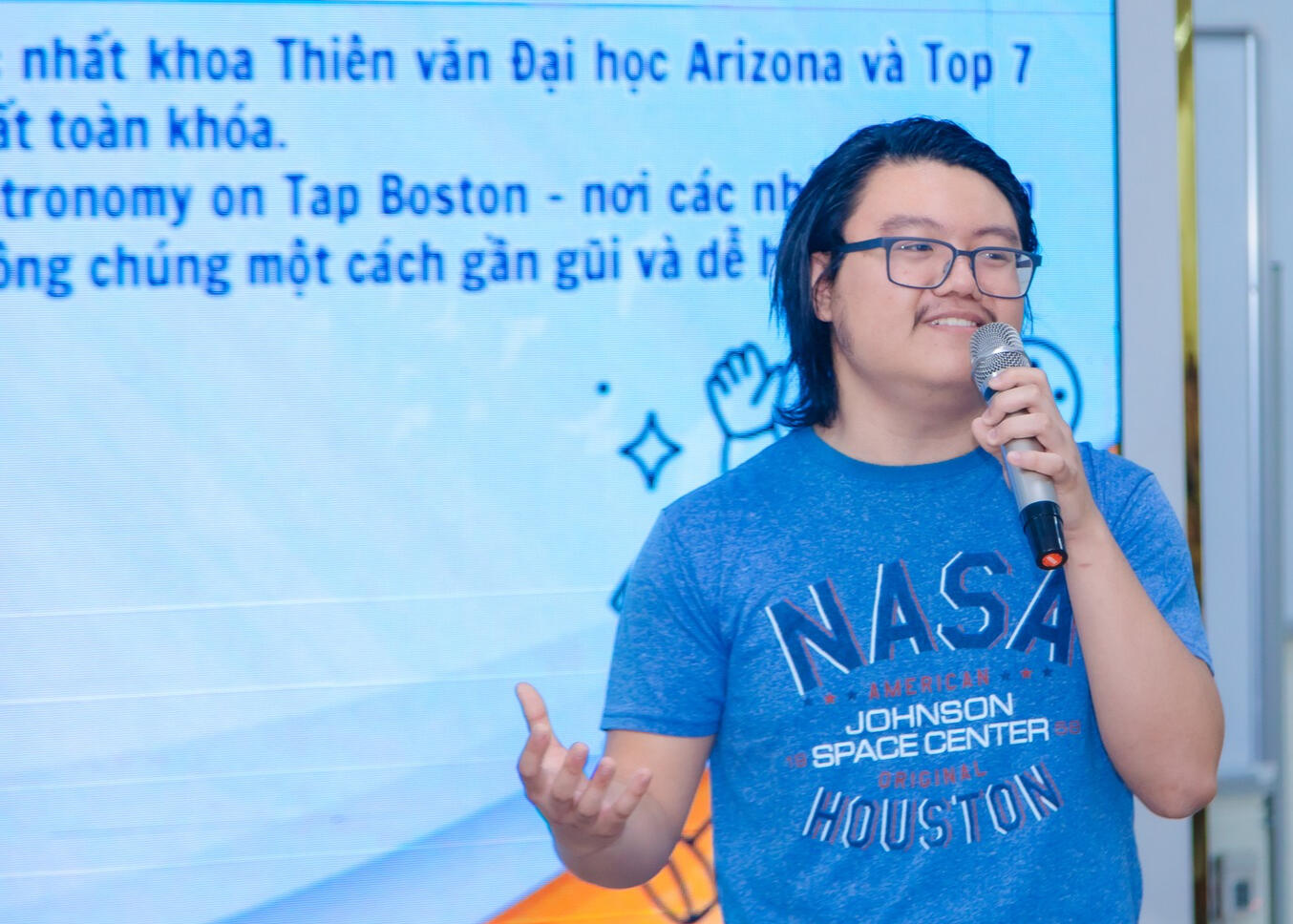
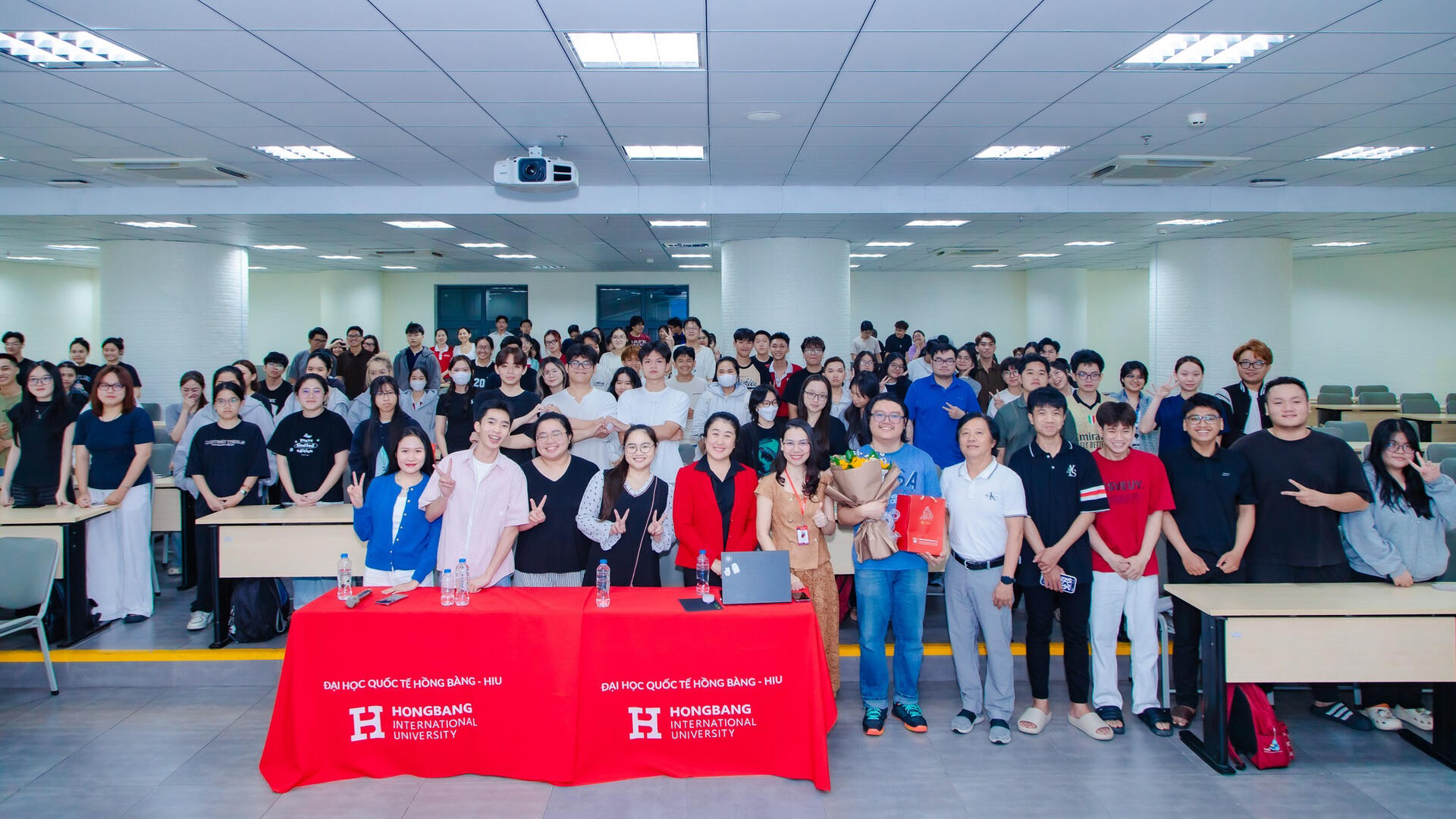
Sharing my studying abroad and scientific research journey with Hồng Bàng International University students in Ho Chi Minh City (3/18/2026)
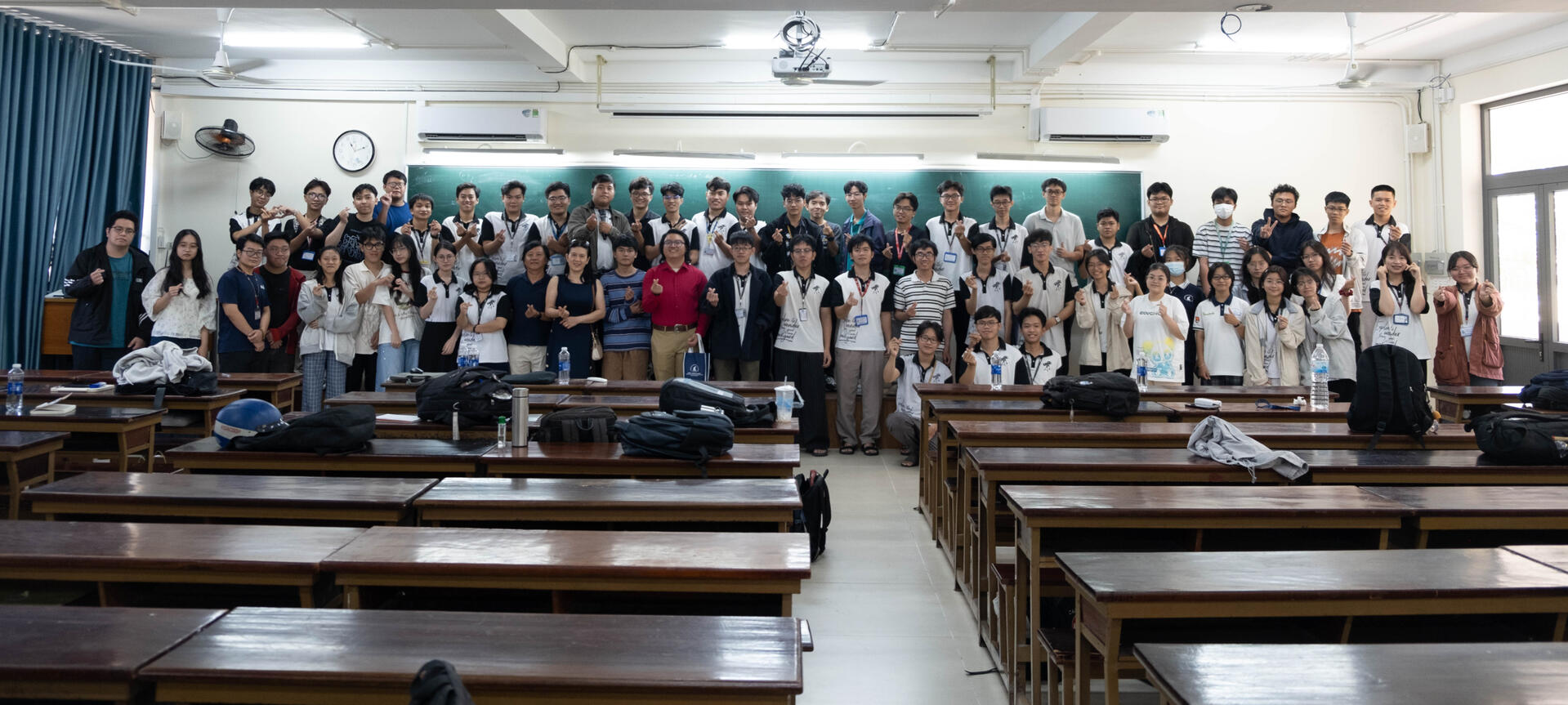
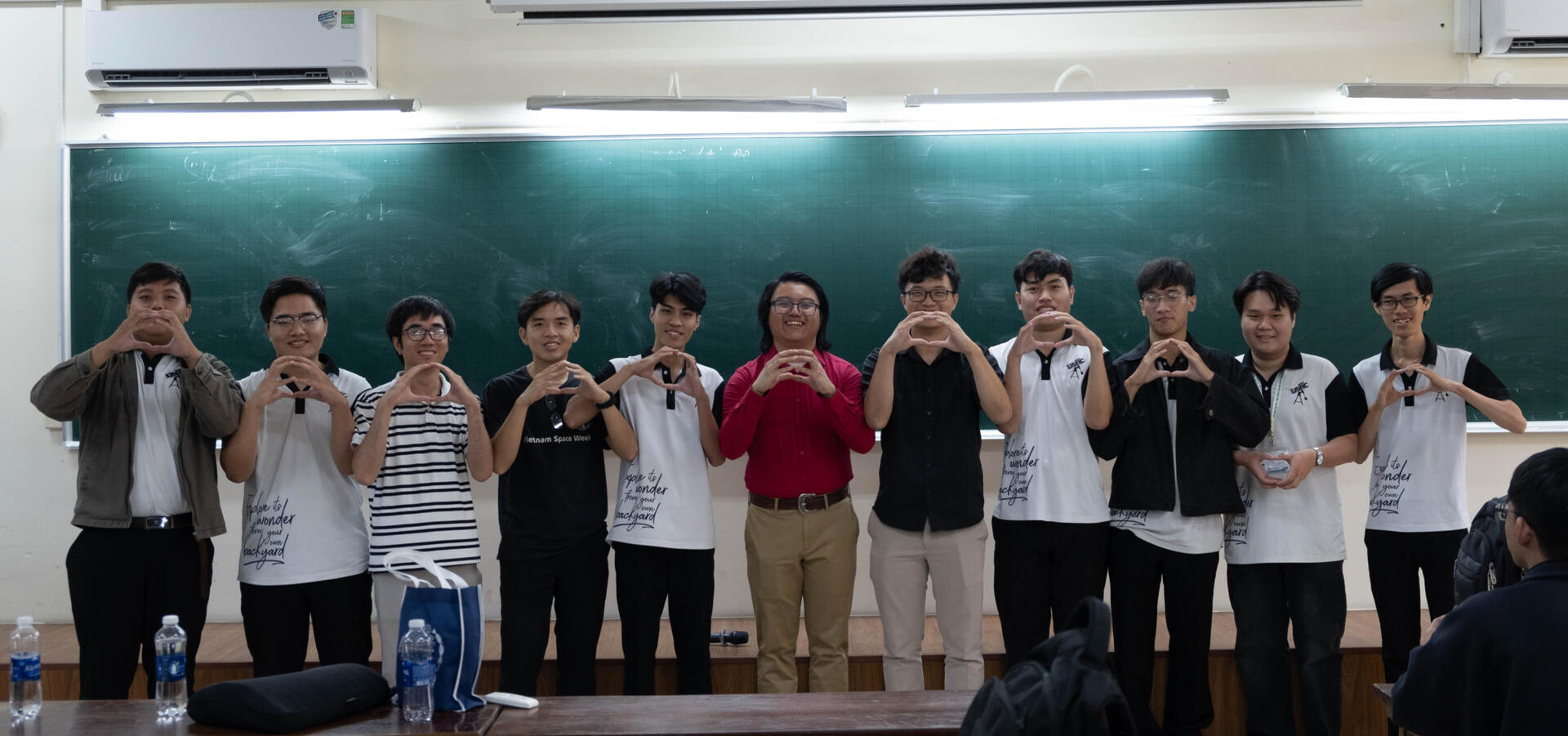
Vietnam National University - University of Science Astronomy seminar "Black Holes in Light and Gravity: A Multi-Messenger Story" (3/22/2026)
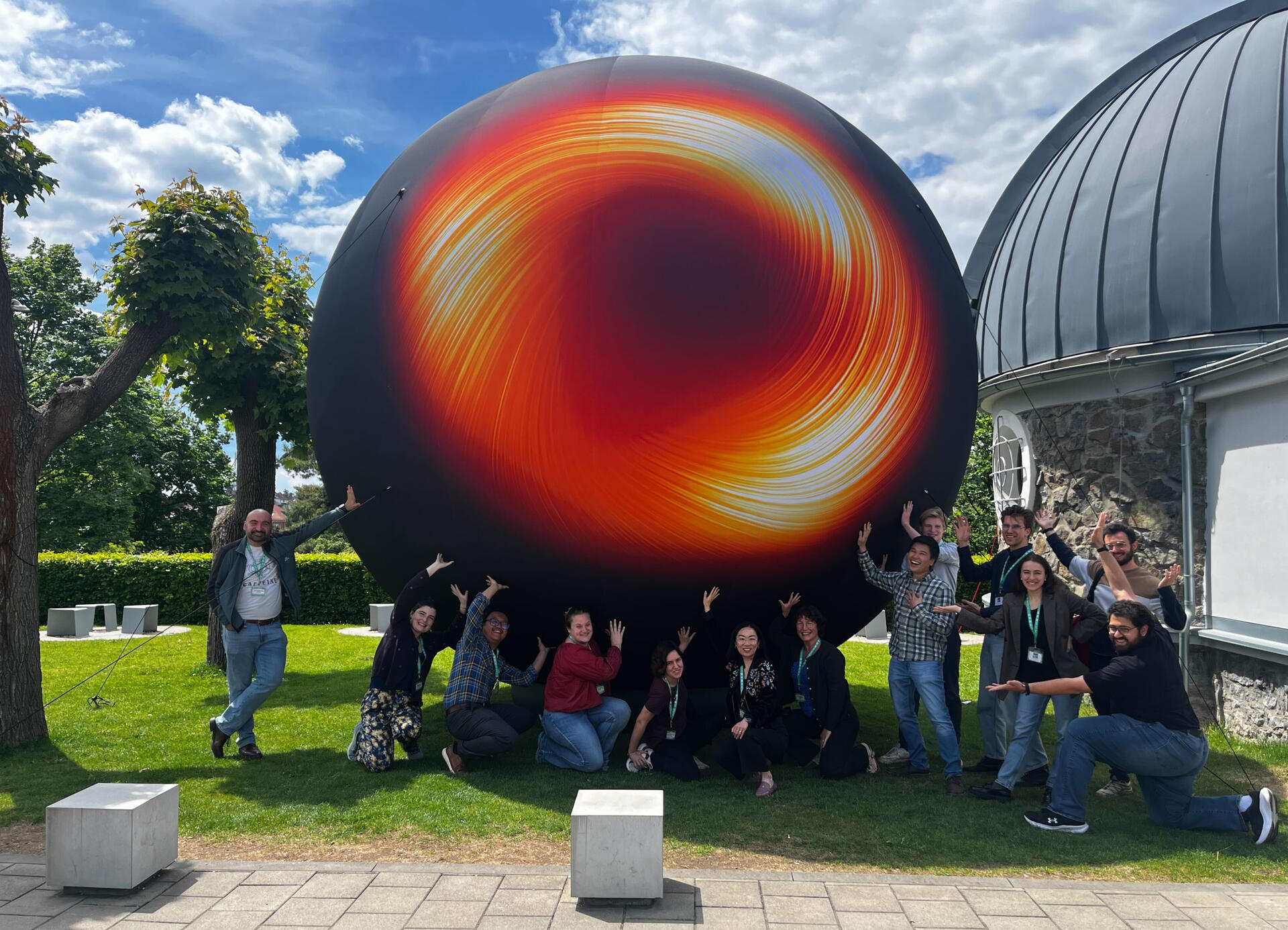
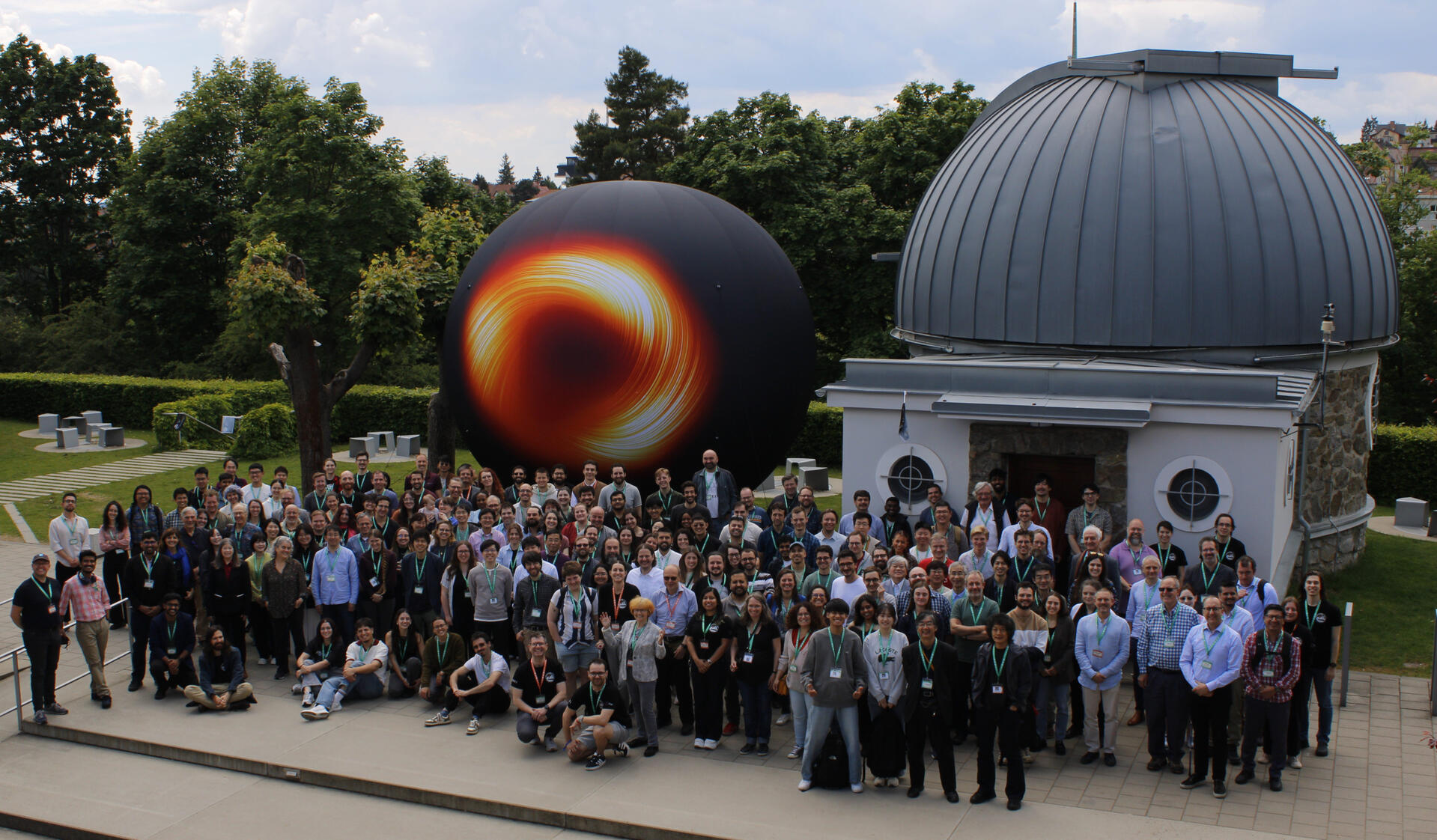
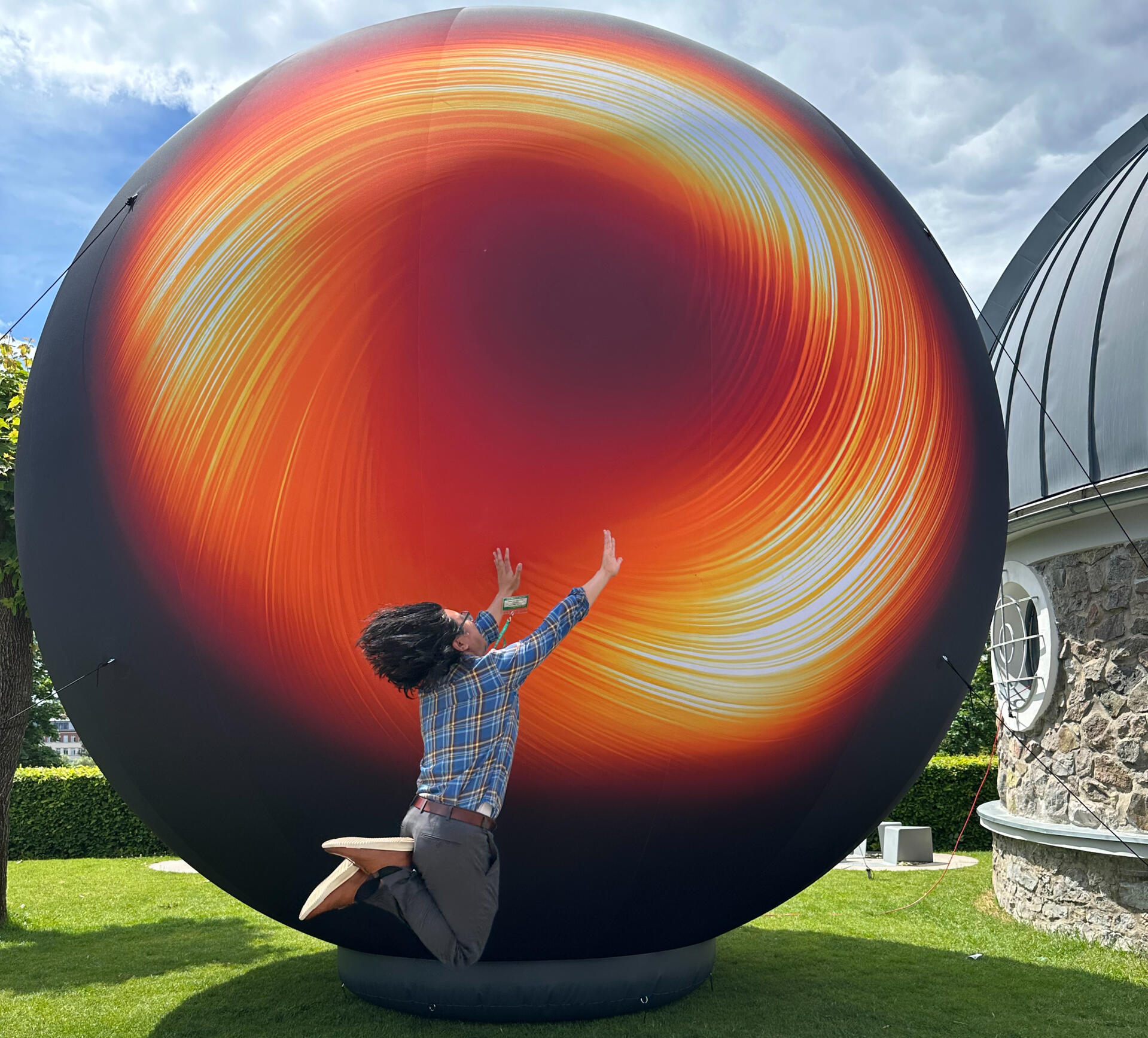
IAU Galactic Center Symposium at Brno, Czechia (5/18-5/22/2026)
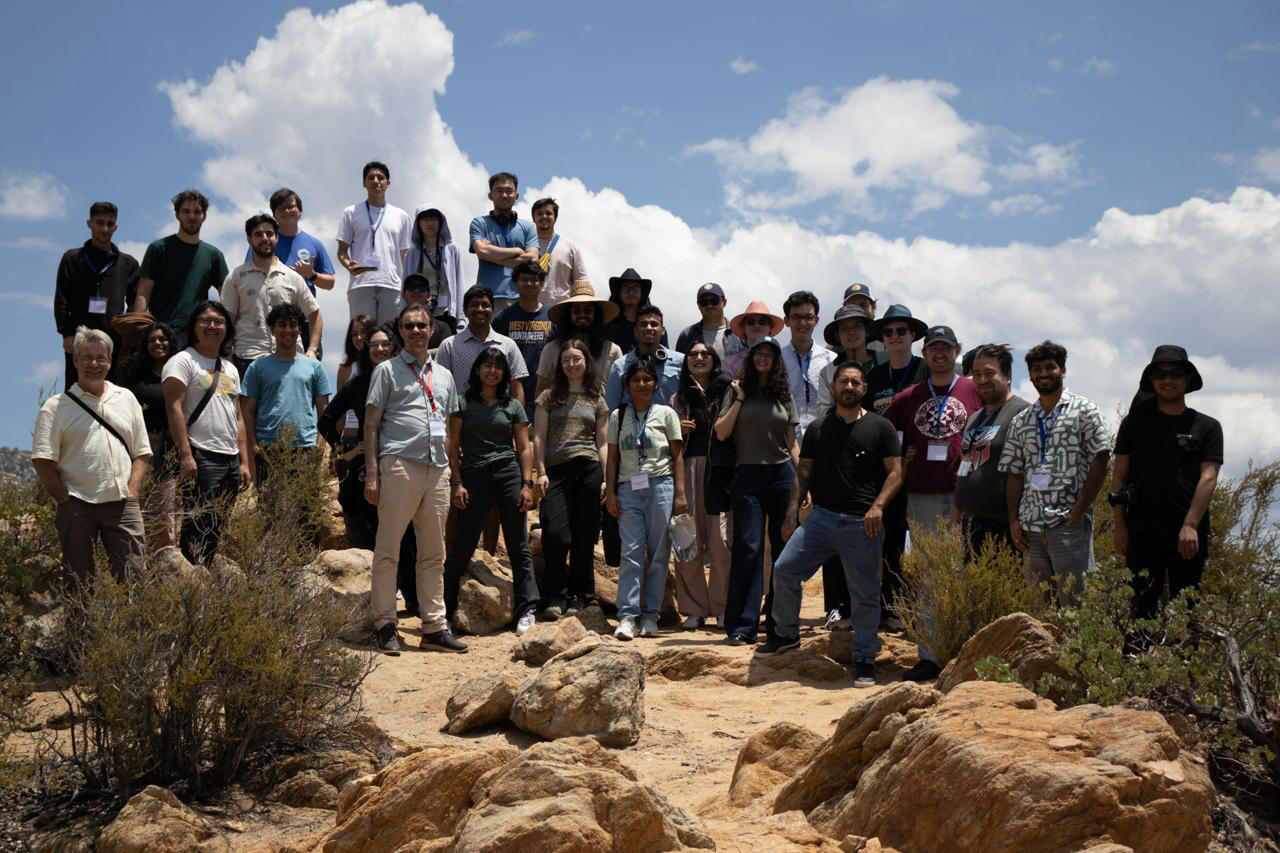
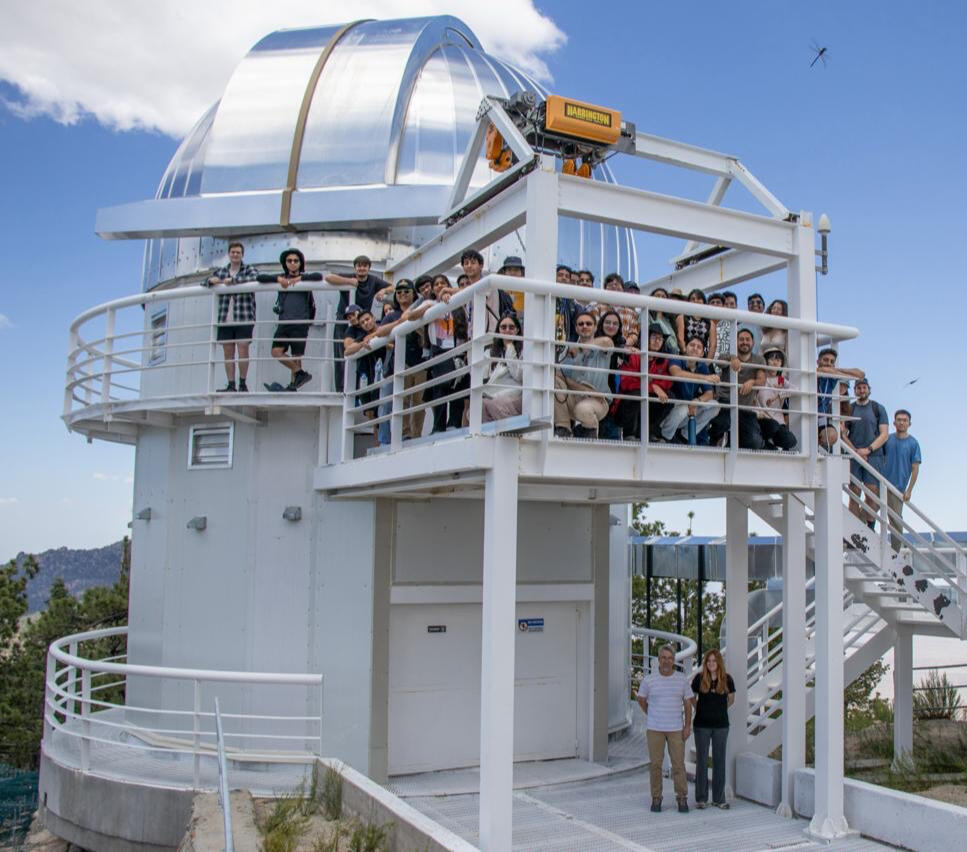
Trip to National Astronomical Observatory in Mexico on the summit of Sierra San Pedro Mártir during SCEECS Summer School “Plasmas Around Black Holes & Neutron Stars” in Ensenada (7/27-8/7/2026)
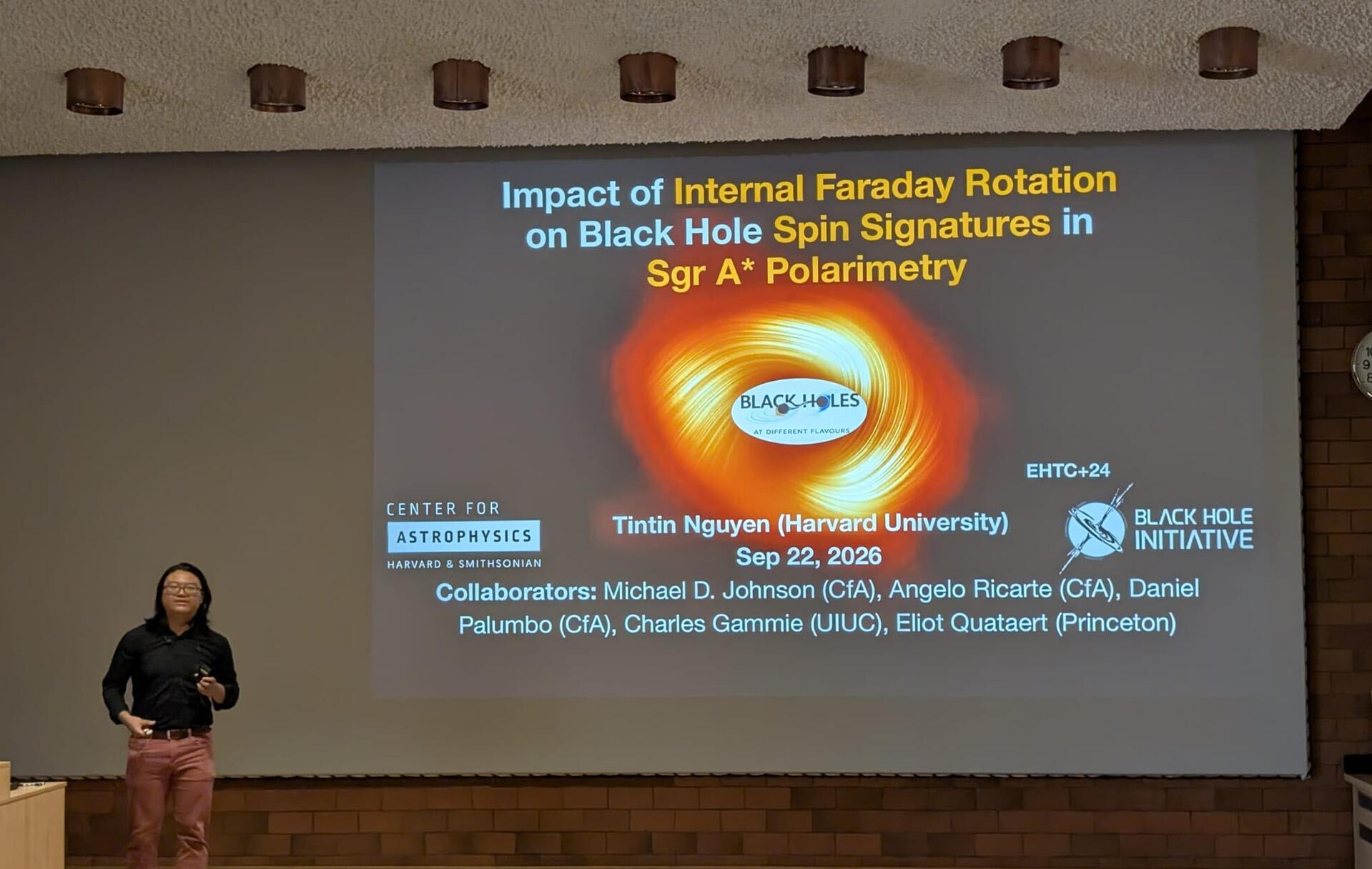
"Black Holes at Different Flavours" workshop for early career researchers in Astronomy, hosted by the Nicolaus Copernicus Astronomical Center in Warsaw, Poland (9/21-9/25/2026)
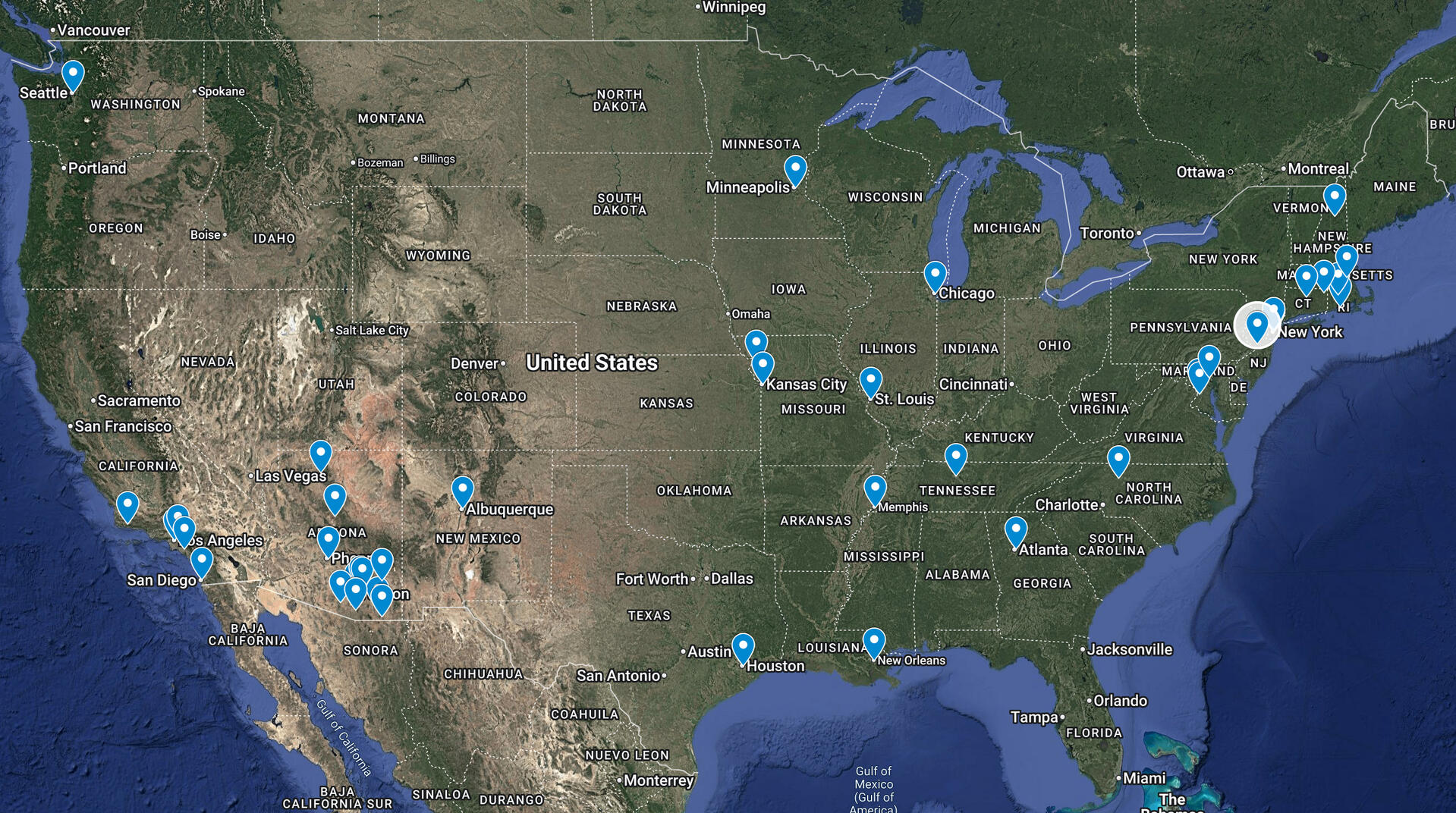
Every place in the US I have visited, many of them thanks to astronomy!
SHORT CV
Education
PhD in Astronomy, Harvard University (2024-2029, expected)
MA in Astronomy and Astrophysics, Harvard University (2024-2026)
BSc in Physics (with Honors), Astronomy, and Mathematics (Applied Emphasis), University of Arizona (2020-2024)Work History
Teaching Fellow, Department of Astronomy, Harvard University (2025-now)
Graduate Researcher, Center for Astrophysics | Harvard & Smithsonian (2024-now)
Undergraduate Researcher, Steward Observatory (2021-2024)
Research Intern, Institute for Theory & Computation, Center for Astrophysics | Harvard & Smithsonian (2023)
Teaching Assistant, Department of Mathematics, University of Arizona (2022)
Math Tutor, Mentorship and Education for Science in Tucson (2021-2022)
Grader, Department of Astronomy, University of Arizona (2021)Research Interests & Experiences
Astrophysical theory: black holes, compact binary, AGN, gravitational waves, general relativity, high-energy astrophysics, polarization
Computation: GRMHD, radiative transfer, geodesic integration/ray tracing, Bayesian statistics, MCMC, high-performance computing, machine learning
Observation: radio (ALMA, SMA), VLBI (GMVA, EHT, BHEX), JWST/NIRSpec, gravitational waves (LIGO/Virgo/KAGRA, LISA, LILA)
Publication: LILA black hole binary detection landscape (Nguyen+26), horizon-scale black hole polarimetry (Bernshteyn+26), Kerr naked singularities (Nguyen+23, Suzuki+26), JWST high-z overmassive black holes (Pacucci & Nguyen+23), compatibilism (Nguyen 23)Observing Programs
Dynamical Mass Measurements of ngEHT/BHEX Supermassive Black Hole Targets with JWST/NIRSpec (PI), JWST Cycle 5 GO (10 hrs), 2026
Schwarzschild-Scale Polarimetric Observations of Sgr A* with GMVA+ALMA (Co-I), GMVA (10 hrs), 2026
Cross-Calibrating Black Hole Mass Methods in Seyfert AGN with ALMA Atomic-C I(1-0) Gas Dynamics (Co-I), ALMA Cycle 13 (27 hrs), 2026Teaching
Cosmology, Harvard University (teaching fellow), Fall 2026
Physics Directed Reading, Harvard University (mentor), Spring 2026
General Relativity, Harvard University (teaching fellow), Fall 2025
Honors Calculus II, University of Arizona (teaching assistant), Spring 2022
The Physical Universe, University of Arizona (grader), Fall 2022
Differential Equations, University of Arizona (preceptor), Spring 2021Research Mentorship
Hina Suzuki (2025-26), undergraduate student at University of Arizona (now graduate student at Heliot-Watt University)
- Project: Photon Rings of Kerr Naked Singularities (publication), co-mentor with C-K. Chan
- Project: Black Hole Parameter Inference with Geometric Model Fitting, co-mentor with F. Niewinski and D. Palumbo (2026 Black Hole Explorers internship program)
Cal Guia (2026), undergraduate student at Harvard University
- Project: Black Hole Accretion States and Spins from Horizon-Scale Polarimetry, co-mentor with A. Ricarte, A. Plavin, and E. Chavez (2026 Black Hole Explorers internship program)Outreach/Volunteer
Astronomy on Tap Boston Lead Organizer (2024-now)
Undergraduate Physics Mentor, Harvard University (2024-2025)
Tucson Initiative for Minoritized Student Engagement in STEM Program (TIMESTEP) Undergraduate Lead, University of Arizona (2022-2024)
Undergraduate Research Ambassador, University of Arizona (2022-2024)
Astronomy & Math Peer Mentor, University of Arizona (2021-2022)
Vietnamese Translator, Coursera (2021-2022)Professional Service
CfA Science Meeting LOC Member (2026)
Harvard Astronomy Student-Faculty Forum Lead Organizer (2025-now)
Harvard Astronomy Graduate Student Mental Health Working Group Member (2025)
Deep Learning in Astronomy Hackathon Lead Organizer, Theoretical Astrophysics Program, University of Arizona (2024)Professional Membership
Event Horizon Telescope Collaboration
American Astronomical Society, High Energy Astrophysics Division
American Physical Society, Division of Gravitational Physics, Astrophysics, and Plasma Astrophysics
Sigma Xi Scientific Research Honor Society
TEACHING
I genuinely really care about pedagogy and how to make STEM materials accessible, whether it's K-12 tutoring or undergraduate courses. Born into a family with a teaching tradition, I found inspiration in my grandparents who taught foreign languages in their impoverished neighborhood, helping many generations of Vietnamese students study abroad. The Math Tutoring course (MATH 196A) and the Undergraduate Teaching Assistant Program at the University of Arizona helped me reflect more intentionally on teaching and pedagogy. Being the first STEM student and first to earn an undergraduate degree overseas in my family, I strive to make the learning experience accessible, welcoming, and supportive to students from any background. On this page, there are some resources I've developed for educational purposes, and you're welcomed to use them if they are helpful!
ExperienceCosmology, Harvard University (teaching fellow), Fall 2026
Physics Directed Reading, Harvard University (mentor), Spring 2026
General Relativity, Harvard University (teaching fellow), Fall 2025
Honors Calculus II, University of Arizona (teaching assistant), Spring 2022
The Physical Universe, University of Arizona (grader), Fall 2022
Differential Equations, University of Arizona (preceptor), Spring 2021
Astrophysical Black Holes Directed Reading ProgramI'm developing a 10-week directed reading program on astrophysical black holes geared towards first and second-year undergraduate students with no General Relativity background. The goal is not to teach purely theoretical physics topics. The goal is to introduce students to a wide range of current and future observations of black holes of all sizes and scales over cosmic time, across the electromagnetic and gravitational wave spectra. The readings highlight astrophysical contexts of black holes (e.g., accretion, jet launching, feedback, co-evolution with galaxies), common astronomical techniques used to search for/observe black holes (e.g., gravitational wave detectors, radio interferometry, X-ray spectroscopy), and how observations inform our physical understanding of black holes. The Spring 2026 syllabus can be found here and I plan to share reading assignments below:Week 1: Introduction to Astrophysical Black Holes (assignment)
Week 2: Schwarzschild Geodesics & Gravitational Lensing (assignment)
Week 3: Accretion & Jet Launching (assignment)
Week 4: AGN (assignment)
Week 5: Massive Black Hole Formation & Evolution (assignment)
Week 6: VLBI Horizon-Scale Imaging
Week 7: Stellar Binaries & Graveyards
Week 8: Compact Binaries & Gravitational Waves
Week 9: X-ray Binaries
Week 10: Astrophysical Implications of Black Hole ThermodynamicsA couple modules I want to add in the future: Black Hole Mass Measurement Techniques, Early Tests of General Relativity, Tidal Disruption Events, Intermediate-Mass Black Holes, Time-Domain Black Hole Astrophysics, Coevolution of Supermassive Black Holes and Host Galaxies
Calculus IIWhen I took Calculus II, I was frustrated whenever I had to memorize so many tedious formulas and mindlessly regurgitate them on exams. As the TA for Honors Calculus II (MATH 129H) at the University of Arizona in Spring 2022, I had the opportunity to write interesting and challenging problem sets for students in the Honors Program. For instance, I had so much fun writing exploratory problems about how strange geometry behaves when infinity is involved after students learned about infinite sequences and series. Many students told me how mindblown they were after discovering by themselves that the Gabriel’s Horn has a finite volume with an infinite surface area and that the Koch Snowflake has a finite area enclosed in an infinite perimeter! I strongly believe math courses should be more fun and colorful! Below are some problem sets I developed for the class.Problem Set 1: recursion, u-substitution
Problem Set 2: integrals with trig substitution and partial fraction
Problem Set 3 (this is from Stewart's Calculus, not my problems): numerical integral algorithms, convergence of integrals
Problem Set 4: Gabriel's Horn/Painter's Paradox
Problem Set 5: leaking bucket, Koch snowflake
Problem Set 6: e is irrational proof, power series interval of convergence
Problem Set 7: Taylor series, Euler's formula, complex number
Presentation on a real-life application of integral calculus: rubric, templateReflection on my teaching experience
Side quests/interests
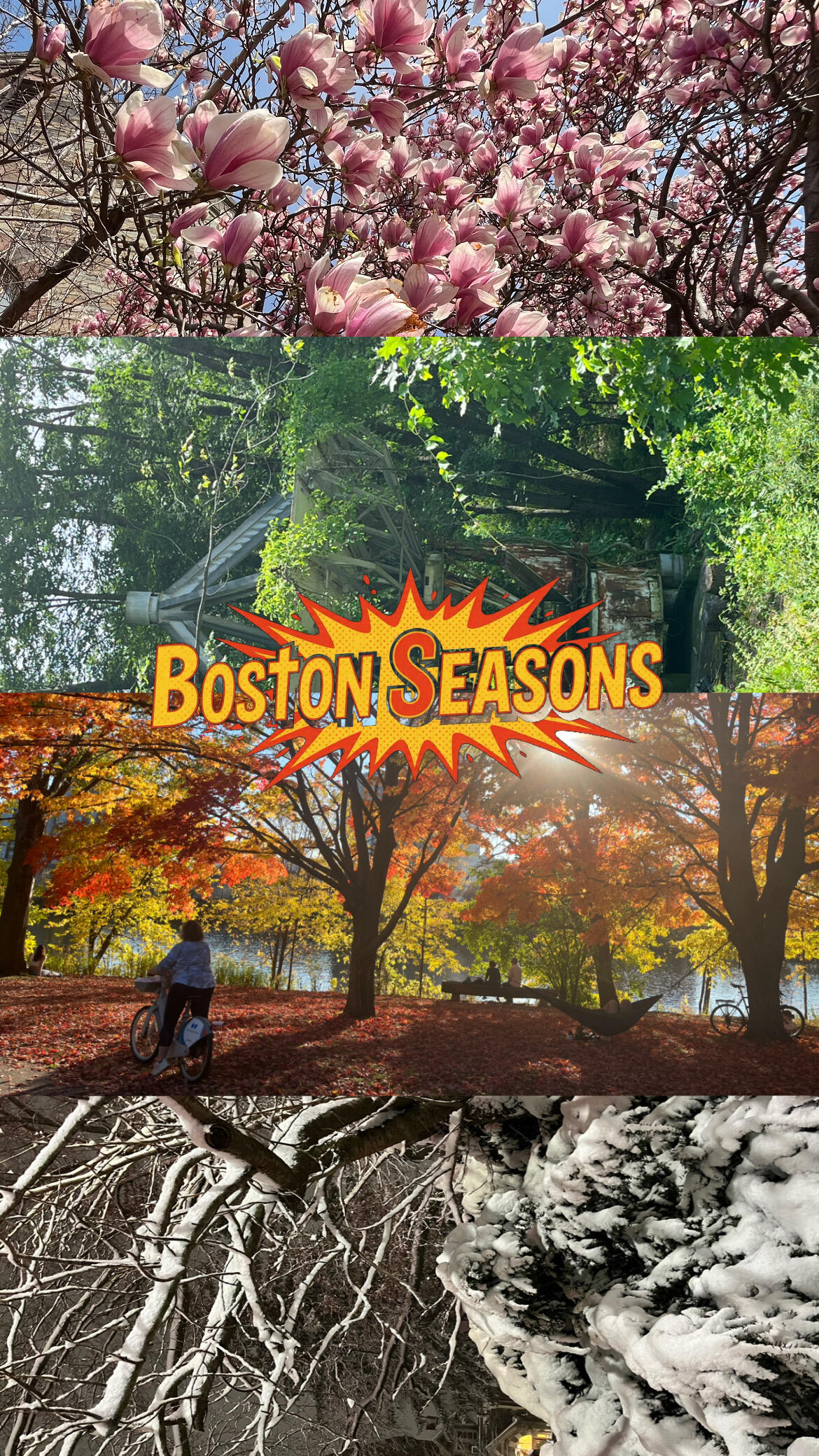
Here are a few side quests I have embarked on outside of astrophysics!
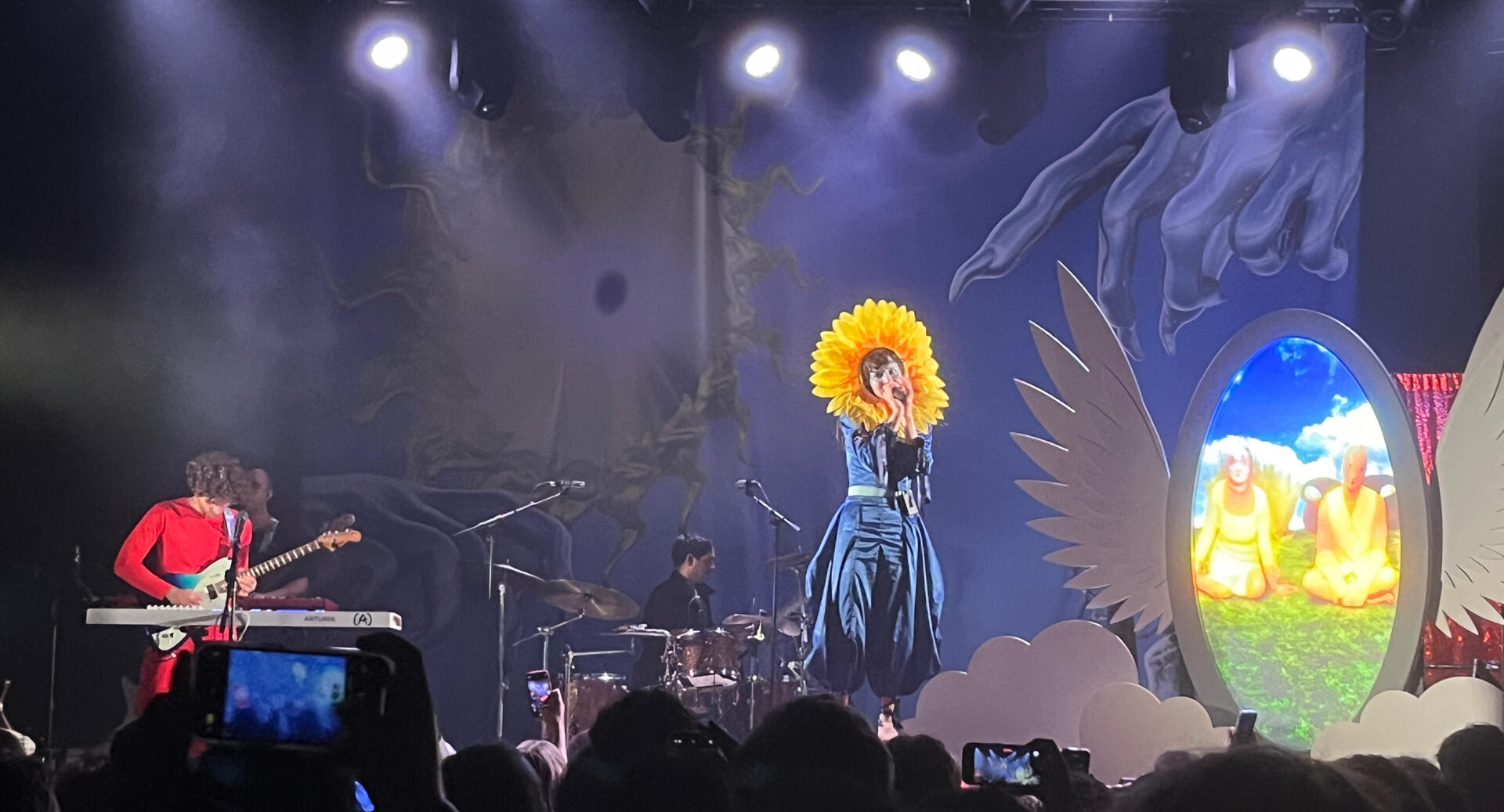
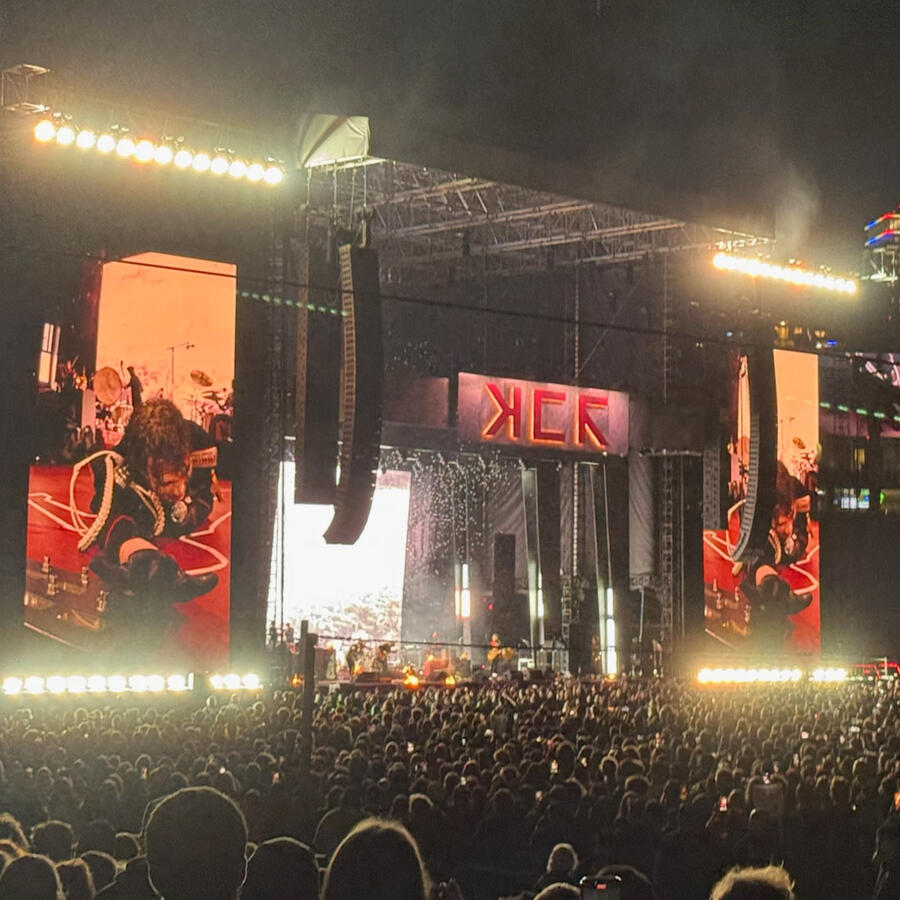
Magdalena Bay concert in Boston (9/18/2024)
Music & ConcertsMusic has always been an indispensable part of my life. In middle and high school, I frequently got lost in my own songwriting world with my piano and ukulele. During my middle school orientation, I still remember watching an electrifying performance of Radioactive from a student band, inspiring me to form a musical duo with a close friend. We spent a lot of time playing music together and we were fortunate enough to perform at the Saigon Opera House twice!While I no longer perform (though the desire is still there), I still find so much joy in discovering new music and going to concerts. In 2025, I went to 32 concerts - basement gigs, jazz festivals, porchfests, underground metal scenes, orchestras, you name it! Some of my favorite concerts include Scorpions, The HU, Royal Blood, Paramore, The Beths, Alvvays, Magdalena Bay (x5), Maruja, My Chemical Romance, Wolf Alice, Big Thief, Lady Gaga, The Last Dinner Party, Muse, Joe Hisaishi (& Orchestra of St. Luke's), Hayley Williams, Girly and the Pops (x10), Cambridge Jazz Festival, Cambridge Porchfest, and Harvard Square Honkfest. Not many enjoyment in life can surpass live music for me!I love listening to alternative rock, post punk, dream pop, and neo-psychedelia and I always welcome music recommendations! I maintain a music review blog (sort of), where I mostly write very short reactions to songs and occasionally longer music reviews or personal reflections on songs/albums. My favorite reviews are Imaginal Disk by Magdalena Bay, Change by Big Thief, and Death by Rock and Roll by The Pretty Reckless.
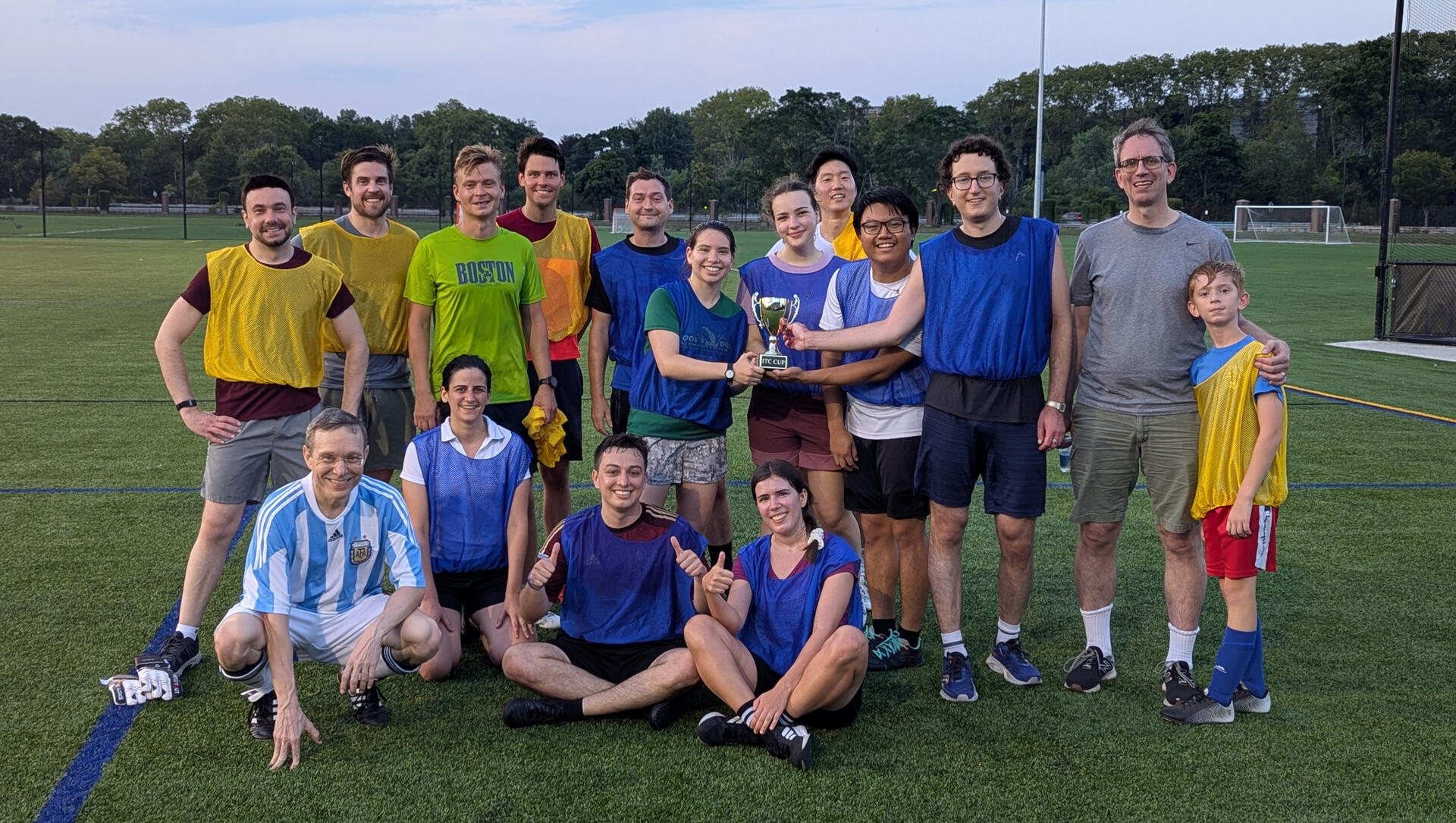
ITC Soccer Match (8/16/2025)
Football (Soccer)Growing up, I played a lot of football in primary and middle school, both competitively and for fun. I've been an avid supporter of Chelsea FC and followed the English Premier League quite religiously since 2010! Staying up past 2am to watch Chelsea win their first Champions League title against Bayern Munich in May 2012 was such a special childhood memory! I also visited Chelsea stadium Stamford Bridge in London in 2016. Another reason why football holds a special place in me is how much football serves as an integral part of national identity and culture in Vietnam. We are crazy about our men's national football team and we would always flood the streets in parades whenever our team accomplishes something major! I will never forget how special it was to follow our men's Under-23 team miraculously battling through multiple heroic comebacks to make it into the Asian cup final for the first time in 2018.
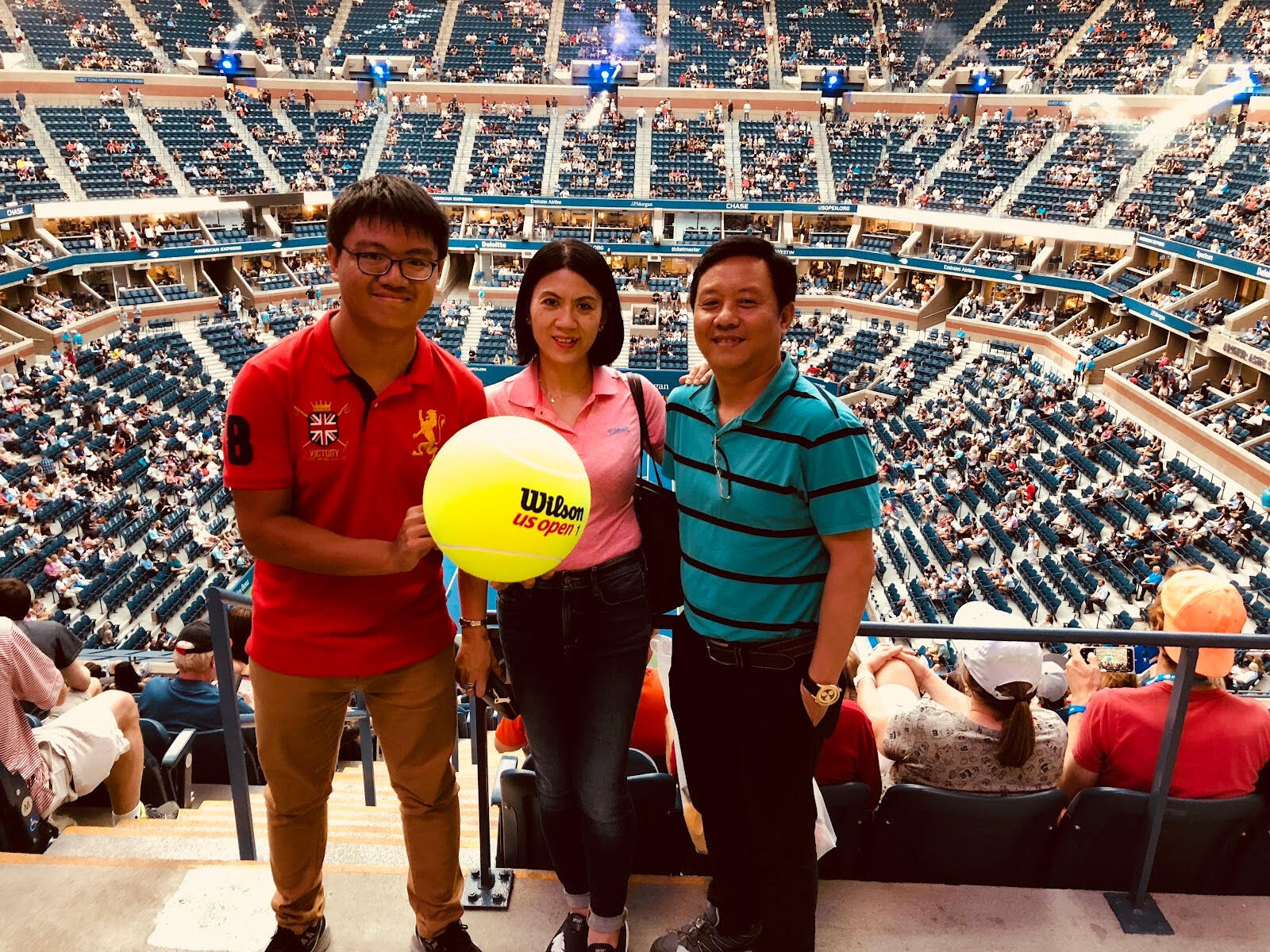
2018 US Open 3rd Round, Arthur Ashe Stadium (9/1/2018)
TennisBesides football, I'm also a massive tennis fan, as I have played tennis and followed the tour religiously since 2013. Growing up in the Big 4 era (Federer, Nadal, Djokovic, Murray), I have incredibly fond memories of watching their epic battles throughout the years. Their relentless drive for pushing themselves beyond their limits, resilience in pursuing impossible dreams, passion for the game, and humility inspired me so much. My biggest idol (and my only celebrity idol) is Rafa Nadal, who chases down every ball as if it was the last point he would ever play. Every time I felt demotivated, I revisited the Australian Open 2022 final when Rafa made a miraculous comeback from the brink of defeat. As someone who watched every single point of that 5h24m long match, I still can't believe how he won that match, an inspiration to keep believing and pushing myself no matter what happens. If felt like a part of me has vanished seeing them retired one by one, but tennis is in currently in great hands with the likes of Carlos Alcaraz, Jannik Sinner, Iga Świątek, and Aryna Sabalenka (and more), with the Roland Garros 2025 men final between Alcaraz and Sinner being one of the best sport matches I've ever watched. I'm fortunate to have seen Novak Djokovic and Maria Sharapova live at US Open 2018!
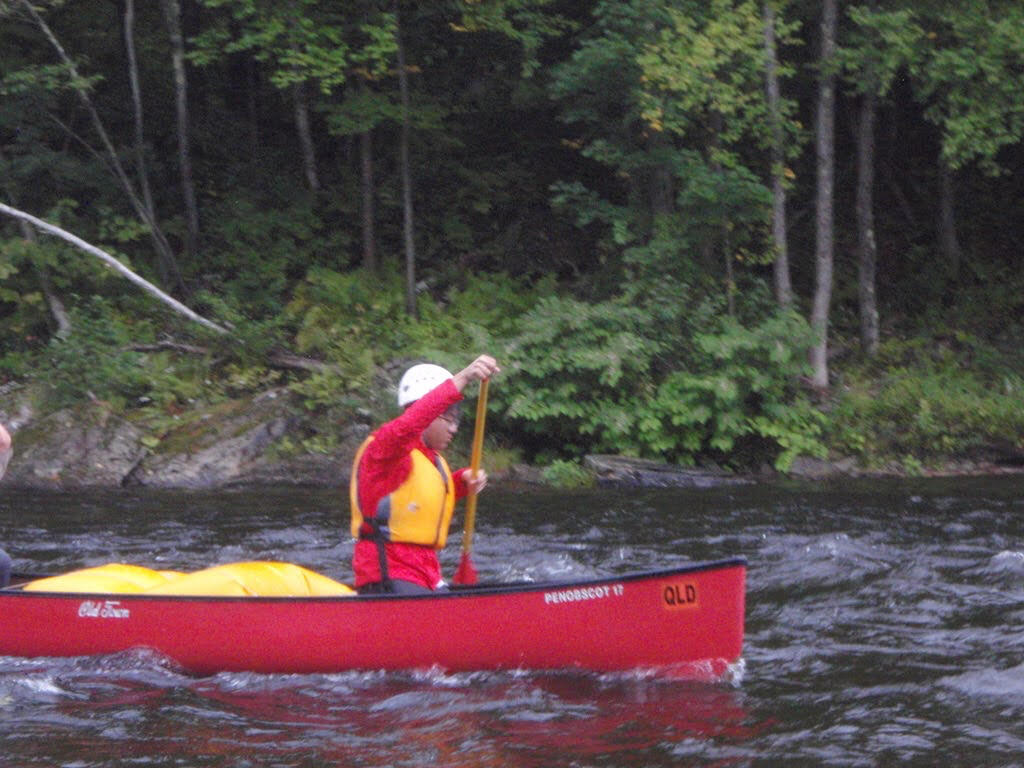
Deerfield River in CT (10/24/2019)
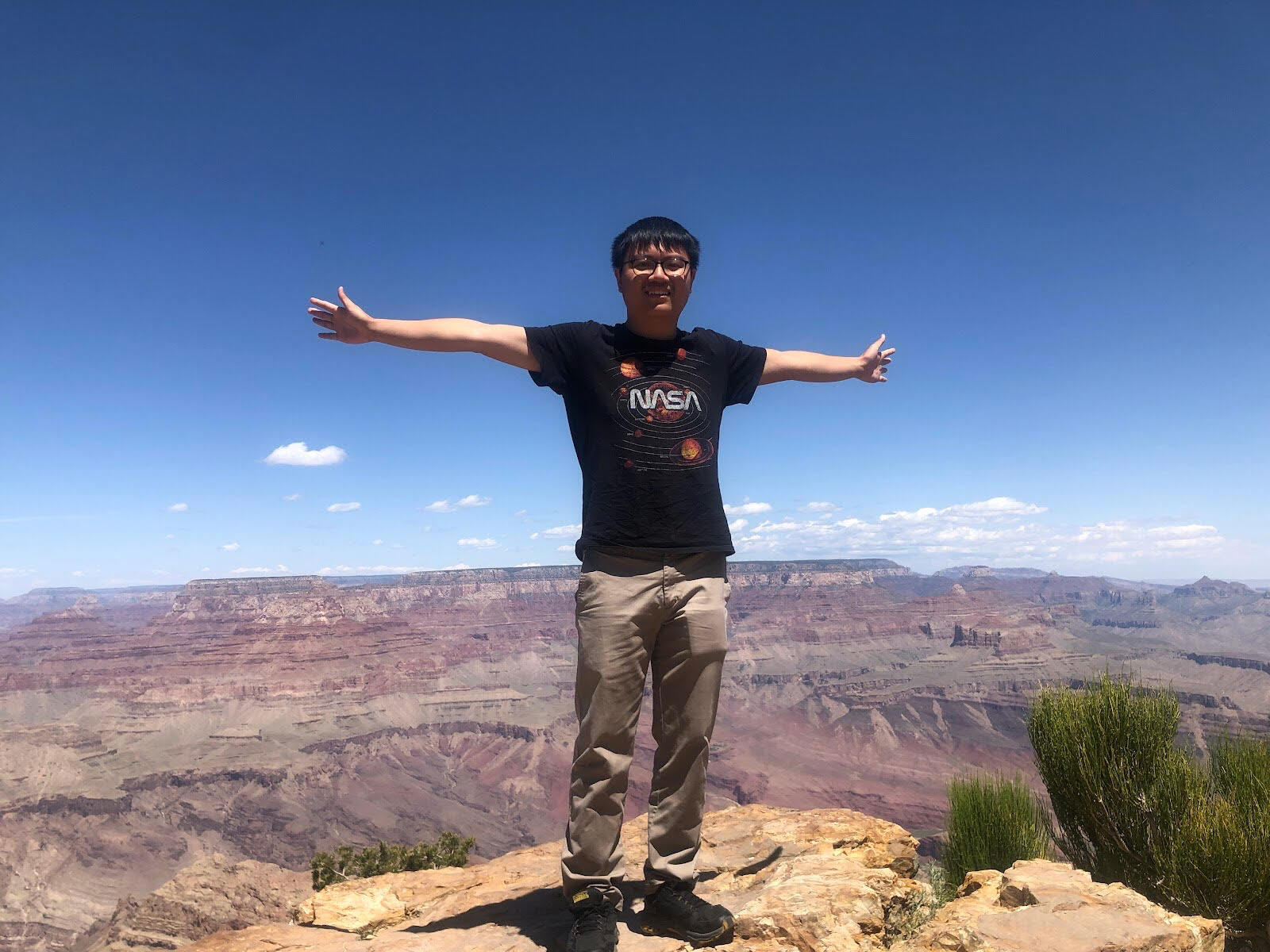
Grand Canyon South Rim (5/26/2023)
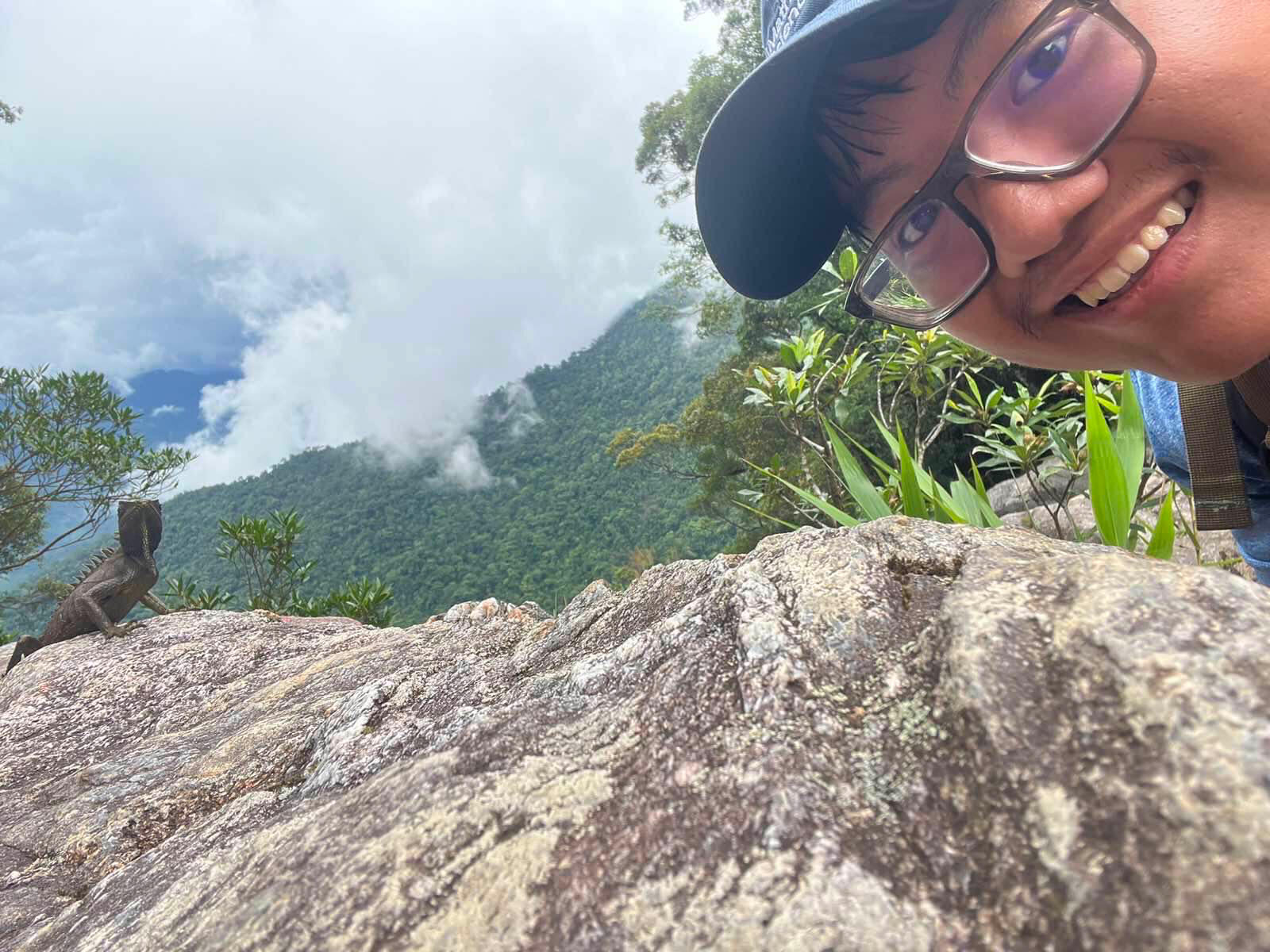
Bạch Mã (lit. White Horse) National Park in Central Vietnam (7/4/2024)
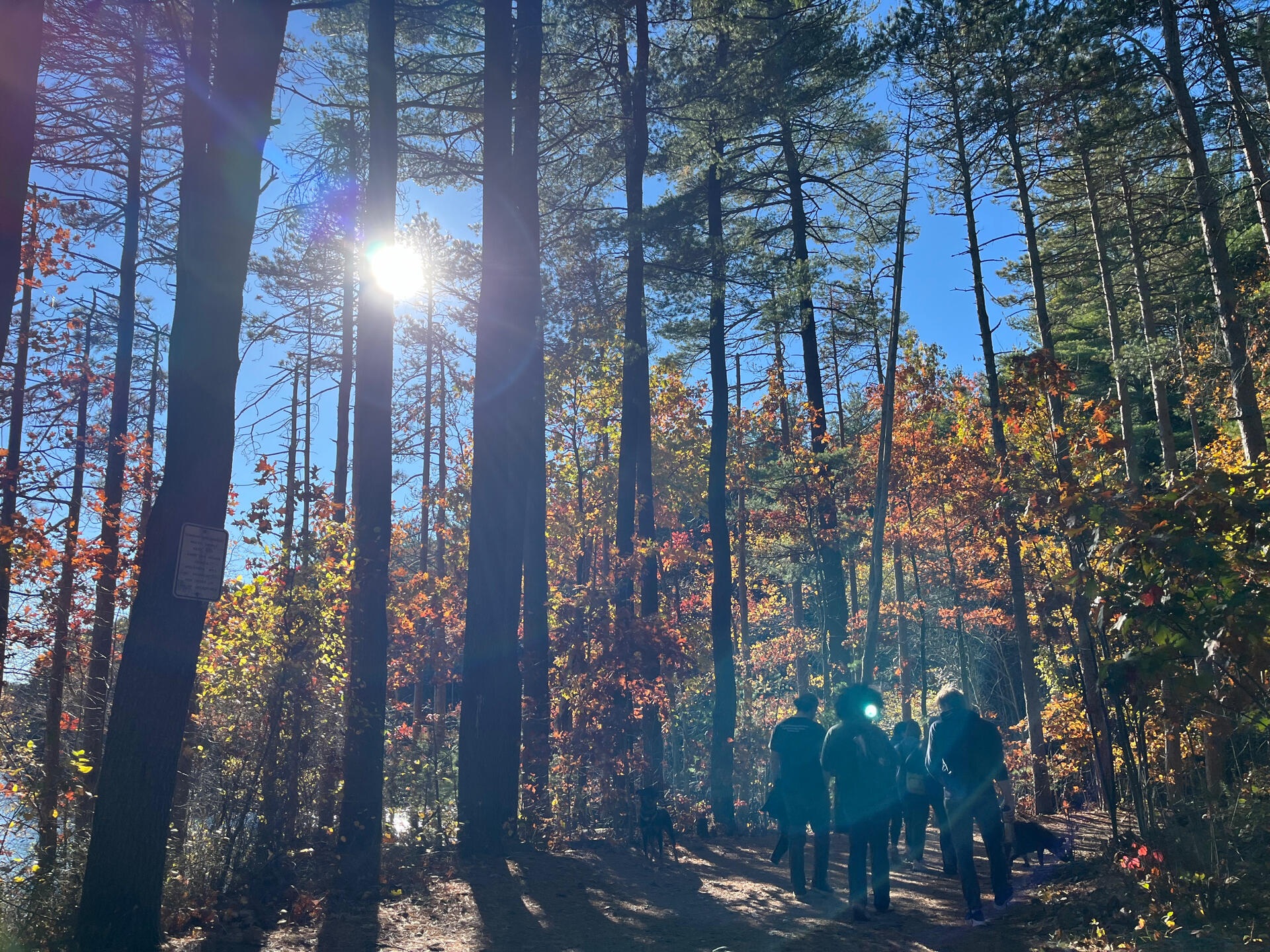
Middlesex Fells Reservation near Boston, MA (11/2/2025)
Outdoor AdventuresIt's cliché to say that I pursue astronomy because of how beautiful the universe and its fundamental laws of nature can be. But being here on Earth, I don't need to go outer space to deeply appreciate the inherent beauty of nature. From the stunning beaches and lush forests in Vietnam to the spectacular Sonoran desert in Arizona and the alluring ever-changing four season landscape of New England, I have cherished how being outdoors provide me with a sense of clarity and peace of mind, a quiet satisfaction that blooms from the natural beauty surrounding me every time I go on a jog, a hike, or a camping trip.
Compatibility Between Free Will and Determinism
In 2023, I published a paper on the Arizona Journal of Interdisciplinary Studies, exploring the compatibility between free will and determinism through the lenses of social science, moral philosophy, theology, and quantum mechanics. This paper idea began in one of my favorite courses I ever took called Certainty and Chance in Spring 2021, which explores the intersection of philosophy, physics, and mathematics underlying determinism and randomness. I was also heavily inspired by Isaiah Berlin's critique on historical determinism in his essay Historical Inevitability, Harry Frankfurt's thought experiment challenging the Principle of Alternative Possibilities, Brian Greene's book The Hidden Reality on the many-worlds interpretation of quantum mechanics, and PBS Space Time Youtube series on quantum mechanics.